
Everyone Called Raidurg's ₹237 Crore Land Price Madness. We Call It Underpriced.
When TGIIC's back-to-back Raidurg auctions closed at ₹237 crore and ₹204 crore per acre within five days of each other, the headlines read it as a market gone irrational. We ran the per-square-foot math, layered in construction costs, checked the GCC demand numbers, and arrived at a different conclusion entirely. The land isn't expensive. It's just being priced correctly for the first time. Here are the details.
By the 1acre Team
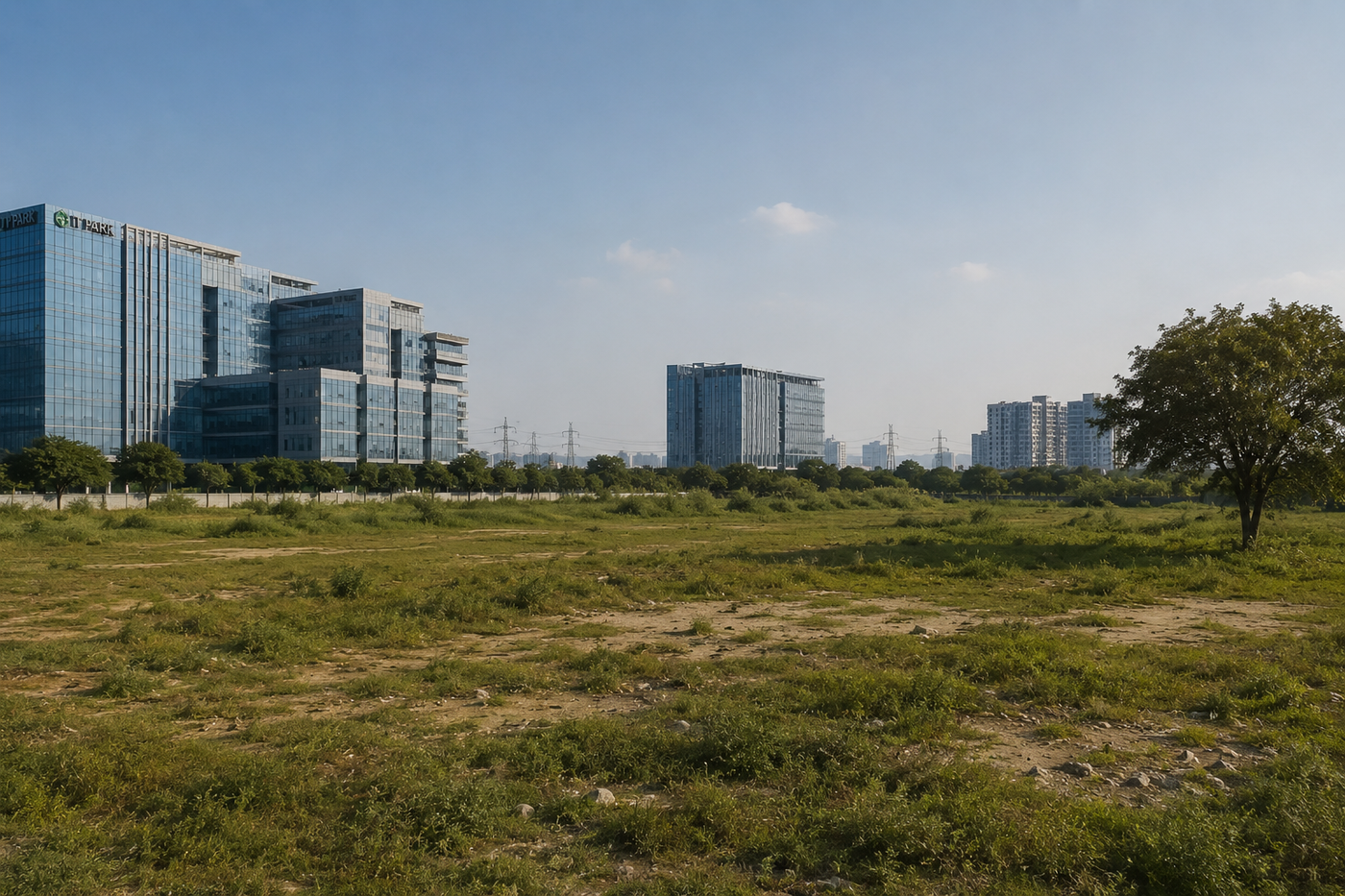
- Two consecutive TGIIC e-auctions in Raidurg (May 28 and June 1, 2026) generated ₹2,529 crore from just 11.38 acres of land, at average realisation of ₹222 crore per acre.
- The headline price is the wrong number to watch. At an effective FSI of 10, the real land cost works out to approximately ₹5,500 per buildable square foot, not ₹237 crore per acre.
- With construction at ₹5,000-5,500/sft, landing cost is ~₹10,000-11,000/sft, well below the ₹18,000-25,000/sft at which prime residential is being absorbed in this micro-market today.
- The demand engine is structural, not speculative: Hyderabad now hosts 20% of all GCCs in India, adding the most new GCCs of any Indian city in 2025, and India's GCC base is projected to cross 2,400+ centres by 2030.
- Raidurg has appreciated ~80-95% over five years, approximately 13-15% annually, and the fundamentals suggest that the runway has not changed.
Introduction
When TGIIC's Raidurg e-auction closed at ₹237 crore per acre last week, most of the commentary we read fell into two buckets: euphoria ("Hyderabad real estate is unstoppable") or alarm ("peak market, irrational exuberance"). Both miss the point.
At 1acre, we spend a lot of time helping founders, developers, and investors make sense of exactly these moments. When a number lands in the news cycle and everyone forms a strong opinion without doing the math underneath it, that is precisely when clarity matters most. This was one of those moments. So we ran the numbers. And what they reveal is neither alarming nor euphoric. It is actually quite methodical.
So let us take you through what actually happened across both auctions and what the numbers say about where this market is going.
Two Auctions, Five Days, ₹2,529 Crore
On May 28, 2026, TGIIC concluded the e-auction of Plot No. 1A & 1/F, a prime 6.29-acre multi-use land parcel in the heart of the Raidurg growth corridor. Gowra Ventures emerged as the successful bidder at ₹237 crore per acre, taking the total transaction value to ₹1,490.73 crore. The bid closed 70.5% above the reserve price of ₹139 crore per acre, a premium range that typically runs between 30% and 50% in comparable auctions. The extraordinary overshoot was attributed to the parcel's main-road frontage, near-rectangular layout, and multi-use designation.
Five days later, on June 1, TGIIC auctioned the neighbouring Plot P4, a 5.09-acre parcel in the same survey number. Vamsiram Builders secured it at ₹204 crore per acre, or ₹1,038.36 crore total, representing a 46.8% premium over the same ₹139 crore reserve. Officials noted the slightly lower price was explained by configuration: this parcel is set slightly interior, U-shaped, and fronts a 45-metre road rather than the main arterial.
Taken together: 11.38 acres, ₹2,529 crore, average realisation of ₹222 crore per acre, which is a 42% increase over last year's average of ₹156 crore per acre across comparable Raidurg auctions. These numbers are dramatic. But the drama is in the headline, not the analysis.
The Number the Headlines Skipped: ₹5,500 Per Square Foot
One calculation. That is all it takes to see this differently. One acre equals roughly 43,000 square feet. This is a multi-use parcel with effectively unlimited FSI. Build at a conservative FSI of 10 and you get approximately 4,30,000 square feet of saleable area. Divide ₹237 crore by 4,30,000 square feet and you arrive at ₹5,500 per buildable square foot as the effective land cost.
That is not an alarming number for a micro-market that sits beside Sattva Knowledge City, ITC Kohenur, and Durgam Cheruvu.
Now layer in construction. Premium-to-luxury high-rise construction in India runs ₹3,200-5,000+ per square foot today. For a signature tower of the grade this land demands, an all-in construction cost of ₹5,000-5,500/sft is a reasonable and conservative assumption. That gives you a landing cost of approximately ₹10,000-11,000 per square foot.
What does the finished product sell for in this location right now? Prime new residential in this micro-market is being absorbed at ₹18,000-25,000 per square foot for signature-grade stock. Build at ₹11,000. Sell at ₹18,000-25,000. The developer margin is not just intact; it is the headline. The land price is not the risk. It is already priced into a model that works.
Why Raidurg Specifically and Why It Holds
Land stories are ultimately demand stories. So the question worth asking is: what is actually generating the demand that justifies ₹18,000-25,000/sft residential pricing in this corridor, and is it structural or cyclical? The answer is unambiguously structural, and it has a name: Global Capability Centres.
Hyderabad attracted 40 new GCCs in 2025 through October alone, the highest count of any Indian city for that period. The city now hosts approximately 20% of all GCCs in India, with 355+ centres and counting. In the 2025-2026 period, Hyderabad captured between 41% and 46% of all new GCC setups nationally, surpassing Bengaluru. Across India, the GCC base is projected to reach 2,400-2,550 centres by 2030, employing upwards of 2.8-3.5 million professionals and contributing USD 105 billion to the global economy.
Almost all of this activity, the leases signed, the salaries paid, the senior professionals relocating families, is concentrated within a few kilometres of this auction plot. GCCs accounted for 38% of office leasing across India's top seven cities in 2025 alone, securing 31.3 million square feet. That demand does not spontaneously generate. It requires housing, retail, and mixed-use infrastructure nearby. Raidurg is that nearby.
This is not speculative demand. It is the natural consequence of enterprise decisions made in boardrooms in New York, London, and Singapore, decisions that are largely irreversible once a centre is established and a talent base is built.
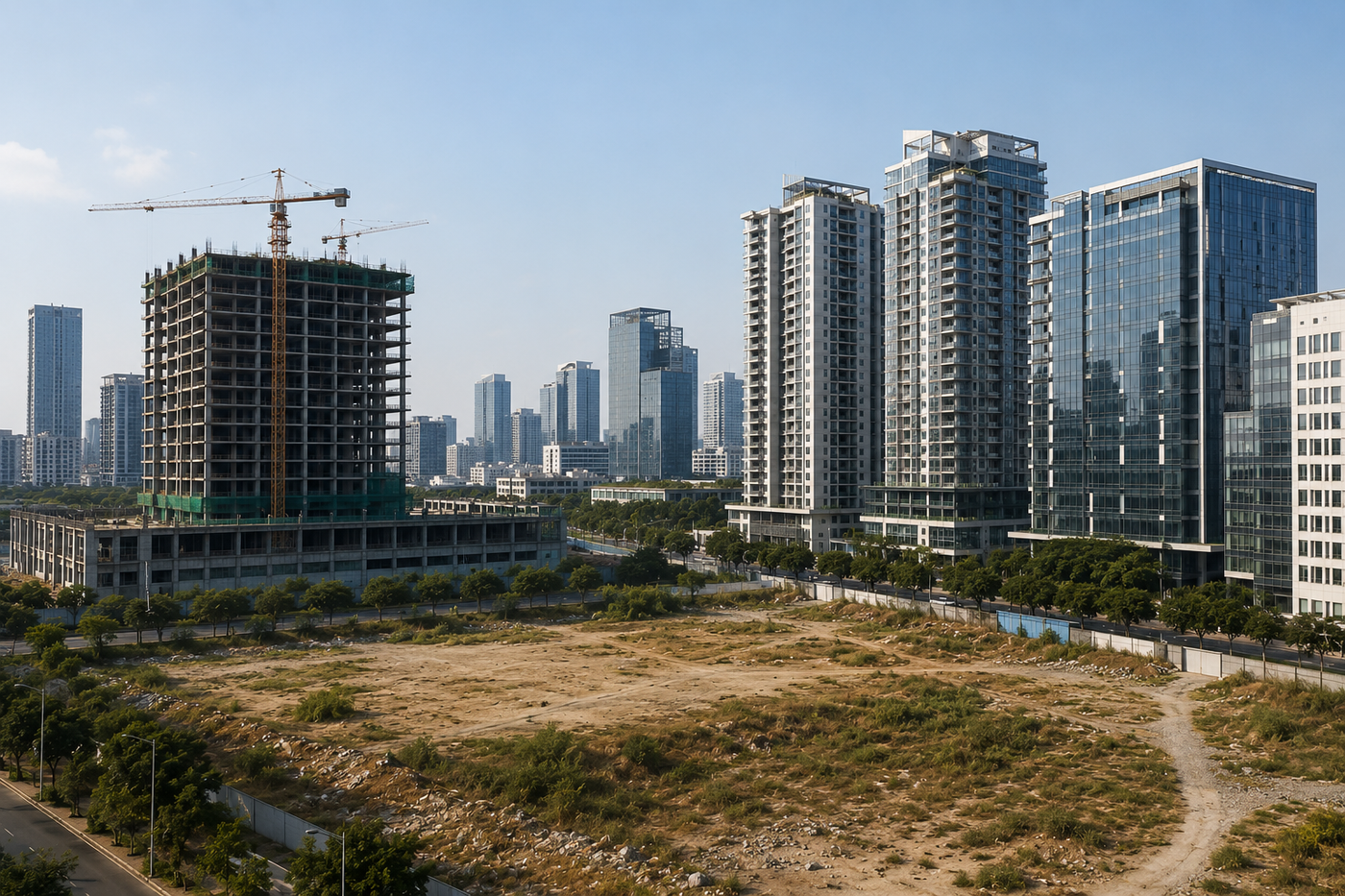
The Five-Year Appreciation Story and What It Implies
Raidurg has appreciated roughly 80-95% over the past five years. That works out to approximately 13-15% compounded annually. The question worth sitting with is not whether that pace can be sustained. No corridor appreciates at 15% forever. The question is whether it reverts, plateaus, or continues, and what the structural drivers suggest.
If prime new residential is priced at ₹18,000-25,000/sft today and demand continues to be driven by GCC-grade employment within 3 kilometres, the trajectory toward ₹35,000/sft over the next five years is not aggressive. It is what 13-15% annual appreciation from a ₹20,000 base implies. Even if the pace moderates to 8-10%, the directional case remains intact.
The Honest Developer Math at Higher Land Prices
There is a version of this story where land prices run harder. Assume a future auction settles at ₹400 crore per acre. At the same FSI of 10:
• Land cost per sft ≈ ₹9,300
• Construction + finishing ≈ ₹5,500
• Landing cost ≈ ₹14,800-15,000/sft
At ₹18,000/sft realisation, the margin compresses but the project still works. At ₹22,000-25,000/sft, which is where this market is trending, it works comfortably.
This is the insight that changes how you read the ₹237 crore headline: the land is not expensive. It is being priced correctly for the first time, against the demand reality that actually exists in this micro-market, not against a historical baseline set when GCC density was a fraction of what it is today.
What This Means for Developers, Investors, and Land Owners
For developers evaluating similar parcels in the Raidurg and Financial District corridor: the FSI math, not the per-acre headline, is your underwriting tool. Model your land cost per buildable square foot, stress-test your construction costs, and validate your exit pricing against current transaction evidence. If the spread holds, the opportunity is real.
For investors thinking about land as an asset in this corridor: the five-year appreciation story is not in early innings, but it is also not at an obvious ceiling. The structural demand driver, GCC-led employment in a supply-constrained micro-market, is a durable tailwind, not a cycle.
For land owners in adjacent areas: the price signal from two back-to-back government auctions at ₹204-237 crore per acre resets the comparables for the entire micro-market. How that flows through to private transactions typically takes 12-24 months of lag, but it does flow through.
Conclusion
Every major land transaction is, at its core, an information problem. The data exists. The math is not complicated. But the gap between the headline and the analysis is where most market participants get misled, either into overconfidence or unnecessary fear.
What the two Raidurg auctions tell us, taken together, is not that Hyderabad has lost its mind. They tell us that a small cohort of sophisticated developers, the Gowra Ventures and Vamsiram Builders of the world, have done the buildable-square-foot math, modelled demand against GCC absorption, and concluded that ₹5,500-9,300/sft of land cost is not a ceiling but a justified entry point into one of India's most durable real estate micro-markets.
We don't know if the next Raidurg parcel prices at ₹250 crore per acre or ₹190 crore per acre. But we do know that the structural case, the employment density, the infrastructure, the supply scarcity, the GCC pipeline, has not changed.
The land isn't expensive. It's just priced correctly for the first time.