
What is Goa Land Records?
Definition
Goa's land records run under the Directorate of Settlement and Land Records, the DSLR, serving Form I & XIV and the survey plans, with mutation through the Talathi and Mamlatdar machinery; verify current online access, as services evolve. Registration and the money history live on NGDRS Goa; conversion runs on the sanad with the Town and Country Planning position; and older titles reach into Communidade, Conservatória and inventory layers.Picture a house renovated many times: the modern rooms are Form I & XIV, bright and searchable, but the foundations are Portuguese, Communidade grants, Conservatória registrations, inventory proceedings, and the building stands on all of it at once. Goa diligence is structural inspection: read the visible record, then check what it rests on, because the state's disputes live in the joints between eras.
The modern machinery is genuinely serviceable: forms viewable through the DSLR's services, registration searchable on the national platform, plans certified from the survey records, mutation running on notice that gives every protected interest its say before changes harden.
Its limit is precisely Goa's depth: tenancy, Mundkar and Communidade rights never needed registering, the Civil Code moves estates through inventories, and coastal and zoning layers decide buildability from outside the record entirely. The complete file consults them all.
Goa Land Records, layer by layer
Each layer answers its own question, and no layer answers another's. Route the question to its keeper.
| Question | Layer / keeper | Service |
|---|---|---|
| Who does the record say holds it? | DSLR (Form I & XIV) | Form view, certified copy |
| Who else holds rights in it? | Tenancy, Mundkar, Communidade law | The form's columns, read whole |
| What money touched it? | NGDRS + older registration books | The EC search, era by era |
| How did the family pass it down? | Civil Code inventories | The inventory position, then mutation |
| Where exactly does it end? | DSLR survey records | Survey plan, measurement |
| What may be built on it? | TCP, coastal machinery, sanad | Zoning position, CRZ, the sanad |
The habit: never let one layer's clean answer stand in for another layer's unasked question. Goa files close layer by layer or not at all.
All Goa Land Records services, with a guide for each
Eight guides across the layers. The NGDRS badge marks the registration platform; everything else runs through the DSLR, revenue and planning machinery.
Records & copies
3 guidesThe form, the name route into it, and the certified copies that carry it through official doors.
Occupants, tenants and Mundkar remarks, with the older layers the form summarises.
Search by owner namePortuguese spellings and house names resolved to survey numbers, village by village.
Certified form copyThe copy banks, courts, inventories and consulates act on, ordered in the right sequence.
Registration (NGDRS)
1 guideThe money history, searched on the platform and extended into the older books beneath.
Change & conversion
2 guidesMutation past its watchers, and the sanad with its zoning and coastal gates.
Deeds, successions and inventory outcomes carried into the form, past the notice stage.
NA / conversion (sanad)The zoning gate, the coastal gate, the sanad and its binding conditions.
Maps & survey
2 guidesBoundaries priced by the metre, and the certified drawings that settle them.
Getting started on the portal
Everything anchors to the survey and subdivision number; Goa's history supplies the aliases.
Survey and subdivision numbers, and the older keys
The modern key is the survey and subdivision number, matched exactly across form, deed and plan. Old papers may speak in earlier dialects, Matriz numbers, Communidade references, Conservatória descriptions, and part of Goan diligence is translating those aliases to today's number through the DSLR's records and the Talathi's memory. Any old receipt or extract shortens the work.
| Step | Online | Offline |
|---|---|---|
| 1. Access | Open the DSLR's records service; verify access | The village Talathi reads the record's remarks fluently |
| 2. Identify the parcel | Select taluka and village, then the number | Mamlatdar offices handle mutation and its notices |
| 3. Use the service | Read every column; save the view | The DSLR issues certified forms and survey plans |
| 4. Keep evidence | Search NGDRS for the registered history | Sub-registrar books hold the pre-platform decades |
Offline Goa runs through the village Talathi, the Mamlatdar offices, the DSLR and its survey records, the sub-registrar on the registration side, and, for the older layers, the offices holding Communidade, Conservatória and inventory files.
Which Goa Land Records service do you need?
Eight services answer eight buyer intents; find yours and follow the link.
| You want to | Use this service | Guide |
|---|---|---|
| See who the record says holds a plot | Form I & XIV view | Form guide |
| Trace family land from a name | Owner name search | Name search |
| Check loans and the deed history | NGDRS registered search | EC guide |
| Move the record after a deed or death | Mutation, past notice | Mutation guide |
| Settle what may be built | Zoning, coast, sanad | Sanad guide |
| Check the boundary you are pricing | Plan against ground | Bhu Naksha |
| Get the plot's certified drawing | Survey plan / NAKSHA | Plan guide |
| Give an institution proof | Certified form copy | Copy guide |
The order a careful buyer runs these in
Goa rewards the layered order: record, rights, money, ground, gates, and only then paper and price.
- Read the form to its last remark. Occupants, tenants, Mundkar entries, and every reference to the older layers, chased to its file. Guide: Form guide
- Establish who else holds rights. Tenancy, Mundkar, Communidade and co-heir positions, the interests a deed cannot erase. Guide: Mutation guide
- Pull the money history to its beginning. NGDRS for the modern chapter, the older books and Conservatória layer where the title starts earlier. Guide: EC guide
- Match the drawing to the ground. The survey plan against the form and the walked boundary, with measurement refereeing any drift. Guide: Bhu Naksha
- Settle zone, coast and sanad before price. The Regional Plan position, CRZ layers where they apply, and the sanad's actual conditions. Guide: Sanad guide
- Close on certified paper. Mutation certified, the updated form and plan ordered, the kit filed for the decades ahead. Guide: Copy guide
Common issues across the portal
Four snags account for most stalled Goa files.
Tenants and Mundkars treated as footnotes. Their rights survive sales; read both columns before pricing.
Communidade, Conservatória and inventory references left unchased. Every citation in the remarks is homework.
CRZ and zoning discovered after the advance. The buildable position, in writing, precedes the price.
Deeds registered, the form unchanged. File, watch the notice stage, and collect the updated form.
Goa Land Records: rules buyers should know
Protected cultivators and registered dwellers keep their rights through sales. Resolve lawfully; never price them away.
The Civil Code divides estates through inventory proceedings. Inherited land lists after that position settles, not before.
Conversion grants specify use and terms. Building outside them invites the enforcement they exist to prevent.
CRZ layers restrict what no grant overrides. Near water, the coastal position comes first and in writing.
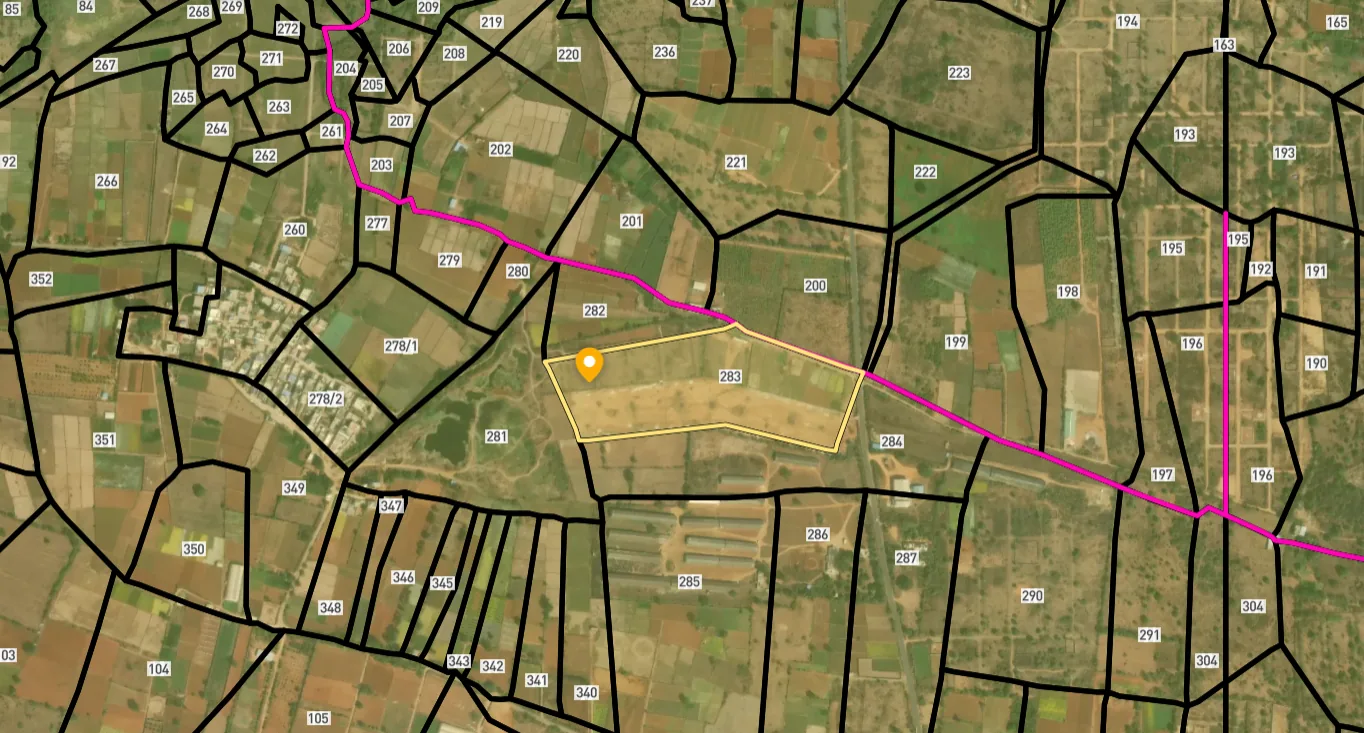
Survey Numbers View on Map Boundaries and numbers come from published state cadastral records. See all map layers.
Looking to sell your land in Goa?
Browse 88+ verified lands & plots in Goa
Frequently asked questions
Where do I check Goa land records online?
Through the DSLR's records services: Form I & XIV by taluka, village and survey number. Verify current access; certified copies come through the DSLR machinery.
What is Form I & XIV?
Goa's record of rights: occupants, tenants, crops and remarks per survey and subdivision number, kept under the DSLR.
Why do tenants and Mundkar entries matter?
Both carry protected rights that survive sales. A name in either column reshapes what the occupant can actually transfer.
How does Goa handle the EC?
Through registration on NGDRS: registered documents searched by property and party, extended into older books and the Conservatória layer for old titles.
What are Goa's older layers?
Communidade records, Portuguese-era Conservatória registrations, Matriz numbers and Civil Code inventory files, the memory beneath the modern form.
How does inherited property transfer?
Through the Civil Code's inventory position first, then mutation to the form. Selling precedes neither.
What is a conversion sanad?
The grant permitting non-agricultural use, issued with reference to the planning position and subject to conditions that bind the build.
Is coastal land freely buildable?
No. CRZ and planning layers restrict what no sanad overrides. Take the coastal and zoning position in writing before pricing.