Document Guide · Haryana

How to Check Lal Dora Land in Haryana — Complete Guide 2026

Lal Dora is the original village settlement boundary marked in 1908. Land inside it falls outside formal planning laws. No building plan approval. No Occupancy Certificate. Banks mostly refuse loans. Haryana has a new Abadi Deh Act but the risks for outside buyers remain serious. Read this before you touch Lal Dora land.

Quick Reference
Also calledAbadi Deh / Extended Lal Dora / Lal Dora Abadi
Issued byRevenue Dept / Gram Panchayat Haryana
Valid forStatus tied to village boundary maps; check current demarcation at local Tehsil office
CostLal Dora certificate from Gram Panchayat
Time takenCertificate issuance timeline varies by Gram Panchayat
Online portaljamabandi.nic.in for revenue records; ulbharyana.gov.in for urban Lal Dora notices
noteLal Dora is original village land. No formal building approvals are possible. You cannot get an Occupancy Certificate. Extremely high risk for outside buyers.
1

What is Lal Dora Land in Haryana?

Definition

Lal Dora refers to the boundary drawn in 1908 during British rule to demarcate the residential habitation area of a village from its agricultural land. The term comes from the red thread (lal dora) tied on revenue maps to mark this line. Land inside that boundary is called Abadi or Abadi Deh. It falls outside normal building byelaws and was never meant to enter the formal property registration system.

The idea was straightforward in 1908. Villages needed space for homes, livestock, and common activities. That space was marked off from agricultural land and left largely ungoverned by municipal rules. Fast forward to 2026 and those same boundaries now sit inside cities like Gurugram, Faridabad, and Sonipat. The land became valuable. Sellers figured out they could sell it cheaply. Buyers assumed cheap meant opportunity. A lot of those buyers are stuck today.

Here is the core problem. Lal Dora land in Haryana has no Khasra number in most cases. Records are not maintained by the Revenue Department the way agricultural land is. The Gram Panchayat holds jurisdiction but often has no proper documentation either. Building plan approval from DTCP or municipal authorities is not possible on this land. No building plan means no Occupancy Certificate. No OC means the structure is technically unauthorised from the moment you build it. Banks know this. Most refuse to lend.

State-specific note: Construction beyond the original Lal Dora boundary in Haryana is illegal under the Punjab Scheduled Roads and Controlled Areas Restriction of Unregulated Development Act, 1963. The Punjab and Haryana High Court and the Supreme Court have both confirmed this position.
2

How to Check Lal Dora Status in Haryana: Step-by-Step

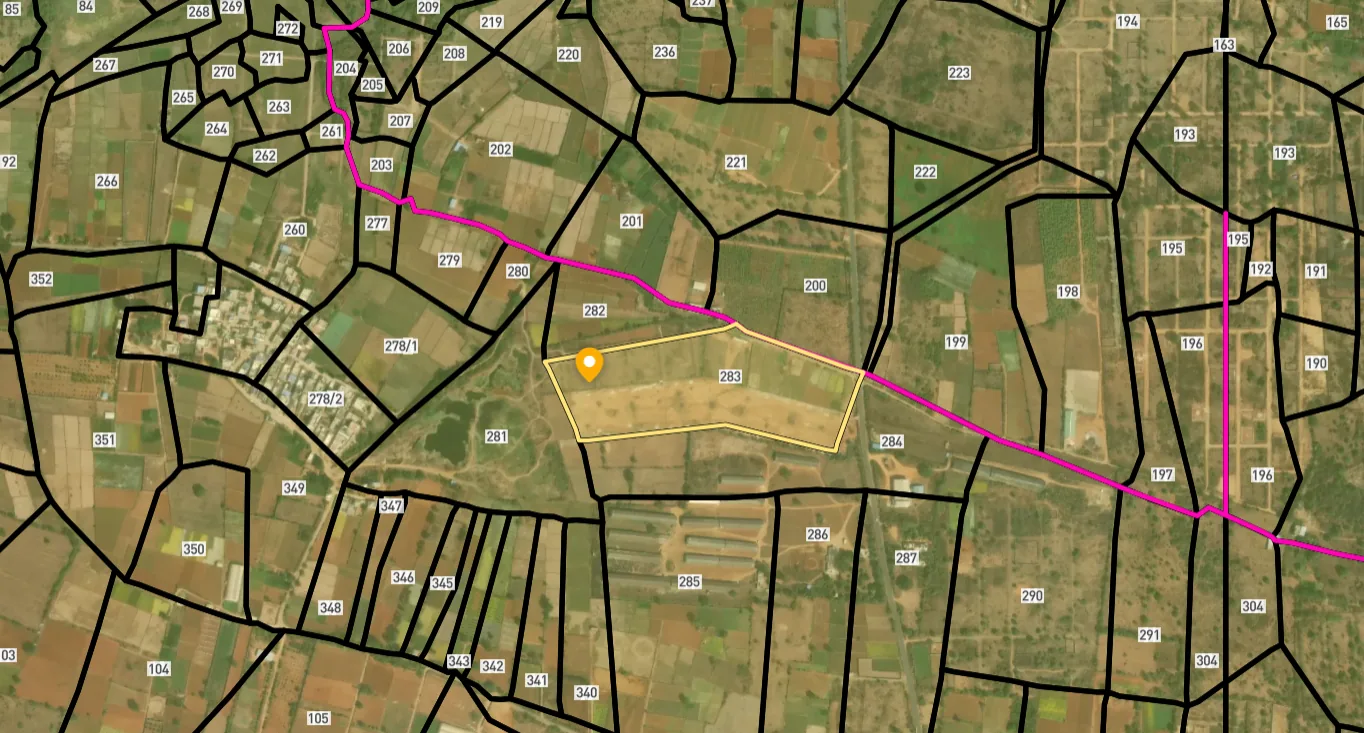
There is no single online portal that shows Lal Dora boundaries with certainty. Verification requires combining the revenue record check with a physical Gram Panchayat visit. Have the village name, Khasra number if available, and property location details ready.

Online method (recommended)

1
Check jamabandi
nic.in Go to jamabandi.nic.in. Search by owner name or Khasra number. If the land appears with an Abadi or residential use category rather than an agricultural classification, it may be inside the Lal Dora boundary.
Many Lal Dora plots have no Khasra entry at all. If a search returns nothing for a property that clearly exists, that absence itself signals Lal Dora or unrecorded Abadi land.
2
Check Svamitva property card status Haryana launched the Lal Dora Mukt Gaon scheme on 26 January 2020 and later aligned it with the central SVAMITVA scheme
Drone mapping was done across villages. If the property has a SVAMITVA property card issued under the Abadi Deh survey, the ownership has been formally recorded. Search via the SVAMITVA portal using the property card ID.
3
Check ULB Haryana for urban Lal Dora For villages absorbed into urban areas, go to ulbharyana
gov.in. The Haryana government issued notifications in 2024 under the Chief Minister Urban Body Ownership Scheme for Abadi Deh properties in municipal areas. Check whether the specific village falls under this scheme.
4
Cross-check the Haryana Abadi Deh Act 2026 The Haryana Abadi Deh (Vesting, Recording and Resolving of Ownership Rights) Act, 2026, which replaced the 2025 Ordinance, formalises the record-of-rights framework for Abadi land
Check whether a field book entry exists for the specific plot under this Act through the Tehsil office.

Offline method (Sub-Registrar Office)

1
Visit the Gram Panchayat The Gram Panchayat holds the Lal Dora map for the village
Ask them directly whether the property falls inside the Abadi Deh boundary. Request a written confirmation or Lal Dora certificate.
2
Request the Lal Dora certificate The Gram Panchayat or local Revenue Department issues a Lal Dora certificate confirming that the property is within the village residential boundary
This is the document that proves Lal Dora status.
The certificate is also required if you ever want to register the property or apply for any future regularisation scheme.
3
Cross-check at the Tehsil office Ask the Patwari to confirm the village Abadi boundary on the Shajra map
The Shajra shows the village layout including the Abadi area. Land appearing inside Abadi on the Shajra is Lal Dora.
4
Check for Svamitva property card at Tehsil Ask whether a SVAMITVA drone survey was completed for this village
If it was, the Patwari or Gram Panchayat can confirm whether a property card exists for the specific plot and in whose name it was issued.
Do not proceed with any purchase if the seller cannot show either a Svamitva property card or a Lal Dora certificate with a Gram Panchayat stamp. Verbal assurances on Lal Dora are worth nothing.
3

What Does a Lal Dora Check Reveal in Haryana?

A proper Lal Dora check tells you where the property stands legally and what approvals are permanently off the table.

Field What it means What to check
Whether the plot sits inside or outside the original Lal Dora lineInside boundary means no DTCP building plan possible; outside means illegal construction Svamitva Property CardWhether drone mapping recorded a formal ownership entry for this plot
Panchayat's record of the property and its holderCheck for disputes, shared boundary conflicts, or unresolved ancestral claims Revenue Record StatusWhether a Khasra entry exists in jamabandi.nic.in
Whether a field book entry was made under the Haryana Abadi Deh Act 2026Formal entry strengthens ownership claim but does not change construction restriction Regularisation StatusWhether the property falls under CM Urban Body Ownership Scheme or similar
Good sign: A valid Svamitva property card in the seller's name, matching Gram Panchayat records, an Abadi Deh Act field book entry, and a Lal Dora certificate all present together. Even then, no OC and no building plan approval remain facts.
4

Common Issues With Lal Dora Land in Haryana

These are the traps buyers fall into regularly on Lal Dora land in Haryana.

No Occupancy Certificate ever
Any structure built on Lal Dora land in Haryana cannot get an Occupancy Certificate. Building byelaws do not apply to Abadi land, which means the approval chain that leads to an OC does not exist. A seller who promises an OC later is either misinformed or lying.
Fix: Accept before buying that no OC is possible. If you need an OC for resale, bank loan, or business use, do not buy Lal Dora land.
Construction outside the Lal Dora boundary
The original Lal Dora line is fixed. Population grew. Villagers expanded outside it. That expansion, called Extended Lal Dora or Abadi Deh, is legally contested in Haryana. Construction beyond the marked boundary has been declared illegal by both the Punjab and Haryana High Court and the Supreme Court.
Fix: Verify the exact boundary on the Shajra map at the Tehsil before buying. Property sitting even slightly beyond the marked Abadi boundary is at demolition risk.
No bank loan possible
Most banks and housing finance companies will not lend against Lal Dora property because title documentation is non-standard, there is no Khasra entry in many cases, and no OC can be obtained. This blocks both your purchase financing and any future buyer's financing.
Fix: Confirm with at least two banks before committing. If they both decline, that is your answer about what this land is worth in formal markets.
Unclear title through generations
Lal Dora land passed through families for decades without formal registration or Mutation entries. Ownership is often based on possession and verbal family agreements. Multiple family members may have claims. Disputes surface only when an outside buyer enters the picture.
Fix: Ask for the Svamitva property card and all records going back at least two generations. Insist on a legal heir certificate where the property passed through inheritance.
Seller uses regularisation promise as bait
Haryana has issued schemes like the CM Urban Body Ownership Scheme for certain urban Lal Dora areas. Sellers use this to suggest all Lal Dora land is being regularised. It is not. The schemes are specific, limited, and do not apply to all villages or all properties.
Fix: Check independently on ulbharyana.gov.in or at the ULB office whether the specific property is covered by any active regularisation scheme. Do not act on a seller's interpretation of a scheme.
Property card issued but title disputed
The Svamitva property card records the person in possession at the time of the drone survey. It does not resolve pre-existing family disputes or competing ancestral claims. A card in the seller's name does not mean there are no challengers.
Fix: Ask the Gram Panchayat directly whether any objection was filed during the draft map display period before the card was issued. Objections filed during that window indicate active disputes.
5

Why Lal Dora Land Check Matters for Buyers in Haryana

The Lal Dora check is not a formality. It is the difference between buying a property and buying a problem.
📋
What you own cannot be formally developed No building plan
No OC. Any structure you build sits outside the formal approval chain permanently, unless the land is specifically covered by a regularisation scheme. That has direct consequences for resale value, bank financing, and commercial use.
The Svamitva scheme changed things partially, not fully Haryana completed drone mapping across its villages under the Lal Dora Mukt Gaon and SVAMITVA schemes
Over 11 lakh property cards have been issued. This is a real improvement in ownership documentation. But a property card does not equal a clean title and does not enable building plan approvals or OC issuance. The construction restriction survives the scheme.
🏦
Courts have repeatedly ruled against Lal Dora expansion Both the Punjab and Haryana High Court and the Supreme Court confirmed that construction outside the marked Lal Dora boundary is illegal
The Haryana government has not managed a full legal resolution of extended Abadi Deh despite multiple attempts since 2012. Buyers betting on legislative changes are taking a long-term political risk with their money.
🔍
Haryana-specific: the Abadi Deh Act 2026 is new law, not a cure The Haryana Abadi Deh (Vesting, Recording and Resolving of Ownership Rights) Act, 2026, gazetted in January 2026, creates a formal record-of-rights framework for Abadi land and replaces the 2025 Ordinance
It is a significant step. But it addresses ownership documentation, not construction approvals. Buyers should read the Act carefully before treating it as a green light for development.
Red flag: Seller says the property is "just like regular land" or "everything will be regularised after you buy." Neither is true. Lal Dora is a separate legal category. Regularisation is not automatic. If the seller cannot produce a Svamitva property card and a Lal Dora certificate with a current Gram Panchayat stamp, you have no foundation to stand on.
For Land Buyers

Browse 52+ verified lands & plots in Haryana

Every listing goes through our Preliminary Verification Process.

Frequently Asked Questions

What is Lal Dora land in Haryana 2026 and why is it risky for buyers?
Lal Dora is the original 1908 village settlement boundary. Land inside it falls outside normal planning laws. No building plan approval or Occupancy Certificate is possible. Banks mostly refuse loans. Title records are informal and disputes through family inheritance are common.
How do I check if a property is Lal Dora in Haryana?
Check jamabandi.nic.in for the revenue record. If no Khasra entry exists, the plot is likely Abadi land. Visit the Gram Panchayat to see the Shajra map boundary and ask for a Lal Dora certificate. Also check whether a Svamitva property card was issued for the plot.
What is the difference between Lal Dora and extended Lal Dora in Haryana?
Lal Dora is the original 1908 boundary. Extended Lal Dora or Abadi Deh refers to areas where villages expanded beyond that line. Construction in the extended area has been declared illegal by both the Punjab and Haryana High Court and the Supreme Court. The legal position of extended areas remains contested.
Can I get a building plan approved on Lal Dora land in Haryana?
No. Lal Dora properties are not eligible for building plan approval from DTCP or municipal authorities. No building plan means no Occupancy Certificate. Any structure built remains technically unauthorised under formal planning law regardless of possession history.
Can I get a bank loan to buy Lal Dora property in Haryana?
Most banks and housing finance companies refuse loans on Lal Dora land because title documentation is non-standard and no OC can be obtained. Check directly with your lender before proceeding. If two banks decline, treat that as confirmation of the land's formal market limitations.
What is the Haryana Abadi Deh Act 2026 and does it make Lal Dora safe to buy?
The Haryana Abadi Deh Act 2026, gazetted in January 2026, creates a formal record-of-rights framework for Abadi land using drone-mapped property cards under the Svamitva scheme. It improves ownership documentation. It does not change the construction restriction or enable building plan approvals.
What is a Svamitva property card for Lal Dora land in Haryana?
It is a legal ownership card issued under the central SVAMITVA scheme after drone survey of village Abadi areas. Haryana issued over 11 lakh such cards. The card formally records who holds the property. It does not remove Lal Dora restrictions or enable regular development approvals.
Is it safe to buy Lal Dora property in Haryana?
It carries extreme risk for outside buyers. No OC, no building plan, no bank loan, and often no clean title chain. Some urban Lal Dora properties covered under specific government schemes are in better shape, but each case needs independent verification at the Gram Panchayat and Tehsil before any money changes hands.

Other Related Guides

© 2026 - 1acre.in - All Rights Reserved

LinkedIn iconYoutube iconInstagram icon