
How to Check the Title Deed in Odisha — Complete Guide 2026
A Title Deed Odisha, locally called the Mother Deed or Mula Deed, is the registered parent document from which a property's chain of ownership flows. Verification through the IGRS Odisha portal is the standard buyer-side check. This guide covers how to read it, how to verify it, and the 30-year trace it anchors.
What is the Title Deed in Odisha?
Definition
A Title Deed in Odisha is the registered conveyance that originally established the seller's predecessor as the lawful holder of the property, recorded under the Indian Registration Act, 1908, with the relevant Sub-Registrar. Locally called the Mother Deed or Mula Deed, it is the foundational document from which every subsequent transfer takes its root.
The Mother Deed is not the same as the current sale deed. The current deed conveys today; the Mother Deed is the historical conveyance from which the seller's chain begins. Between the two sit any number of intermediate sales, gifts, partitions, or successions. Each one must reconcile cleanly into the next. A break in this chain leaves title open to challenge, regardless of how recent the latest deed is.
In Odisha, this matters because title tracing standardly runs 30 years back. The Mother Deed sits at or near the start of that window. The buyer reads the Mother Deed alongside every intermediate registered transfer, the Settlement Khatiyan, the mutation chain, and the EC. The Title Deed Odisha is therefore not one document; it is the document that opens a 30-year line you must walk all the way to the present.
How to Verify the Title Deed in Odisha: Step-by-Step
The Mother Deed and its successors are read in two ways: pulled from the seller's set of originals, and verified against the registered record at IGRS Odisha or the relevant Sub-Registrar. Carry deed numbers, registration years, and the property's village and Khata details before starting.
Online method (recommended)
Offline method (Sub-Registrar Office)
What Does the Title Deed Contain in Odisha?
A Title Deed is dense by design; every field on it determines whether the document genuinely supports the title behind it.
| Field | What it means | What to check |
|---|---|---|
| Deed Number and Year | Registration reference assigned by the Sub-Registrar | Verifiable on IGRS Odisha with parties, date, and office |
| Parties to the Deed | Vendor and vendee in the registered transfer | Vendee in this deed matches the vendor in the next; chain unbroken |
| Property Description | Khata, plot, mouza, area, and boundaries | Reconciles with the Khatiyan, Bhunaksha, and the current sale agreement |
| Consideration and Stamp Duty | Amount paid and duty paid at execution | Stamp duty paid as per the rates of the relevant year |
| Encumbrances and Recitals | Any mortgage, charge, or earlier reference noted in the deed | Cleared or satisfied through a later registered release deed |
Common Issues With Title Deeds in Odisha
A Title Deed is dense by design; every field on it determines whether the document genuinely supports the title behind it.
Why the Title Deed Matters for Land Buyers in Odisha
The Title Deed is the document that decides whether the seller has the right to sell at all; everything else in the file is read against it.
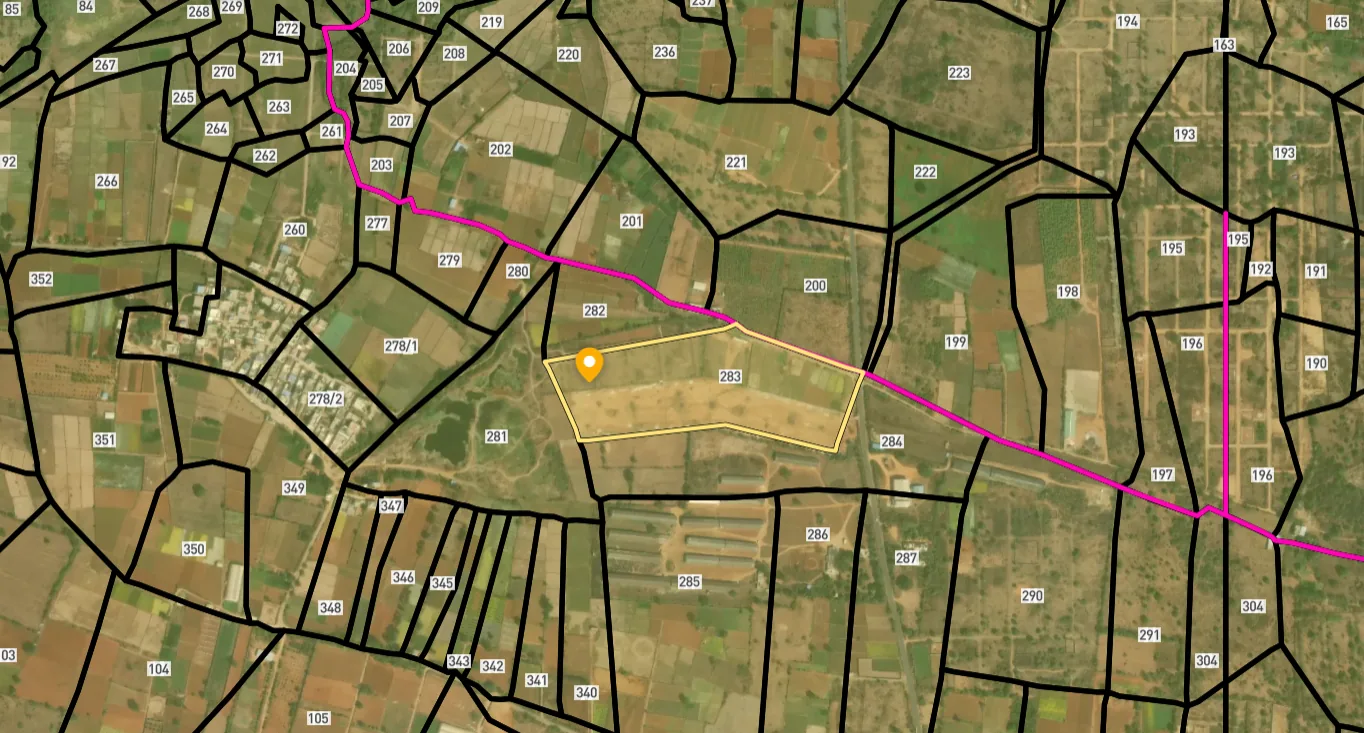
Survey Numbers View on Map Boundaries and numbers come from published state cadastral records. See all map layers.
Looking to sell your land in Odisha?
Browse 200+ verified lands & plots in Odisha
Frequently Asked Questions
What is a Title Deed Odisha and how is it different from a sale deed?
Why is the Mother Deed important when buying property in Odisha?
How many years of title chain should a buyer verify in Odisha?
How do I verify a deed on the IGRS Odisha portal?
What if the Mother Deed has been lost in Odisha?
Why do banks ask for the Mother Deed during home loan processing in Odisha?
Other Related Guides
RoR / Plot Extract Odisha: Bhulekh Guide 2026
Download your RoR / Plot Extract from Bhulekh Odisha, decode Khatiyan and Kisam fields, and verify Raiyat ownership before any land purchase in Odisha.
Read guide →Khatiyan Odisha 2026: RS & Settlement Record Guide
Khatiyan Odisha is the settlement record that anchors land title in the state. Read what RS Khatiyan proves, how to obtain one, and why buyers must verify it.
Read guide →Patta Odisha 2026: Hal Patta & Transfer Guide
A Hal Patta Odisha is the current ownership certificate that must be in the seller's name on the day of sale. Read what it proves and how to transfer it.
Read guide →Mutation Odisha 2026: Dasakhata & Patta Update Guide
Mutation Odisha is the Tahasildar's order that updates Patta after sale. Read what Dasakhata records, how to track it, and how to confirm it is final.
Read guide →Encumbrance Certificate Odisha 2026: IGRS OD Guide
The Encumbrance Certificate Odisha lists every registered transaction on a plot. Cover 30 years through IGRS OD before any land purchase in the state.
Read guide →Land Conversion Odisha 2026: Agri to NA Order Guide
Buying agri land in Odisha and planning to build? Get the Land Conversion Order under Section 8(A) of the OLR Act first. Read how, where, and the buyer traps.
Read guide →