
How to Check land conversion in Tamil Nadu — Complete Guide 2026
Land Conversion Tamil Nadu is the order issued under the Change of Land Use Rules 2017 that legally converts agricultural land to residential, commercial, or industrial use. Without it, construction on agri land is illegal and faces demolition. This guide covers the application route, fees, common defects, and red flags.
What is land conversion in Tamil Nadu?
Definition
Land Conversion in Tamil Nadu, formally Change of Land Use (CLU), is the order issued by the local authority with the prior concurrence of the Director of Town and Country Planning, converting agricultural land to non-agricultural use. It is governed by the Tamil Nadu Change of Land Use (From Agriculture to Non-Agriculture Purposes in Non-Planning Areas) Rules, 2017 in non-planning areas, and by Section 32 of the Tamil Nadu Town and Country Planning Act, 1971 (Master Plan reclassification) in planning areas.
A Patta classifies land as Nanjai (wetland), Punjai (dryland), or Manavari (rainfed). The CLU order converts that classification to non-agricultural before any construction is legal. Sellers offering "agricultural land suitable for housing" without a CLU order are selling the obligation to convert. Buyers either pay the conversion charge themselves or face demolition. The Madras HC and the local body enforce the T&CP Act on unconverted construction.
The 2017 Rules cover non-planning areas under DTCP. Planning areas (CMDA, LPA, NTDA) use the Master Plan reclassification process. Both routes need a 3% market value conversion charge under the Indian Stamp Act 1899, plus a ₹1,000 scrutiny fee. Wetlands need Collector concurrence after a personal site visit under Section 47A. Drylands need a report from the Joint Director of Agriculture. The agricultural to non-agricultural conversion file must reach the Director through the local body, not direct.
How to Get a Land Conversion Order in Tamil Nadu: Step-by-Step on onlineppa.tn.gov.in
Two routes get you a CLU Tamil Nadu order. The Tamil Nadu Single Window Portal at onlineppa.tn.gov.in handles online filing for non-planning and planning areas. Offline filing goes to the local body and DTCP regional office. Have the Form-I land conversion form, Patta Chitta, FMB sketch, EC, sale deed, and the latest market valuation ready before starting.
Online method (recommended)
Offline method (Sub-Registrar Office)
What Does a Land Conversion Order Contain in Tamil Nadu?
Each CLU order is a formal proceedings document. Mismatch on any field against the Patta or the proposed development is a transfer-blocking defect.
| Field | What it means | What to check |
|---|---|---|
| Conversion Order Number | Unique reference issued by the local authority | Verify with the local authority and on Patta Chitta update |
| Survey Number and Sub-division | Land parcel identifier | Match against Patta, FMB, and sale deed |
| Original Classification | Nanjai, Punjai, or Manavari | Confirms the source classification before conversion |
| Converted Use | Residential, commercial, industrial, or institutional | Determines what construction is legally permitted |
| Extent Converted | Area in hectares or square metres | Match against the parcel being purchased |
| Conversion Charge Paid | 3% of market value plus ₹1,000 scrutiny fee | Receipt copies must be on file |
| Director Concurrence Reference | Director of Town and Country Planning approval reference | Confirms statutory route was followed |
| Collector Concurrence (wetland) | Personal site visit and concurrence under Section 47A | Mandatory only for Nanjai conversions |
Common Issues With Land Conversion in Tamil Nadu
Each CLU order is a formal proceedings document. Mismatch on any field against the Patta or the proposed development is a transfer-blocking defect.
Why Land Conversion Matters for Land Buyers in Tamil Nadu
The CLU order is the single document that decides whether agricultural land can legally host residential, commercial, or industrial construction.
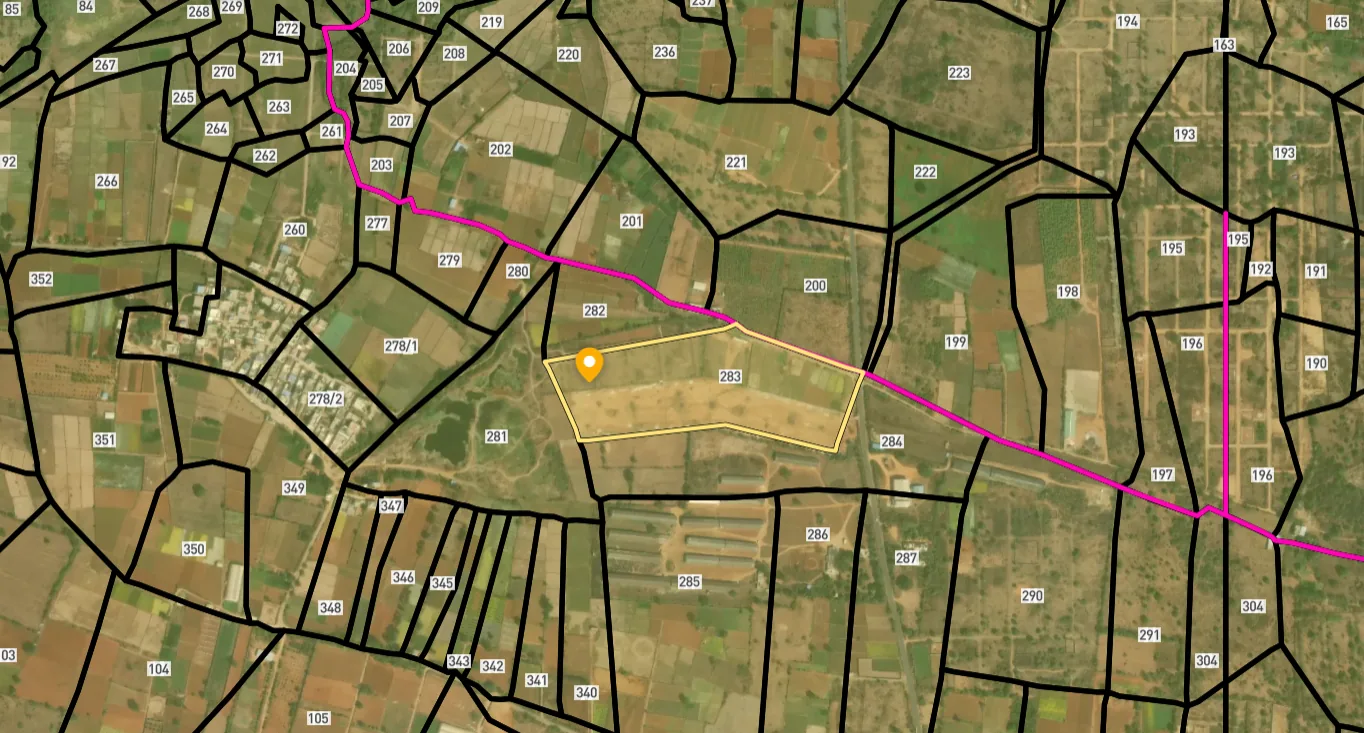
Survey Numbers View on Map Boundaries and numbers come from published state cadastral records. See all map layers.
Looking to sell your land in Tamil Nadu?
Browse 1,300+ verified lands & plots in Tamil Nadu
Frequently Asked Questions
What is Land Conversion Tamil Nadu?
What are the charges for converting agricultural land in Tamil Nadu?
Can wetland be converted to residential in Tamil Nadu?
How long does the land conversion process take in Tamil Nadu?
What lands cannot be converted in Tamil Nadu?
Is land conversion required before building permission?
What is the difference between non-planning area conversion and Master Plan reclassification?
What happens if I build on agricultural land without conversion?
Other Related Guides
Panchayat Municipality NOC Tamil Nadu: Guide 2026
Get the Panchayat Municipality NOC Tamil Nadu before any building or layout approval. The Annexure-XVII access road certificate from EO, BDO, or Commissioner is mandatory.
Read guide →Legal Heir Certificate Tamil Nadu: Varisu Apply 2026
Apply for Legal Heir Certificate Tamil Nadu (Varisu) on tnesevai.tn.gov.in. All named heirs must consent to any inherited property sale. Skip the disputed inheritance trap.
Read guide →TNPDCL (TANGEDCO) and TWAD NOC Tamil Nadu: 2026 Guide
Check the TNPDCL (formerly TANGEDCO) and TWAD NOC before buying a plot in Tamil Nadu. Confirm electricity, water and drainage availability upfront.
Read guide →Encumbrance Certificate Tamil Nadu: TNREGINET EC Guide 2026
Apply for the Encumbrance Certificate Tamil Nadu on TNREGINET in 5 minutes. Pull a 30-year EC, decode Form 15, and spot unreleased mortgages before buying.
Read guide →Property Tax Receipts Tamil Nadu: Pay Online Guide 2026
Pay Property Tax Receipts Tamil Nadu online via tnurbanepay.tn.gov.in or GCC portal. Demand a Nil Dues Certificate before any purchase. Skip the inherited tax shock.
Read guide →Sub-Division Sketch Tamil Nadu: How to Apply Guide 2026
Apply for the Sub-Division Sketch Tamil Nadu at the Tahsildar's office. Required for partition, sale of part-survey, and layout plots before registration.
Read guide →