
What is TN e-Services?
Definition
TN e-Services is the Tamil Nadu revenue department's citizen portal at eservices.tn.gov.in, serving the patta and chitta extract, patta transfer, the A-Register, FMB sketches and the urban TSLR. The encumbrance certificate and guideline value issue separately through TNREGINET, the registration department's system.Think of Tamil Nadu's records as a well-run filing room. Each register answers one question: the patta says who holds, the chitta details what, the A-Register keeps the village's permanent ledger, the FMB draws the ground, the TSLR takes over inside town limits. eservices.tn.gov.in is the counter for all of them; tnreginet.gov.in is the other room, where deeds, charges and rates live.
The system's quiet strength is the patta number itself: one account gathering a holder's parcels, so a single lookup reads a portfolio. And the state has wired registration to patta transfer, so a clean sale flows into the record without a separate application, with the VAO, Revenue Inspector and Tahsildar as the human chain behind the screens.
Its boundary is the money and the ground. Nothing on the records side shows a mortgage or a rate, that is TNREGINET's room, and fine subdivisions mean the screen's survey number is never enough: the fraction's own FMB is where geometry gets real.
TN e-Services or TNREGINET: where each service lives
Revenue and registration are separate departments with separate systems, and the records family adds a third distinction: rural registers versus the town survey.
| Question | System | Service |
|---|---|---|
| Who holds this land, and what class? | TN e-Services | Patta Chitta view |
| What is the village's permanent entry? | TN e-Services | A-Register extract |
| What was registered against it? | TNREGINET | Encumbrance Certificate |
| What does duty compute on? | TNREGINET | Guideline value |
| What is the fraction's true geometry? | e-Services / survey office | FMB sketch |
| Is this urban, TS-numbered land? | Town survey records | TSLR extract |
The habit to build: record questions to e-Services, money questions to TNREGINET, geometry to the FMB at the exact subdivision, and town-limit land to the TSLR.
All TN e-Services services, with a guide for each
Eleven guides across the two systems. The TNREGINET badge marks registration-department services; everything else serves through the revenue side.
Records & accounts
5 guidesThe filing room's core: everything here serves through eservices.tn.gov.in, keyed by the patta number and the survey with its subdivision.
The core extract: holders, patta number, extent and the nanjai or punjai class, read at the exact subdivision.
Search by owner nameResolve a name to a patta number and read the account outward, the standard route for family and diaspora tracing.
Patta transfer P1Registration-linked for sales, taluk-filed for heirs, finished only when the extract shows the new holder.
Certified patta copyThe issued extract institutions act on, listing every joint holder the free view can crop.
A-Register extractThe village's permanent ledger: survey-wise class, assessment and history behind the patta.
Registration & value (TNREGINET)
2 guidesThe other room: tnreginet.gov.in holds the registered chain and the published rates. Neither appears on the records portal.
Thirty years of registered history, walked beside the patta before any advance moves.
Guideline valueTNREGINETThe state's published rate per survey and street, the floor stamp duty computes on.
Maps & surveys
3 guidesThe geometry shelf: screen views to orient, the FMB to govern, and the TSLR where town limits change the numbering.
Screen views for orientation, water margins and access, before the sketch and the site visit.
FMB sketchThe measured drawing at the subdivision, the geometry that governs every fraction deal.
TSLR extract (urban)The town survey record for TS-numbered urban land, where the rural registers hand over.
Conversion
1 guideOne guide for the buildability question, where planning approvals lead and the record follows.
Getting started on the portal
Every guide assumes you can name the parcel and the account precisely; Tamil Nadu gives you two keys and one trap.
Patta number, survey and subdivision
The patta number reads a holder's whole account; the survey number with its subdivision pins the exact ground; and the trap is stopping at the parent survey. Old receipts and extracts carry the patta number; the VAO bridges whatever the portal cannot.
| Step | Online | Offline |
|---|---|---|
| 1. Access | Open eservices.tn.gov.in; viewing needs no fee | The VAO keeps the village's registers and explains them |
| 2. Identify the parcel | District, taluk, village, then survey and subdivision | Carry an old extract so staff match the right fraction |
| 3. Use the service | Pick the service; its guide above walks the rest | e-Sevai centres file requests and print records |
| 4. Keep evidence | Save views; request certified copies for institutions | Only issued, certified extracts carry standing |
Offline Tamil Nadu runs through the VAO's table, e-Sevai centres for filings and prints, and the taluk office above them, with the Revenue Inspector and Tahsildar deciding what the village level cannot.
Which service do you actually need?
Start from the question, and the table hands you the register built to answer it.
| You want to | Use this service | Guide |
|---|---|---|
| Read the core land record | Patta Chitta on e-Services | Patta Chitta |
| Recover family or lost land | Name to patta trace | Name search |
| Check loans and the title chain | EC on TNREGINET | EC guide |
| Move the record after a deed or death | Patta transfer | Patta transfer |
| Budget the stamp duty | Guideline value lookup | Guideline value |
| See the fraction's true geometry | FMB at the subdivision | FMB sketch |
| Check an urban TS-numbered plot | TSLR extract | TSLR |
| Build on farmland lawfully | Approvals, then the record | Conversion |
The order a careful buyer runs these in
Tamil Nadu's registers reward being read in sequence, because the subdivision and the class can each invalidate everything checked after them.
- Pull the Patta Chitta at the subdivision. Holders, extent and class, read against the sellers; joint pattas set the consent map for everything after. Guide: Patta Chitta
- Walk the EC beside it, thirty years. Every registered transfer and mortgage on TNREGINET, reconciled with the patta's story. Guide: Encumbrance Certificate
- See the FMB for the exact fraction. Parent surveys hide subdivisions; the measured sketch of your fraction is the geometry that governs. Guide: FMB sketch
- Check class, water margins and approvals. Nanjai entries, tank and channel distances, and the planning question for anything you intend to build. Guide: Conversion guide
- Do the guideline value maths. Duty computes on the higher of the published rate and the price; the true cost is knowable before the offer. Guide: Guideline value
- After the deed, watch the patta transfer home. The registration-linked update, tracked to the certified extract in your name, closes the purchase. Guide: Patta transfer
Common issues across the portal
Four snags account for most stuck Tamil Nadu searches and deals.
Usually the wrong revenue village or a skipped subdivision. Confirm the village with the VAO, then search fraction by fraction.
Joint pattas are the norm, not the exception. Every name on the account consents, or the deal covers only a share.
A deed-record mismatch strands the linked transfer silently. Carry the deed to the taluk office and find the diverging field.
Tank beds, channels and poromboke margins discipline the state's geography. Measure the distance on the FMB and the ground.
Rules buyers should know
No mortgage or rate appears on the records side. The EC at thirty years and the guideline value are separate, mandatory pulls.
Records, sketches and deals all resolve at the subdivision. A parent-level read prices someone else's land.
Nanjai entries and planning conformity decide buildability. Approvals lead, the record follows, and future-tense promises mean farmland.
Joint accounts are Tamil Nadu's default. The certified extract lists every holder, which is the consent map the deal must cover.
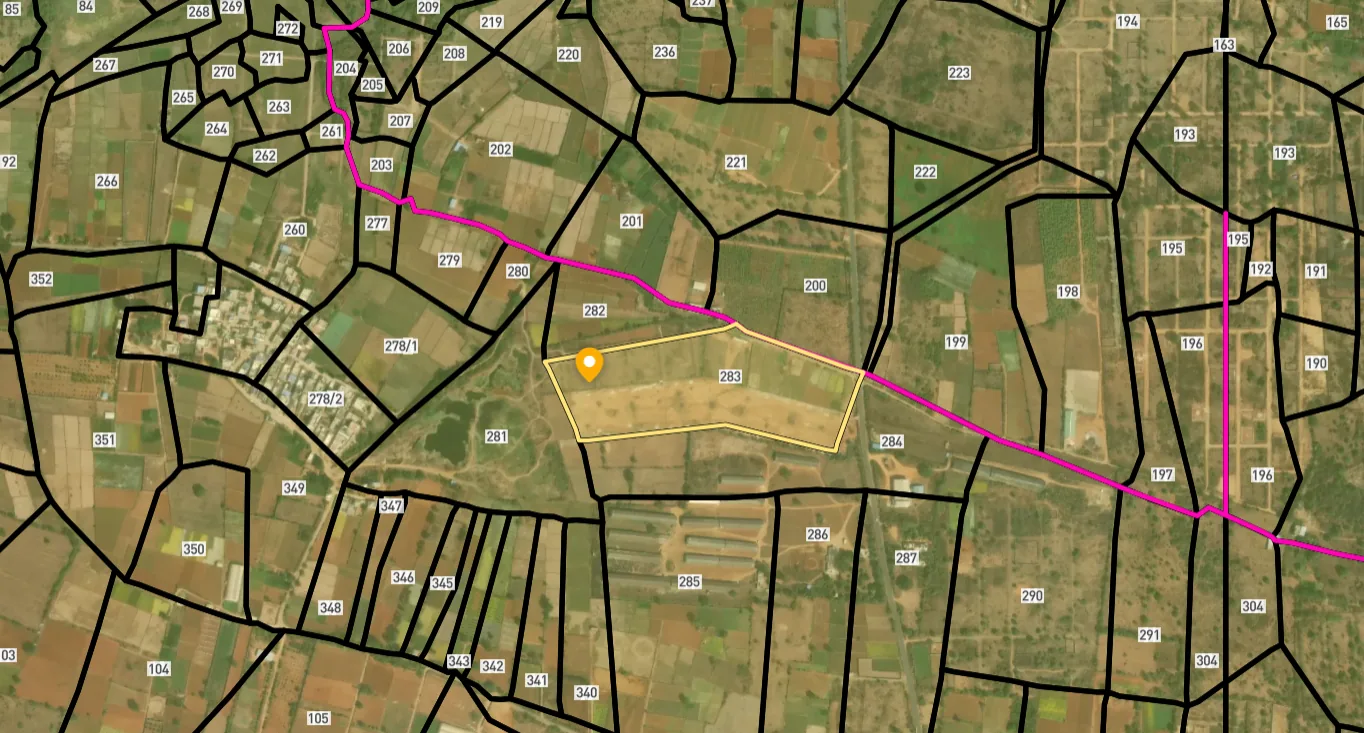
Survey Numbers View on Map Boundaries and numbers come from published state cadastral records. See all map layers.
Looking to sell your land in Tamil Nadu?
Browse 1,300+ verified lands & plots in Tamil Nadu
Frequently asked questions
What services are on TN e-Services?
The patta and chitta view, name search, patta transfer, certified copies, the A-Register and FMB access. The EC and guideline value sit with TNREGINET.
What is the difference between e-Services and TNREGINET?
TN e-Services is the revenue department's records portal; TNREGINET is the registration department's. Records on the first, deeds, charges and rates on the second.
How do I check land ownership in Tamil Nadu?
Pull the Patta Chitta extract at the exact survey and subdivision, and read every holder on the patta, not just the seller's name.
Is patta transfer automatic after registration?
Registration is linked to the transfer for sales, so clean deeds flow through. Verify to the updated extract; heirs file at the taluk office.
What are nanjai and punjai?
Tamil Nadu's wet and dry land classes. The entry shapes value, water rights and the conversion route for construction.
What is the A-Register?
The village's permanent land ledger: survey-wise classification, assessment and history, the register the patta extract summarises.
What is a TSLR extract?
The Town Survey Land Register record for urban, TS-numbered land, serving where the rural registers hand over inside town limits.
Where do I check guideline value?
On TNREGINET, published per survey number and street. Stamp duty computes on the higher of the guideline value and your price.