
How to Check Mutation in Andhra Pradesh — Complete Guide 2026
Mutation in Andhra Pradesh is the Revenue Department's process of updating the ROR 1B and Pahani to reflect a new owner after a sale, inheritance, gift, or partition. Under Section 4 of the AP Rights in Land and Pattadar Pass Books Act, 1971, buyers must intimate the Mandal Revenue Officer within 90 days of any acquisition. This guide covers how auto mutation works after registration, how to track it on meebhoomi.ap.gov.in, and what to do when the update stalls.
What is Mutation in Andhra Pradesh Land Records?
Definition
Mutation in AP is the formal update of the Record of Rights (ROR Form 1-B) and Pahani to replace the previous owner's name with the new owner's after a registered transfer, inheritance, court decree, or government patta. It is governed by Section 4 and Section 5 of the AP Rights in Land and Pattadar Pass Books Act, 1971.
The mutation record does not create or extinguish legal title , that is settled by the registered Sale Deed. What it does is bring the Revenue Department's records in line with the registered transaction. A buyer whose name does not appear in the ROR 1B on Meebhoomi is legally the owner, but practically invisible to banks, government schemes, and anyone doing a land record check. The Pattadar Passbook cannot be reissued in the new owner's name until mutation is complete, and all AP banks require an Aadhaar-seeded, mutated ROR before approving agricultural loans.
The 2026 auto mutation system changes how this works for Sale Deed transactions. Once a Sale Deed is registered at the Sub-Registrar Office, the registration data flows to the Tahsildar's digital desk immediately. The ROR 1B is provisionally updated on Meebhoomi within 7 to 15 working days. The Tahsildar then conducts a title enquiry and confirms the mutation within 30 working days. The buyer no longer needs to file a separate application for mutations triggered by registered Sale Deeds. For inheritance, gifts, and court decrees, a manual application at the MRO or MeeSeva is still required.
How to Get Pahani Mutation 1 B Update in Andhra Pradesh
For Sale Deed transactions, auto mutation triggers automatically after registration , no application needed. For inheritance, gifts, and other non-registration acquisitions, apply at MeeSeva or the MRO. Have your Sale Deed or acquisition document, Aadhaar, and Survey Number ready.
Online method (recommended)
Offline method (Sub-Registrar Office)
What Does Mutation Record Contain in Andhra Pradesh?
The updated ROR 1B after mutation shows these fields that a buyer must verify match the Sale Deed and Pattadar Passbook.
| Field | What it means | What to check |
|---|---|---|
| Name of the new owner as recorded in the ROR 1B | Must match the buyer's Aadhaar exactly; a misspelling requires MRO correction before any bank submission Mutation Acceptance Date | Date the Tahsildar confirmed the mutation |
| Parcel identifier and land area in acres and cents | Cross-check against the Sale Deed and Adangal , any reduction signals an unrecorded sub-division Khata Number | Account linking all survey numbers to one pattadar in the village |
| The name removed after mutation | Confirms the mutation correctly replaced the seller, not a different prior owner; a different name signals a chain gap Type of Acquisition | Records whether mutation was by sale, inheritance, gift, partition, or court decree |
Common Issues With Mutation Andhra Pradesh Land Records
The updated ROR 1B after mutation shows these fields that a buyer must verify match the Sale Deed and Pattadar Passbook.
Why Mutation Matters for Land Buyers in Andhra Pradesh
Completing mutation is the step that connects the registered Sale Deed to the Revenue Department's live records, and skipping it blocks every downstream benefit.
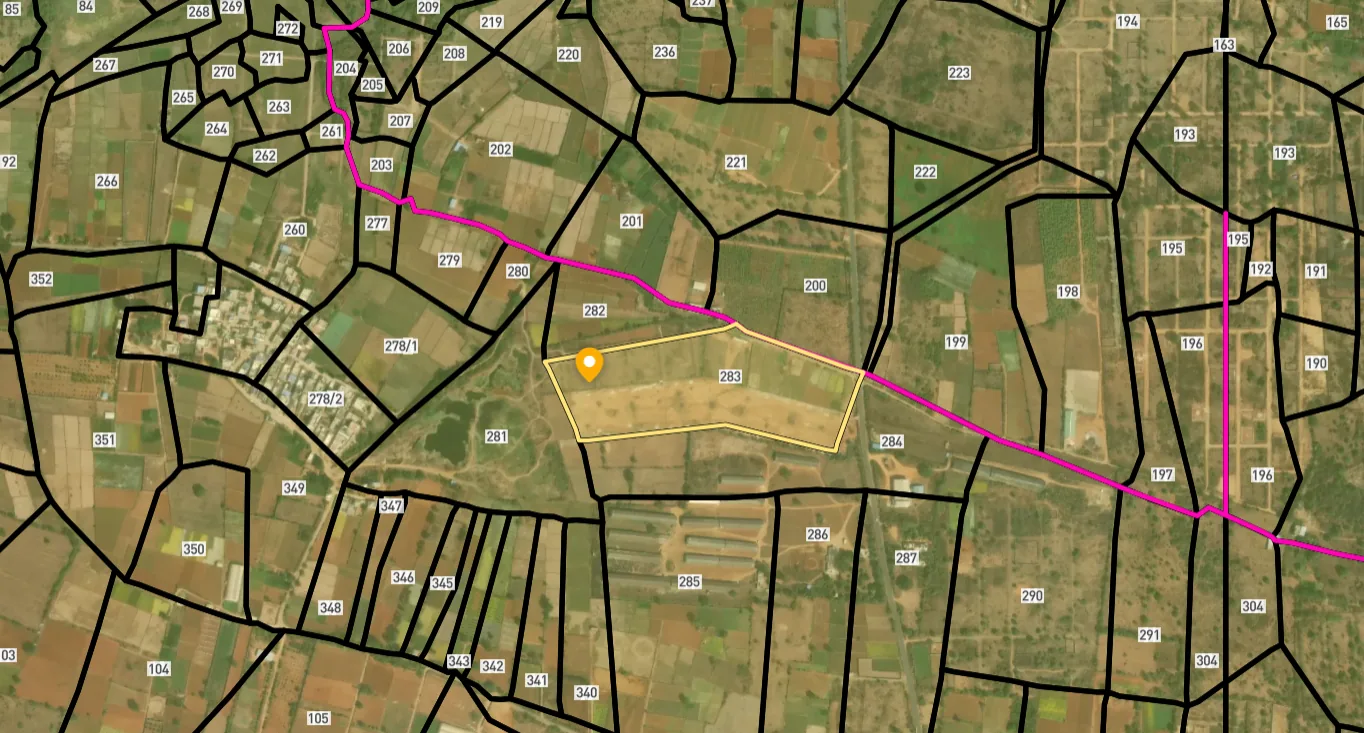
Survey Numbers View on Map Boundaries and numbers come from published state cadastral records. See all map layers.
Looking to sell your land in Andhra Pradesh?

Browse 1,300+ verified lands & plots in Andhra Pradesh
Frequently Asked Questions
What is mutation in Andhra Pradesh land records and why does it matter?
How does auto mutation work in AP after registration?
How do I check mutation status on Meebhoomi AP?
Is mutation mandatory within 90 days of purchase in AP?
How do I apply for mutation in AP for inheritance or gift?
What happens if mutation is rejected by the Tahsildar in AP?
Does mutation prove ownership in Andhra Pradesh?
How long does mutation take to reflect on Meebhoomi AP in 2026?
Other Related Guides
Land Conversion NA Order Andhra Pradesh: 2026 Guide
How to get land conversion NA Order in Andhra Pradesh, OTC tax rates, what documents are needed, and why building without conversion brings a 50% penalty and demolition.
Read guide →Deed Mother Deed Andhra Pradesh: 2026 Guide
Understand Title Deed and Mother Deed in Andhra Pradesh, how to verify the 30-year chain on IGRS AP, and why a missing link costs you the deal.
Read guide →Meebhoomi
Every AP land record service in one place, with a guide for each.
Read guide →Pahani ROR 1B Andhra Pradesh: Complete Guide 2026
Check Pahani ROR 1B Andhra Pradesh free on Meebhoomi. Learn what it contains, why it must match the Pattadar Passbook, and how to fix errors before buying land.
Read guide →Adangal Andhra Pradesh Land Records: 2026 Guide
Check Adangal Andhra Pradesh free on Meebhoomi. Learn what wet, dry and waste classification means, how it affects your purchase, and how to spot land use problems.
Read guide →Pattadar Passbook Andhra Pradesh: Complete Guide 2026
What Pattadar Passbook Andhra Pradesh contains, why banks need it for agri loans, how to download it on Meebhoomi, and why transfer after purchase is mandatory.
Read guide →