
Goa Land Records by Owner Name
Half of Goa lives somewhere else. From Lisbon to London to Toronto, Goan families carry keys to houses they visit once a decade and questions about fields nobody has cultivated since an aunt's wedding. The name search is how those questions come home: a remembered holder, tested against a village's records through the DSLR's services, resolved to survey numbers, and read as Form I & XIV entries that finally replace family legend with the register's version.
How the name search works in Goa land records
Definition
Searching Goa land records by name means testing a holder's name against a village's Form I & XIV records through the DSLR's services, resolving matches to survey and subdivision numbers, and reading each form in full, tenants, Mundkar remarks and older references included. Searches run village by village; verify the current search facilities, and use the Talathi's register where the online route runs thin.
Goa's name problem is its history's gift. The register may hold a name in any of its lives: the Portuguese spelling, the post-liberation respelling, the house name the village actually uses, the baptismal form nobody uses at all. Fernandes, Fernandez and the same man are one entry; write out every form the family remembers before searching, and let the Talathi's memory arbitrate what the search box cannot.
Villages are the search's unit and Goa's are small, which helps: a family that can name the village and the vaddo has done most of the work. Old paper does the rest, a Matriz receipt, a Communidade document, an inventory citation, each carrying names and numbers the register recognises instantly.
Close on the record's terms: survey and subdivision numbers, then the full form for each. In Goa especially, a name match is only an invitation, because the form's other columns, tenants, Mundkars, references to older files, decide what the family actually holds as opposed to what it remembers holding.
Running the Goa land records name search
Village, name forms, numbers, forms, in that order.
The trace
With the Talathi
Goa's name forms, and where each hides
One holder, five possible register entries.
| Form | Example of drift | Where it surfaces |
|---|---|---|
| Portuguese spelling | The Conservatória-era entry | Older records, remarks |
| Post-liberation respelling | The modern register's version | Form I & XIV |
| House name | What the village calls the family | The Talathi's memory |
| Baptismal full form | Rarely used, formally recorded | Church-adjacent old papers |
| Initials and contractions | Clerks' economies | Search results, receipts |
Common name search issues, and the fix
Goa name traces stall four ways.
Goa land records by name, from far away
For the diaspora family, the finished trace is a one-page truth: the villages, the survey numbers, the register's current names, the tenants and Mundkar positions, and the inventory status, assembled once and shared, so the next generation inherits facts instead of legends.
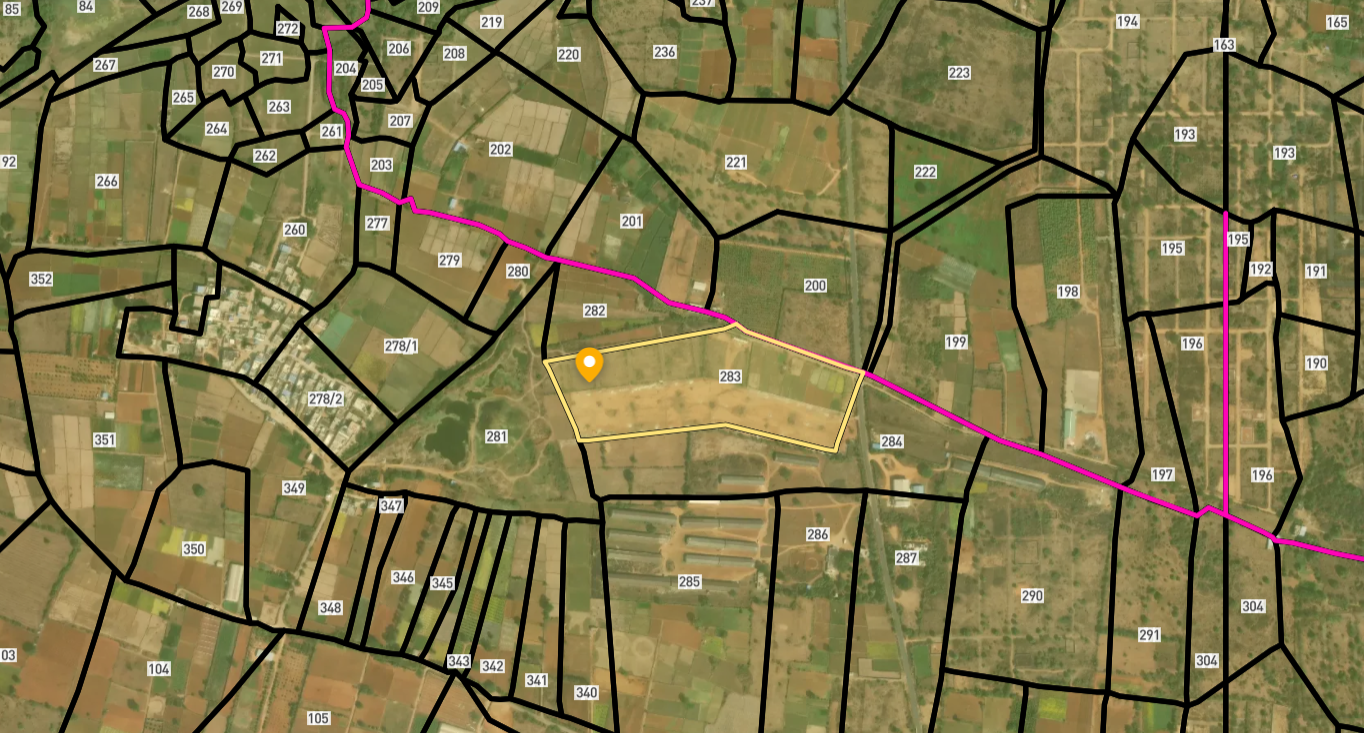
Survey Numbers View on Map Boundaries and numbers come from published state cadastral records. See all map layers.
Looking to sell your land in Goa?
Browse 91+ verified lands & plots in Goa
Frequently asked questions
Can I search Goa land records by name?
Why do spellings cause trouble?
Which village do I search?
What closes the trace?
The land traces to great-grandparents?
Can buyers use this route?
Other Related Guides
Goa Land Records
Every Goa land record service in one place, with a guide for each.
Read guide →Form I & XIV in Goa: Record of Rights Complete 2026 Guide
Read, obtain, and verify Form I & XIV in Goa. Covers DSLR portal, Mamlatdar process, Section 105 presumption, tenant entries, mundkar warnings, and mutation.
Read guide →Mining Zone Check Goa: Mines & Geology Verification Guide 2026
The Mining Zone Check Goa confirms whether land sits in an active or legacy iron ore mining area. Former mining zones carry construction restrictions and health hazards.
Read guide →Property Tax Receipts Goa: Nil Dues Verification Guide 2026
Property Tax Receipts Goa prove the seller paid all dues. Pull 5 years minimum and a Nil Dues Certificate. Unpaid tax transfers with the property to the buyer.
Read guide →Water Bill Dues in Goa: Buyer's Guide 2026
Water Bill Dues in Goa stay with the meter. Verify nil water dues using the 8-digit Consumer ID, transfer the connection, avoid PWD disconnection.
Read guide →TCP Technical Clearance Goa: FAR Certificate Guide 2026
The TCP Technical Clearance Goa confirms FAR and height compliance under the T&CP Act 1974. Excess construction is illegal. Verify before buying any built property.
Read guide →