
Encumbrance Certificate Haryana: deeds on the same portal
Haryana is one of the few states where the deed search and the record of rights sit on the same platform. Jamabandi Haryana carries both: the Fard on the records side and the registered deeds and charges on the encumbrance side. The convenience is real, and the discipline is still required: reach back far enough to surface an old mortgage, reconcile the deed chain with the current co-holder list, and treat a clean screen result as a starting point.
Where the Haryana encumbrance history lives
Definition
In Haryana the deed search runs on Jamabandi at jamabandi.nic.in, the same portal as the Fard. Registered sales, mortgages and charges against a khewat or khasra are traced through the deed-search service, and the portal also carries collector rates and registration details. Reach back many years, since older paper deeds can sit only in the sub-registrar's volumes off-portal. Reconcile every deed against the current Fard to confirm the holder chain is consistent.
Having the deeds and the record on one portal is a genuine Haryana advantage. A buyer can read the Fard for the current co-holders, then move to the deeds side and trace the chain of registered sales and mortgages without leaving Jamabandi. That compression makes a first-pass check faster, but it does not change what the check requires: the deed chain must be traced back far enough to surface an old mortgage, and every deed in the chain must be reconciled against the current Fard.
The depth a search needs in Haryana is shaped by the state's consolidation history. Holdings that passed through chak consolidation often carried mortgages taken before the consolidation, and the mortgage's khasra number from 1975 may differ from the post-consolidation khasra it now sits on. A search across only recent years can look clean while a pre-consolidation charge on the underlying parcel still binds the land. Reaching the full span, into the sub-registrar's volumes for the pre-digital period, is what surfaces those.
After assembling the deed chain, place it beside the Fard. The Fard names the current co-holders; the deed chain shows how title moved to them. Where the chain is continuous, every mortgage discharged, and the closing deed matches the holder on the Fard, the title is on firm ground. Where the chain has a break at or near the consolidation period, or a mortgage sits open, that is a question to resolve with the seller before a price is named.
How to run a Haryana encumbrance search
The portal runs both reads; the depth and the khasra-variant step are what the check turns on.
On Jamabandi
Cross-check
Haryana EC: Fard and deeds together
Both sit on Jamabandi; read them together and across a long span.
| The Fard shows | The deed search shows | Reconcile by |
|---|---|---|
| Current co-holders | A registered sale chain | Matching deed to Fard |
| Shares and khasra | A recorded mortgage | Taking it to discharge |
| The Intkaal log | An attachment or decree | Reading the full deed side |
| No charge, visibly | A pre-consolidation charge | Searching old khasra too |
| Possession record | A pre-digital paper deed | Opening the sub-registrar volumes |
Common Haryana encumbrance certificate issues, and the fix
Four gaps that make a Haryana encumbrance check look cleaner than the title is.
How far a Haryana deed search should reach
Because Haryana's land has been through bulk consolidation, the depth of an encumbrance search matters more than in most states. A charge taken on an old khasra number still binds the land if it was never formally discharged, and a search under only the post-consolidation khasra will miss it. Combining the portal search with a check of the sub-registrar's volumes for the pre-digital years, and running both the old and new khasra numbers in consolidated villages, is what a complete Haryana search looks like. After depth, reconciliation. The deed chain should end in the current Fard: the closing deed names the holder the Fard shows, every mortgage in the chain is discharged, and the consolidation period did not leave a break. Where these conditions hold, the title stands. Where any chain link is open, undischarged or missing, the answer is legal advice before price, not an advance.
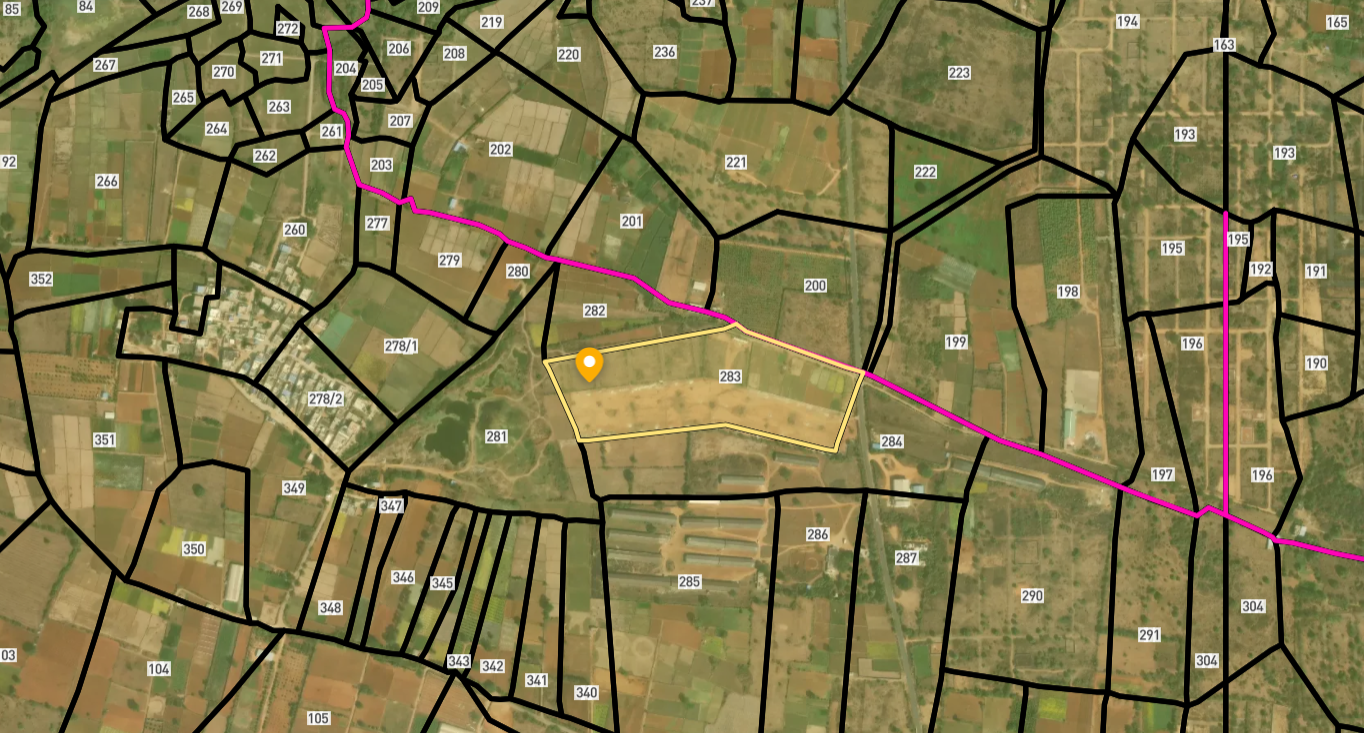
Survey Numbers View on Map Boundaries and numbers come from published state cadastral records. See all map layers.
Looking to sell your land in Haryana?
Browse 200+ verified lands & plots in Haryana
Frequently asked questions
Where do I check encumbrances in Haryana?
Does the Fard show encumbrances?
How far back should the search go?
Does the deed search prove ownership?
What is the collector rate on Jamabandi?
Does the search cost anything?
Other Related Guides
Jamabandi Haryana
Every Haryana land record service in one place, mapped for buyers.
Read guide →Property Tax Haryana 2026: Complete Guide for Land Buyers
Check property tax dues and get Nil Dues Certificate in Haryana before buying. Pay online via NDC portal, avoid inheriting arrears. Full buyer guide 2026.
Read guide →Intkal Mutation Haryana 2026: Complete Buyer's Guide
Learn how to check and verify Intkal Mutation in Haryana 2026. Full 30-year chain guide, jamabandi.nic.in steps, common risks, and Tehsildar tips for land buyers.
Read guide →Jamabandi Haryana 2026: Complete Guide for Land Buyers
Check Jamabandi Haryana online at jamabandi.nic.in. Verify seller name, Khasra, Khewat, mutation status before buying land. Full buyer guide 2026.
Read guide →Khasra Girdawari Haryana 2026: Complete Guide for Land Buyers
Check Khasra Girdawari Haryana before buying land. Verify land use, crop status, and NA conversion via jamabandi.nic.in. Full buyer guide 2026.
Read guide →Legal Heir Certificate Haryana 2026: Complete Step-by-Step Guide
Learn how to get a Legal Heir Certificate in Haryana in 2026. Covers Antyodaya SARAL online process, documents, fees, Patwari verification, and why all heirs must consent before sale.
Read guide →