How to Buy Land in
Andhra Pradesh:
Complete Property Buyer's Guide 2026
Andhra Pradesh is fully open to all Indian citizens - but one check stands above everything else: Section 22A. If a property appears in AP's prohibited list, registration is permanently and automatically blocked. No Sub-Registrar can override it. This guide covers everything you must verify before paying a single rupee of advance.
Understanding Andhra Pradesh's Property Market
YES - fully open. Any Indian citizen, no domicile restriction.
5–7% (slab) + 1.5% Transfer Duty + 1% Registration = ~7.5–9.5%
Section 22A Prohibited Properties - check BEFORE any advance
MeeBhoomi: ROR-1B, Adangal, Pattadar Passbook, FMB, Bhudhaar
Andhra Pradesh is one of India's most strategically important emerging real estate markets. After bifurcation from Telangana in 2014, the state is building a brand-new capital city - Amaravati - and has invested heavily in infrastructure, industrial corridors, and port-led development along its 974 km coastline. Major property markets include Vijayawada, Visakhapatnam (Vizag), Tirupati, Guntur, Nellore, Kakinada, Rajahmundry, and Kurnool.
AP is completely open - any Indian citizen from any state can purchase property without restriction. The complexity lies not in who can buy but in three specific legal checks that are unique to AP: the Section 22A prohibited property system, the Transfer Duty of 1.5% that many buyers miss on top of stamp duty, and the MeeBhoomi digitised records system that is the authoritative source for all land ownership data.
Vijayawada, Visakhapatnam (Vizag), Tirupati, Guntur, Nellore, Amaravati Capital Region, Kakinada, Rajahmundry, Kurnool, Ongole
IGRS AP: registration.ap.gov.in - Section 22A, EC, stamp duty, registration
MeeBhoomi: meebhoomi.ap.gov.in - ROR-1B, Adangal, e-Passbook, FMB
AP declared 2026 'Bhumi Nama Samvatsaram' (Year of Land Reforms). G.O.Ms.No.2 (Jan 2026) expanded Section 22A enforcement powers - Registrars can now cancel already-registered documents that violated Section 22A.
Who Can Buy - Open Market with Critical Land-Type Checks
Andhra Pradesh is a completely open market - any Indian citizen can purchase any private property without residency or domicile requirement. The restriction is not on the buyer, but on the land type. AP has multiple categories of land that are legally non-transferable, and these show up in the Section 22A prohibited property database.
✓ Urban residential and commercial property - fully open
✓ Private patta agricultural land - any Indian citizen
✓ NRIs and OCIs - residential + commercial (FEMA rules apply)
✓ No domicile, no residency certificate required
✓ No non-agriculturist bar (unlike Karnataka/Maharashtra)
✕ Assigned land (government-allotted to landless poor) - void
✕ Endowment / Temple land (Devasthanam) - not transferable
✕ Government / Poramboke land - not privately owned
✕ Ceiling surplus land - vested in government
✕ NRIs/OCIs: agricultural/plantation/farmhouse land (FEMA)
Unlike Karnataka (before 2020) or Maharashtra, AP has no blanket non-agriculturist bar. Any Indian citizen can buy private patta agricultural land. The key restriction is entirely on the land type - not the buyer's profession or state of origin. Always verify land type via ROR-1B Nature of Land column on MeeBhoomi and Section 22A status on IGRS AP before anything else.
Section 22A - The Most Critical Check in Andhra Pradesh
Section 22A of the Registration Act, 1908 empowers the AP government to classify certain land parcels as 'prohibited' - meaning registration is automatically blocked by the digital system. This is the single most important step in any AP property purchase. The block is permanent, automatic, and cannot be overridden even by a Sub-Registrar who wants to help you.
Five categories under Section 22A:
| 22A Category | Land Type | What It Means for Buyers |
|---|---|---|
22A(1)(a) | Assigned Land | Land assigned by government to landless poor. AP Assigned Lands Act 1977 prohibits all transfers. Cannot be sold or purchased. Registration auto-blocked. |
22A(1)(b) | Endowment / Temple Land | Land belonging to Hindu religious endowments managed by AP Endowments Dept. Cannot be privately purchased. Registration auto-blocked. |
22A(1)(c) | Government / Poramboke | Revenue land, roads, drainage channels, water bodies, government reserves. Not privately owned. Registration blocked. |
22A(1)(d) | Ceiling Surplus Land | Agricultural land declared surplus under AP Land Reforms Act 1973 and vested in government. Cannot be purchased. |
22A Others | Wake Land, Inam, Notified Land | Various historically regulated categories. Check IGRS AP portal for specific survey number status. |
How to check Section 22A - do this before anything else:
1. Visit IGRS AP portal - registration.ap.gov.in
2. Go to 'Prohibited Properties' section (Section 22A check)
3. Enter District, Mandal, Village, and Survey Number
4. If the property appears in results - registration is PERMANENTLY BLOCKED
NEVER pay any advance or token money without completing this check first. Even if the seller shows you other documents claiming clear title - always independently verify Section 22A status. G.O.Ms.No.2 (January 2, 2026) expanded powers to cancel even already-registered documents that violated Section 22A.
Assigned Land - the most common risk
The AP Assigned Lands (Prohibition on Transfers) Act, 1977 strictly prohibits transfer of any land assigned by the government to weaker sections - including SC/ST landless farmers, poor housing site beneficiaries, and ex-servicemen. Any sale, gift, exchange, mortgage, or transfer of assigned land is void. The government can resume such land and restore it to the original assignee regardless of how many times it has been subsequently sold.
Read the Adangal Remarks column carefully: Any entries showing 'Assigned' (పోరంబోకు / సర్కారు), 'Endowment', 'Government', or 'Prohibited' in the nature or remarks column indicate restricted/non-transferable land. The Adangal is your second line of defence after Section 22A - always request the full certified Adangal copy from the Village Administrative Officer (VAO).
MeeBhoomi Land Records - ROR-1B, Adangal, Pattadar Passbook, FMB, Bhudhaar
Andhra Pradesh has one of India's most comprehensive digitised land records systems via the MeeBhoomi portal (meebhoomi.ap.gov.in). Understanding the five key documents is essential - each answers a different question about the property.
Stamp Duty, Transfer Duty & Registration Charges
Andhra Pradesh uses a tiered slab system for stamp duty - the rate increases with the property value. The critical point many buyers miss: AP also levies a Transfer Duty of 1.5% in addition to stamp duty and registration, making the total effective cost 7.5–9.5%.
| Property Value Slab | Stamp Duty | Transfer Duty | Registration Fee | Total ~ |
|---|---|---|---|---|
Up to ₹50 lakh | 5% | 1.5% | 1% | ~7.5% |
₹50 lakh to ₹1 crore | 6% | 1.5% | 0.5–1% | ~8–8.5% |
Above ₹1 crore | 7% | 1.5% | 0.5% | ~9–9.5% |
Gift Deed - close family | 2% | Reduced/nil | 0.5% | ~2.5% |
Gift Deed - non-family | 5–7% (slab) | 1.5% | 1% | ~7.5–9.5% |
Agricultural land (private patta) | 5% (rural slab) | 1.5% | 0.5–1% | ~7–7.5% |
The Transfer Duty trap: AP and Telangana are among the very few Indian states that levy a separate Transfer Duty (1.5%) in addition to stamp duty and registration. Many buyers calculate only stamp duty + registration and are caught off guard by this additional charge. On a ₹1 crore property, Transfer Duty alone adds ₹1.5 lakh to the transaction cost.
Encumbrance Certificate (EC) - Form 15 and Form 16
The Encumbrance Certificate (EC) shows the complete transaction history of a property - all registered sales, mortgages, gifts, leases, and court orders. AP provides EC online through the IGRS AP portal in two forms.
Shows all registered legal and financial transactions on the property - sales, mortgages, gifts, leases, court attachments - for any date range. Use for due diligence. Get minimum 13 years; 30 years strongly recommended.
IGRS AP portal → EC Search → enter district, sub-registrar office, village, survey number, date range. Free online view; small fee for certified copy.
Also called Nil EC. Confirms no existing mortgage or encumbrance on the property to the lender. Required by banks when processing home loan applications. Same IGRS AP portal - lenders specifically use this to confirm property is free from prior claims.
EC alone does not confirm ownership. The EC shows registered transactions - it does not independently confirm who the legal owner is. For ownership verification, always check the ROR-1B on MeeBhoomi separately. If EC shows 'Nil' for a long period, it can mean no historical registration - which itself may be a risk flag if the title chain is incomplete.
AP Land Titling Act 2022 & the 2026 Land Reforms
The Andhra Pradesh Land Titling Act, 2022 is among the most significant land reforms in India in recent years. It aims to move AP from a 'deed registration' system (where the registrar only records what is presented) to a 'title registration' system (where the government certifies and guarantees the title). This resolves the fundamental problem of multiple sales and fraudulent documents that has historically affected AP's property market.
Creates a Land Titling Authority with a Register of Titles - once registered, title is government-guaranteed.
Integrates Aadhaar + MeeBhoomi + IGRS + satellite surveys into one authoritative registry.
Implementation: ongoing as of 2025–26. Verify with local Sub-Registrar whether your specific area has been notified under the Act.
Until full implementation: continue traditional due diligence.
AP declared 2026 as 'Year of Land Reforms'.
G.O.Ms.No.2 (Jan 2, 2026): expanded Section 22A enforcement - Registrars can now cancel already-registered documents that violated Section 22A.
Section 77-A: Inspector General can cancel forged registrations.
Anti-forgery: Aadhaar + PAN cross-referencing before all registrations.
Genuine private Patta land incorrectly listed as prohibited: can be corrected in 15–45 days.
The 2026 reforms are positive for long-term buyers - they mean stronger title security and less fraud. But in the short term, expanded Section 22A enforcement means even past registrations can be challenged. This makes thorough due diligence more important, not less. Always engage a qualified AP property advocate who knows MeeBhoomi and IGRS AP procedures.
The Complete Property Registration Process in Andhra Pradesh
AP uses a fully digitised registration process via the IGRS AP portal with mandatory Aadhaar-based biometric authentication. The Section 22A automated check runs again at registration stage - even if you missed it earlier, the system will block the deed automatically.
Documents required for registration: Sale Deed on e-stamp paper, Aadhaar + PAN of buyer and seller (biometric auth mandatory), ROR-1B (certified copy), Adangal (certified copy from VAO/MRO), Pattadar Passbook/e-Passbook, EC Form 15, property tax receipts, FMB/LP Map (for rural land), RERA registration number (for builder projects), TDS Challan (for transactions above ₹50 lakh).
Agricultural Land - Restrictions, Ceiling & Conversion
AP does not have a blanket non-agriculturist bar on purchasing private agricultural land - unlike Karnataka (pre-2020) or Maharashtra (Section 63). Any Indian citizen can purchase private patta agricultural land in AP. The key restriction is the land type: assigned land, endowment land, and government land cannot be purchased by anyone regardless of profession.
Any Indian citizen can purchase private patta agricultural land in AP. Nature of Land in ROR-1B must show 'Private'. Section 22A must be clear. Ceiling limits apply to total holding. No non-agriculturist restriction.
Assigned land (government-allotted). Endowment/temple land. Government/Poramboke land. Ceiling surplus land. Any land appearing under Section 22A. NRIs/OCIs: agricultural, plantation, and farmhouse land prohibited under FEMA.
Ceiling limits: The AP Land Reforms (Ceiling on Agricultural Holdings) Act, 1973 sets maximum limits on agricultural landholding - the ceiling varies by irrigation type and family composition. Buying agricultural land that pushes your total holdings above the ceiling is legally problematic - surplus land is vested in the government. Verify that your total holding (including the proposed purchase) stays within limits.
Land Conversion: Agricultural land intended for residential, commercial, or industrial development must be converted to non-agricultural (NA) use. Apply to the Revenue Divisional Officer (RDO) or District Collector. For land within approved layout areas, the DP designation may be used instead of a separate conversion order. Check conversion status on MeeBhoomi.
Amaravati Capital Region & Key Development Authorities
Amaravati is AP's new capital city - a greenfield development on the banks of the Krishna River in Guntur district. The Capital Region Development Authority (CRDA) governs all development in this zone. Buying in or near Amaravati has unique considerations not found elsewhere in AP.
CRDA governs ~217 sq km around Amaravati across Guntur and Krishna districts. Land Pooling Scheme (LPS): farmers received 'Returnable Plots' (RP) in exchange for pooled land - these RPs are increasingly traded. RP land transactions: verify CRDA allotment and RP number at crda.ap.gov.in before purchase. AP government (2024 onwards) has revived Amaravati as the sole capital - significant infrastructure commitment underway.
VMRDA - Visakhapatnam Metro Region: vmrda.ap.gov.in - layout + building approvals
VGTM UDA - Vijayawada-Guntur-Tenali-Mangalagiri corridor
AP RERA - rera.ap.gov.in - builder project registration
Municipal Corp / Panchayat - building plan approval, OC, property tax
Amaravati's development has seen political disruption - state government changes in 2019 and 2024 caused delays in construction. The current AP government (from 2024) has fully revived Amaravati as the sole capital with significant infrastructure commitment. If buying near Amaravati, verify current CRDA notifications and project timelines at crda.ap.gov.in before any investment decision.
NRI / OCI Rules for Buying Land in Andhra Pradesh
✓ All residential property - no AP-specific restriction
✓ All commercial property
✓ Payments via NRE/NRO banking channels only
✓ MeeBhoomi + IGRS AP accessible globally for remote verification
✓ POA: notarised at Indian Consulate + registered at AP Sub-Registrar + Aadhaar-authenticated
✕ Agricultural land (FEMA 2000 restriction - nationwide)
✕ Plantation property
✕ Farmhouses
✕ Assigned / Endowment / Section 22A land (same as residents)
✕ FEMA declaration mandatory at registration
MeeBhoomi and IGRS AP portals are both globally accessible - NRIs can independently check ROR-1B, Adangal, Section 22A status, and EC without visiting India. This is one of AP's strengths for NRI buyers. However, the final registration still requires physical presence (biometric Aadhaar authentication) or a registered, Aadhaar-authenticated POA holder.
Red Flags When Buying Property in Andhra Pradesh: Walk Away Immediately
No price discount justifies proceeding when any of these are present. In many cases these red flags indicate not just a legal risk but a transaction that is fundamentally non-registrable.
Andhra Pradesh Land Buyer Checklist: Documents to Verify Before You Buy
Verification: Government Portals & Contacts
You will need the District, Mandal, Village name, Survey Number, and Khata/Account Number to verify records. These are available on the sale deed or from the seller before any advance payment.
| Portal / Authority | What you get | URL |
|---|---|---|
IGRS AP | Section 22A Prohibited Properties check (do first). EC (Form 15 and 16). Market Value / RRR lookup. Stamp duty calculator. e-payment. Pre-registration data entry. SRO appointment. Certified copy download. | |
MeeBhoomi | ROR-1B (Record of Rights), Adangal/Pahani, e-Passbook download, FMB/Village Maps, Aadhaar linking status, mutation details, land conversion status, Village Land Disputes Table. Search by Survey No., Account/Khata No., Pattadar Name, or Aadhaar. | |
Bhunaksha AP | Digital cadastral maps of land parcels. Satellite-linked boundary verification. GPS-based land identification. | |
CRDA | Amaravati Capital Region layout approvals, Returnable Plot (RP) allotments, CRDA schemes and notifications. Essential for any property in the Amaravati zone. | |
VMRDA | Layout and building approvals for Visakhapatnam Metropolitan Region. | |
RERA Andhra Pradesh | Builder project registration verification. Complaint filing. Quarterly progress reports. Mandatory for projects above 500 sq m or 8 units. | |
AP Endowments Dept | Verify temple/Devasthanam land for specific survey numbers. Endowment classification queries. |
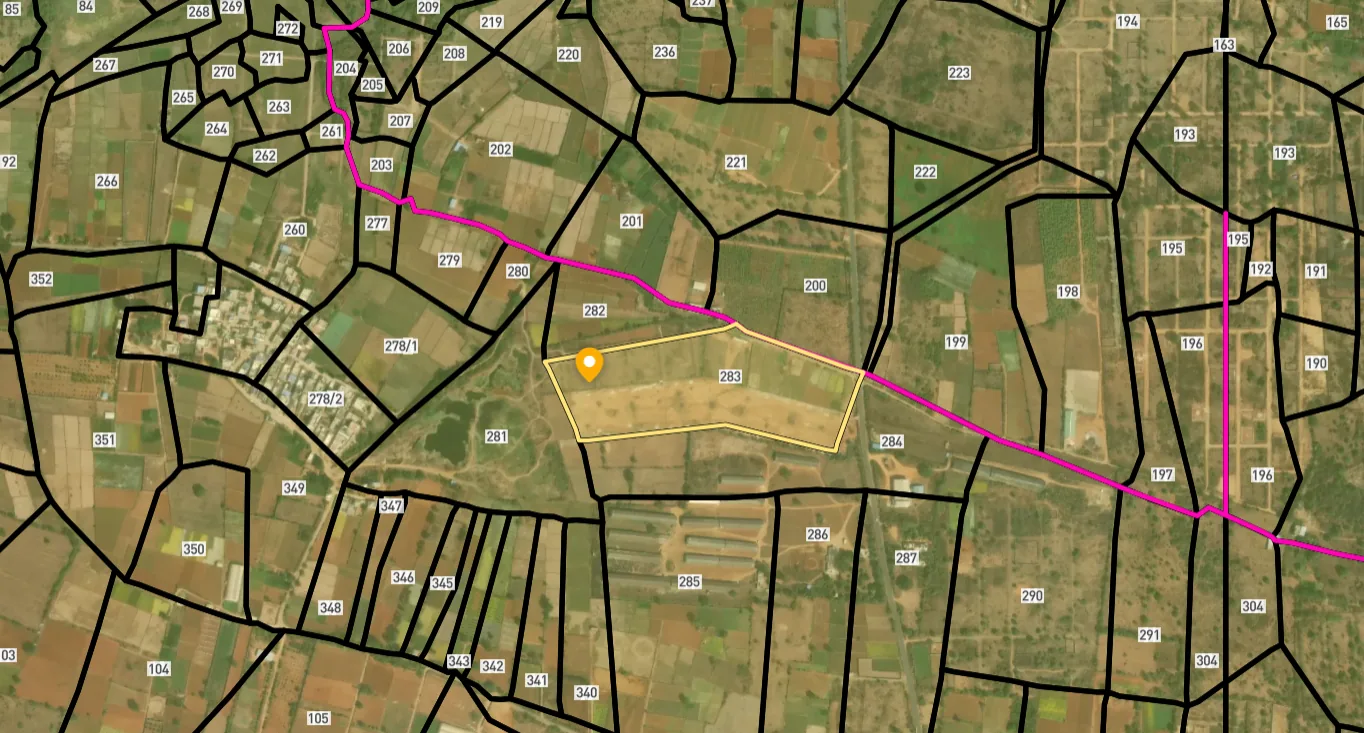
Survey Numbers View on Map Boundaries and numbers come from published state cadastral records. See all map layers.