How to Buy Land in
Assam:
Complete Property Buyer’s Guide 2026
Any Indian citizen can buy property in Assam, but the rules are unlike most other states. Tribal Belt and Block area restrictions can render a sale completely illegal, Sixth Schedule autonomous councils have their own land laws, char land and flood-prone plots carry severe risk, and land records span the Jamabandi, Patta and Dag-number systems on the Dharitree portal. This guide covers everything you must verify.
Why Buying Land in Assam is Different from the Rest of India
Assam Land & Revenue Regulation, 1886
Tribal Belt & Block Areas
Jamabandi, Patta, Dag Number
40%+ land flood-prone; Char land
Most buyers from outside Assam apply a standard Indian due diligence checklist to this state. That is a serious error. Assam has a unique combination of restrictions that can make a property transaction completely illegal and unenforceable in court - even after the deed has been registered and money paid.
The Assam Land and Revenue Regulation of 1886, its 2024 amendment, the Sixth Schedule of the Constitution, and the Tribal Belt and Block reservation system create layers of complexity that simply do not exist in most other Indian states. Layered on top is a severe physical risk: over 40% of Assam's total land is susceptible to flood damage, and char lands on river islands carry extreme erosion and ownership uncertainty.
2024 Amendment - New Restriction: Within 5 km of designated iconic structures over 250 years old, only residents with pre-1951 roots may transact. The Government has proposed further restrictions in Jania, Kalgachia, Dhing, Ruphihat, and Jamunamukh revenue circles. Verify current status before transacting in these areas.
What Types of Properties Are Safe to Buy in Assam
A property in Assam is generally safe to buy only when all five of the following conditions are true simultaneously. A single missing condition is a reason to pause, investigate, or walk away.
Properties You Should Avoid or Be Cautious About
These are the most common categories of problematic properties in Assam, regularly marketed attractively by agents. Knowing what to look for before visiting a site can save you significant time and money.
Only an agriculturist can buy agricultural land in Assam. For any non-agricultural purpose the Reclassification NOC must already exist and the premium must be paid.
Reserved exclusively for Scheduled Tribe communities. Any sale to a non-tribal without Government permission is illegal and unenforceable. You may lose both money and possession.
Karbi Anglong, Dima Hasao, and Bodoland Territorial Areas have their own land laws. Outsiders face significant restrictions. Engage a lawyer with specific council expertise.
Char lands appear and disappear with floods. Ownership histories are disputed and legally unreliable. Physical boundaries shift every season. Avoid entirely.
Over 40% of Assam is flood-susceptible. There is no formal floodplain zoning law. Verify flood history with ASDMA hazard maps before any purchase near rivers or wetlands.
A consistent pattern in Assam property fraud. Insist on at least one direct meeting with the actual owner and verify the POA is registered, not just notarised.
Full Title Check Procedure (Assam-Specific)
Assam's primary land record system uses the Jamabandi (Record of Rights), Patta (ownership document), and Dag number (unique plot identifier). All three must be cross-verified between physical documents and the Dharitree portal before any transaction.
Jamabandi (RoR)
Patta (PP / AP)
Dag Number
Mutation Records
Encumbrance Certificate
Bhunaksha / Survey Plan
Khajna Receipt
Circle Officer NOC
Patta type matters: Periodic Patta (PP) has fewer restrictions and is the most desirable for buyers. Annual Patta (AP) is issued for agricultural land and has conditions on transfer - some require Government permission before transfer is possible. Always verify the Patta type and any conditions attached before proceeding.
Land Classification and Reclassification in Assam
Agricultural land cannot be bought by non-agriculturists, and it cannot be used for non-agricultural purposes without a formal Reclassification NOC. Misrepresenting or ignoring land classification is one of the most common causes of financial loss for Assam property buyers.
Basti / Homestead - build directly
Residential Site-I or Site-II
Agricultural land WITH Reclassification NOC
Periodic Patta with no transfer conditions
Agricultural land WITHOUT Reclassification NOC
Annual Patta with Govt transfer conditions
Khas / Waste land - government-owned
Tribal-allotted land - non-tribal purchase illegal
Reclassification NOC - verify before buying agricultural land: (1) NOC already obtained by the current seller - only the Pattadar can apply, not a POA holder. (2) Premium paid: 10% of minimum zonal value for standard reclassification; 15% for reclassification-cum-transfer. (3) Purpose of reclassification matches your intended use. (4) For land above 50 bighas, approval must come from the Revenue & Disaster Management Department, not just the Deputy Commissioner.
Under the Assam Fixation of Ceiling on Land Holdings Act, 1956, the ceiling in plain districts is 49.05 acres (plus up to 9 acres for orchards). For large parcels, verify the seller's total holding does not exceed this limit.
Tribal Belt, Block Areas & Sixth Schedule - The Critical Check
This is the most critical Assam-specific restriction and the single biggest cause of invalid property transactions in the state. It is also the most commonly glossed over by sellers and agents. There is no grey area - a non-tribal purchasing tribal belt land without Government permission will not be protected by any court.
Tribal Belt and Block Areas: Any transfer of tribal-allotted land to a non-tribal is strictly prohibited without specific Government permission. Courts will not entertain claims from non-tribal buyers who transacted without permission. You may lose both money and possession. Always verify with the Circle Office whether a specific Dag/Patta falls within a tribal belt or block before any step - get this in writing.
Sixth Schedule Areas (Hill Districts):
Karbi Anglong, Dima Hasao (NC Hills), and Bodoland Territorial Area Districts are governed under the Sixth Schedule of the Constitution with their own Autonomous District Council land laws. Outsiders face significant restrictions. Do not rely on a general Assam lawyer - engage one with specific expertise in the relevant Autonomous Council's regulations.
Flood Risk, Char Land & Environmental Checks
Assam is one of India's most flood-prone states. Over 40% of its total land surface is susceptible to flood damage. Unlike coastal states, Assam has no formal floodplain zoning legislation - there are no official No Development Zone markers on flood-risk land. Buyers cannot rely on official zoning maps and must independently verify physical site risk.
Char lands are alluvial deposits in the Brahmaputra and its tributaries. They change shape every flood season. Ownership histories are unclear and legally complex. Physical boundaries are unreliable. Never buy char land without specialised local legal advice.
Check ASDMA district hazard maps at asdma.gov.in. Verify flood history with long-term local residents and the Revenue Circle Office. Avoid construction near rivers, beels (lakes), and wetlands.
Forest & Environmental checks: Verify with the District Forest Office whether the land is in a Reserved Forest, Protected Forest, or Eco-Sensitive Zone. Wetlands (beels) are protected under the Wetlands Conservation Rules - avoid construction near them. Any land near Kaziranga, Manas, or Dibru-Saikhowa National Parks requires Environmental Clearance.
Stamp Duty, Registration & Transaction Process
Under Section 17 of the Registration (Assam Amendment) Act, sale deeds, gift deeds, mortgage deeds, and partition deeds must be compulsorily registered at the Sub-Registrar's Office. Unregistered deeds are inadmissible as evidence in court.
| Transaction Type | Rate |
|---|---|
Stamp Duty - Male Buyer | 6% of registered property value |
Stamp Duty - Female Buyer | 5% of registered property value (1% concession) |
Registration Charge | 8.5% of property value (properties above ₹5 lakh) |
GMDA NOC - Guwahati only | Additional 1% of land value |
E-Stamping | Mandatory for transactions above ₹1 lakh (since Sept 2021) |
Example - ₹50 lakh property: Male buyer: Stamp ₹3L (6%) + Registration ₹4.25L (8.5%) = Total ₹7.25 lakh. Female buyer: Stamp ₹2.5L (5%) + Registration ₹4.25L (8.5%) = Total ₹6.75 lakh.
Documents required for registration: Signed Sale Deed on stamp paper · E-Stamp Certificate with UIN (SHCIL portal) · Seller's and buyer's Aadhaar / PAN / Passport · Patta and Jamabandi · NOC from Circle Officer · Site plan or trace map · Passport photos · Khajna receipt. After registration, apply for mutation on Dharitree portal - typically 30–45 days.
NRI / OCI Rules for Buying Land in Assam
Residential property
Commercial property
Basti / Homestead land
Via registered POA representative
Agricultural land
Tribal Belt or Block Area land
Sixth Schedule / Autonomous Council land
Plantation land
All NRI/OCI payments must comply with FEMA regulations and go through NRE/NRO banking channels. Documents must carry valid passport or OCI card details. Power of Attorney must be notarised or attested at an Indian Consulate and ideally registered with a Sub-Registrar in India.
Red Flags When Buying Property in Assam: Walk Away Immediately
No price discount justifies proceeding when any of these situations are present. Each represents a legal defect that cannot be fixed after purchase, or a pattern associated with fraud or a problematic title.
Assam Property Buyer Checklist: Documents to Verify Before You Buy
Verification: Government Portals & Links
You can verify most Assam land records online. You will need the District, Revenue Circle, Village name, Patta number, or Dag number - typically available on the sale deed or from the seller.
| Portal | What you get | URL |
|---|---|---|
Dharitree / ILRMS | Jamabandi (RoR), Patta, Dag number, Mutation records and status, Bhunaksha cadastral maps, NOC application and tracking, certified document copies (₹50–200 per doc) | |
IGR Assam | Stamp duty and registration rates, Sub-Registrar office locations, registered deed verification by party name or property details | |
RTPS Assam | Certified copies of Jamabandi and land documents; duplicate Patta application via Sewa Setu (₹10 fee, ready in 7 days) | |
ASDMA | District-wise flood hazard maps, historical flood data, real-time monsoon flood alerts | |
Revenue & DM Dept / DC Office | Reclassification NOC applications, tribal belt / block verification (in writing), land ceiling queries, khas land inquiries | District Collector / DC Office (district-wise) |
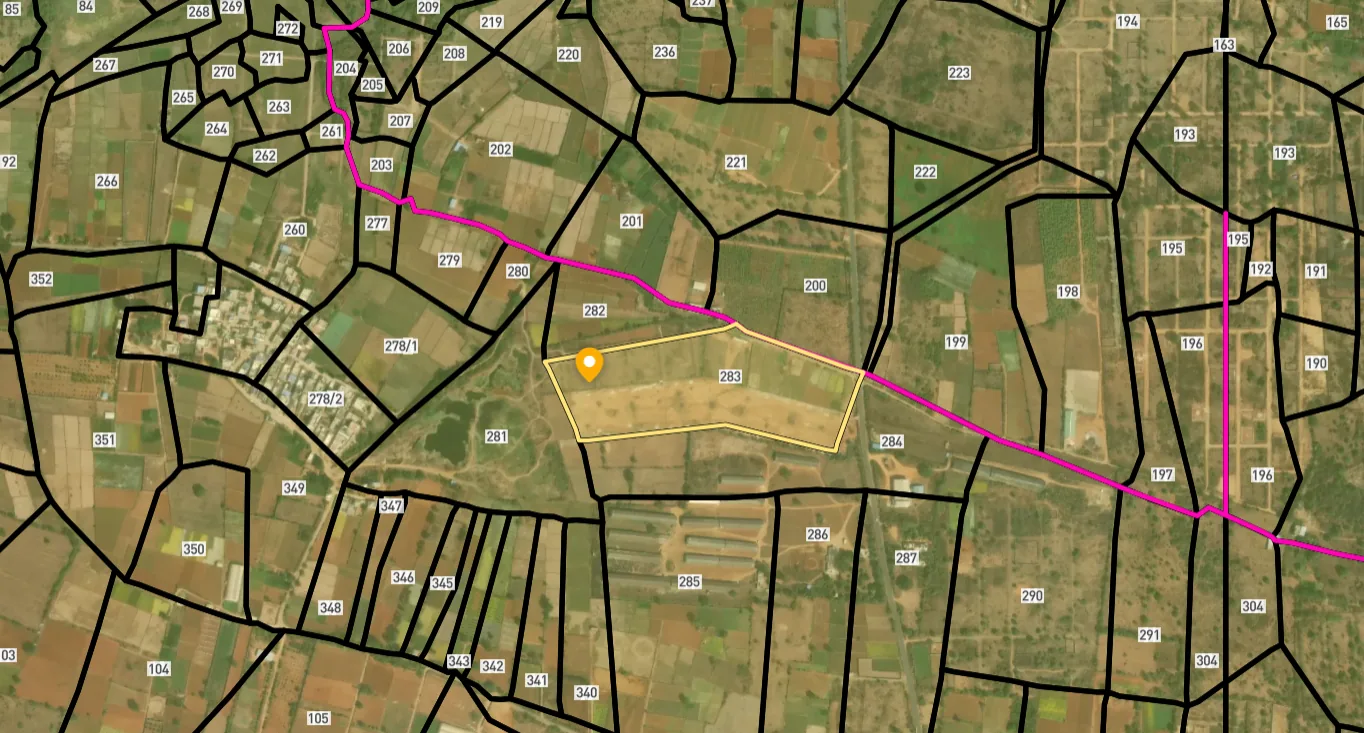
Survey Numbers View on Map Boundaries and numbers come from published state cadastral records. See all map layers.