
What is JharBhoomi?
Definition
JharBhoomi, the Revenue and Land Reforms Department portal, provides the khatiyan, Register-II, dakhil kharij and map access statewide, drilling from district through anchal to mauza. Deeds sit on the registration side, the plot map on jharbhunaksha. Because the CNT and SPT Acts govern tribal-land transfer, verify the land nature and any Deputy Commissioner permission on jharbhoomi.jharkhand.gov.in before relying on a record.Take one idea into every Jharkhand file: the record names a holder, but two laws decide whether that holder may sell. The Chotanagpur and Santhal Pargana Tenancy Acts keep large classes of tribal land out of the ordinary market, tying any transfer to the parties' category and location and, often, to the Deputy Commissioner's permission. So the opening question is not who owns the plot, but whether the plot can lawfully change hands at all.
What JharBhoomi delivers is early sight of that question. The khatiyan and Register-II open on any handset, a dakhil kharij is lodged and followed on screen, and jharbhunaksha draws the plot. Crucially, the khatiyan's rights-description field states the land nature up front, so a buyer can see whether a parcel is raiyati tribal, and therefore restricted, before a single meeting rather than after an advance has changed hands.
What the portal cannot do is prove ownership or clear a transfer. Courts hold the khatiyan neither creates nor destroys title; the registered deed governs, and it lives on the registration side. The map is drawn from old surveys, and any CNT or SPT permission is a matter for the Deputy Commissioner, not the screen. The portal finds the holder and the land nature; the deed, the DC and the ground decide the rest.
JharBhoomi: what sits where, and the CNT and SPT gate
Eight services across records, deeds, maps and transfer, all shadowed by the tribal-land question. Here is the map of it.
| You need | It lives at | The Jharkhand catch |
|---|---|---|
| Holder and land nature | JharBhoomi (khatiyan, Register-II) | Names the holder, not the title |
| Whether it can be sold | CNT and SPT, the DC office | Tribal land may be barred outright |
| Deeds and charges | Registration side, JharNibandhan | Part-manual for older years |
| Plot boundary | jharbhunaksha | Old survey lines, not re-measured |
| Mutation | Dakhil kharij, the anchal | Void tribal sale is caught here |
| Building on it | NA conversion, the SDM or DC | Tribal and forest status come first |
In practice, read the land nature on JharBhoomi, settle the CNT or SPT position with the Deputy Commissioner, search the deeds on the registration side, and take the mutation to the anchal. The screen names the holder; the DC office, the deed and the ground decide whether the land is yours to buy.
All JharBhoomi services, with a guide for each
Eight services, sorted into four families below. The P1 tag marks the reads a purchase turns on; the JharNibandhan tag marks the one service that lives on the registration side.
The record, and its limits
3 guidesThe khatiyan and how to reach it, and the attested copy that still is not proof of title.
The khatiyan and Register-II, and the rights-description field the deal turns on.
Search by nameReach a khatiyan from a holder's name, then read its land nature.
Certified copyThe attested khatiyan a bank or court accepts, still not proof of title.
Deeds and the money trail
1 guideThe registered deed chain that actually carries title, searched on the registration side.
Placing the plot
1 guideThe boundary map that locates a plot, drawn from Jharkhand's old revisional surveys.
Transfer, use and the tribal-land gate
3 guidesWhether the land can be sold, how a lawful transfer is recorded, and what the plot may become.
Getting started on the portal
Each service has a counter twin at the anchal, the registration office or the Deputy Commissioner.
What identifies a Jharkhand holding
A mauza sets the village, a khata gathers a holding, and a khesra pins one plot; a holder's name is the weak fallback, and it often lands on an earlier holder rather than the seller. Whichever key opens the entry, the rights-description field is read first, since it carries the CNT or SPT status.
| Step | Online | Offline |
|---|---|---|
| 1. Access | Sign in to JharBhoomi, pick a service | Go to the anchal in person |
| 2. Identify the parcel | Narrow to your district and mauza | Have the Circle Officer pull the record |
| 3. Use the service | Query by khata, khesra or holder | Lodge the request at the counter |
| 4. Keep evidence | Download the record and map view | Collect the stamped copy |
Two offices settle a Jharkhand deal that the screen cannot. The anchal, with its Circle Officer, orders the dakhil kharij and holds the register; the Deputy Commissioner alone can permit a tribal-land transfer under CNT or SPT. The portal finds the holder and the land nature; the DC office decides whether a sale is even allowed, and the anchal records it once it is.
Which JharBhoomi service do you need?
Start from what you need done; more than one service leads back to the land nature, because that is where a Jharkhand file begins.
| You want to | Use this service | Guide |
|---|---|---|
| See who holds it, and the land nature | The khatiyan and Register-II | Khatiyan guide |
| Reach a holding from a name | The name lookup, in a mauza | Name search guide |
| Get an attested record | A certified khatiyan copy | Certified copy guide |
| Trace the deeds and charges | The registered deed search | EC guide |
| Locate the plot boundary | Bhu Naksha Jharkhand | Bhu Naksha guide |
| Enter a purchase against your name | Dakhil kharij via the Circle Officer | Dakhil kharij guide |
| See if the plot can be built on | The NA conversion route | Land-use guide |
| Learn if it can be sold at all | The CNT and SPT position | CNT / SPT guide |
The order a careful buyer runs these in
A Jharkhand purchase runs in order: land nature read, CNT or SPT settled, holder and plot confirmed, deeds searched, land use checked, then permission and mutation.
- Read the land nature first. On the khatiyan, the rights-description field tells you whether CNT or SPT even lets the land change hands. Guide: Khatiyan guide
- Settle the CNT or SPT question. Where the land is tribal, establish the parties, the location and whether a lawful transfer is possible at all. Guide: CNT / SPT guide
- Trace the holder and place the plot. Confirm the seller against the record and locate the parcel on the survey map before you go further. Guide: Name search guide
- Search the deed chain. Cover a full thirty years on the registration side, reaching the paper registers for older years. Guide: EC guide
- Test the land use if you intend to build. Classification, tribal status and forest land together settle whether a structure is even possible. Guide: Land-use guide
- Register with permission, then mutate. On tribal land the DC's permission must precede the deed; dakhil kharij then records it in Register-II. Guide: Dakhil kharij guide
Common issues across the portal
Four snags account for most failed Jharkhand deals.
Raiyati tribal land is sold as if freely transferable. Read the rights description and settle the CNT or SPT position before any price is discussed.
A revenue entry is treated as proof of ownership. Verify the registered deed on the registration side, which governs where the two disagree.
Register-II still carries a deceased or earlier holder. Expect a succession mutation before the seller counts as the recorded holder.
Forest or agricultural land is bought to build on. Confirm forest status and obtain the NA order before you plan any structure.
JharBhoomi: rules a buyer should know
CNT or SPT land may be barred from sale. Read the land nature and settle the position before treating any plot as available.
A record neither creates nor destroys ownership. The registered deed governs, so verify it on the registration side.
A tribal-land transfer without the DC's permission is void, and registering it does not cure that. The order must come first.
Boundaries are digitised from old surveys, not re-measured. Confirm the true edge on the ground and against the khatiyan area.
Looking to sell your land in Jharkhand?
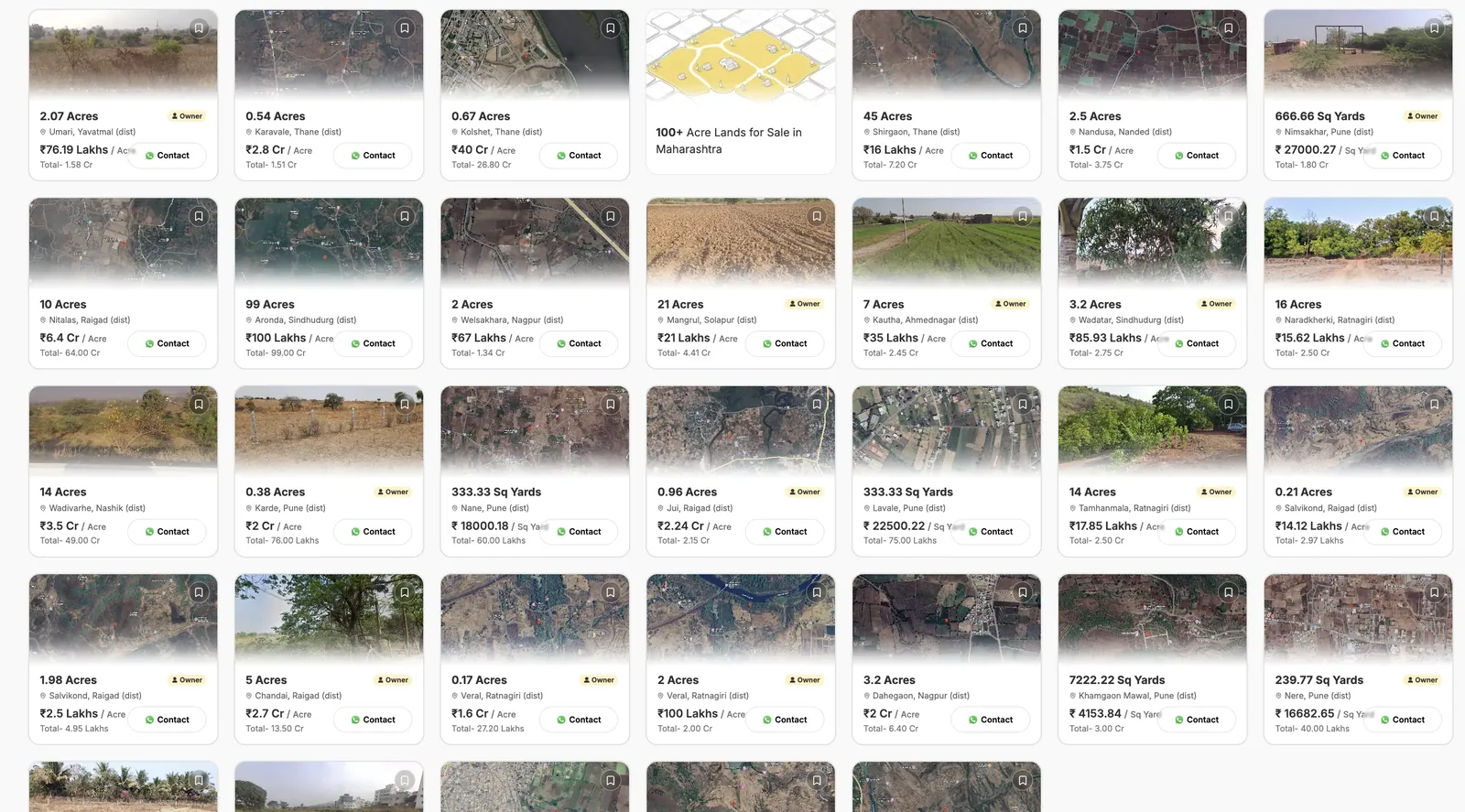
Browse 37+ verified lands & plots in Jharkhand
Frequently asked questions
What is JharBhoomi?
JharBhoomi is Jharkhand's Revenue and Land Reforms Department portal for viewing the khatiyan, Register-II, mutation status and maps, and for applying online for land services.
Does the khatiyan prove ownership?
No. Courts hold a khatiyan neither creates nor destroys ownership. Where it and the registered deed differ, the deed governs. Treat the khatiyan as a cross-reference.
What are the CNT and SPT Acts?
The Chotanagpur Tenancy Act 1908 and Santhal Pargana Tenancy Act 1949, which restrict or bar the transfer of tribal land across most of Jharkhand's tribal areas.
Can a non-tribal buy tribal land in Jharkhand?
Generally no. Ordinary tribal-land sales to non-tribals are barred, with only narrow routes such as certain industrial acquisitions through the Revenue Department, never a plain sale deed.
What is dakhil kharij?
Jharkhand's mutation: the Circle Officer updating Register-II with the buyer's name after a transfer. On tribal land it should follow the Deputy Commissioner's permission.
Where do I check deeds in Jharkhand?
On the registration side, through the registered deed search, with deeds verifiable on JharNibandhan. The process is part-manual, so older records may sit only on paper.
Is checking Jharkhand land records free?
Viewing the khatiyan, Register-II and map online costs nothing. Certified copies, deed searches and applications carry scheduled fees, so check the current charges before you rely on them.
Is the online record enough to buy on?
No. It names the holder and the land nature, not the title or the permission. Confirm the deed, the CNT or SPT position and the mutation before you commit.