
The Encumbrance Certificate on Kaveri 2.0
Bhoomi tells you about the land; Kaveri tells you about the money. Karnataka's registration system, rebuilt as Kaveri 2.0, issues the encumbrance certificate: the registered history of sales, mortgages, releases and attachments on a property across whatever window you request. It is the document a loan officer reads first, and the one buyers most often read too narrowly.
What the encumbrance certificate settles
Definition
The encumbrance certificate is the registration department's extract of registered transactions on a property for a requested period, issued in Karnataka through Kaveri 2.0. Sales, mortgages, releases, gifts and attachments appear as dated entries; anything never registered does not.
Treat the EC as a ledger of hand-offs and burdens. Read downward and the property should pass cleanly from holder to holder, each mortgage eventually answered by a release, until the final entry lands on your seller. A ledger that does that is a title chain; one that skips a link is a question.
Its blindness is as important as its sight. Hand loans against the land, pending suits, family arrangements sealed with a handshake, none of it registers, so none of it appears. Which is why Karnataka diligence pairs the EC with the RTC's liabilities column: two different nets, catching different fish.
Window selection decides everything. An EC covering five years is an alibi for five years, nothing more. Purchases warrant thirty, and older properties sometimes need the pre-digital ledgers searched manually at the sub-registrar office.
Getting the encumbrance certificate online
Minutes on Kaveri 2.0 once the property details are exact.
On Kaveri 2.0
Reading EC entries against the RTC
Each entry type has a counterpart check on the record side.
| EC entry | What it means | Cross-check on Bhoomi |
|---|---|---|
| Sale deed | A hand-off in the chain | MR entry moving the RTC the same way |
| Mortgage | A charge loaded on | RTC liabilities column entry |
| Release | A charge lifted | Liabilities column cleared |
| Gift / partition | Family transfer | RTC owner and extent adjusted |
| Attachment | Court freeze | Liabilities entry; stop until lifted |
| Nil period | No registered activity | Verify possession did not change informally |
Common Karnataka EC issues, and the fix
Four EC readings go wrong repeatedly.
Why lenders open with the encumbrance certificate
A Karnataka bank's legal scrutiny starts by laying the EC beside the RTC and walking the two histories in parallel: every registered event should have left a footprint on the record, and every record change should trace to a registered event.
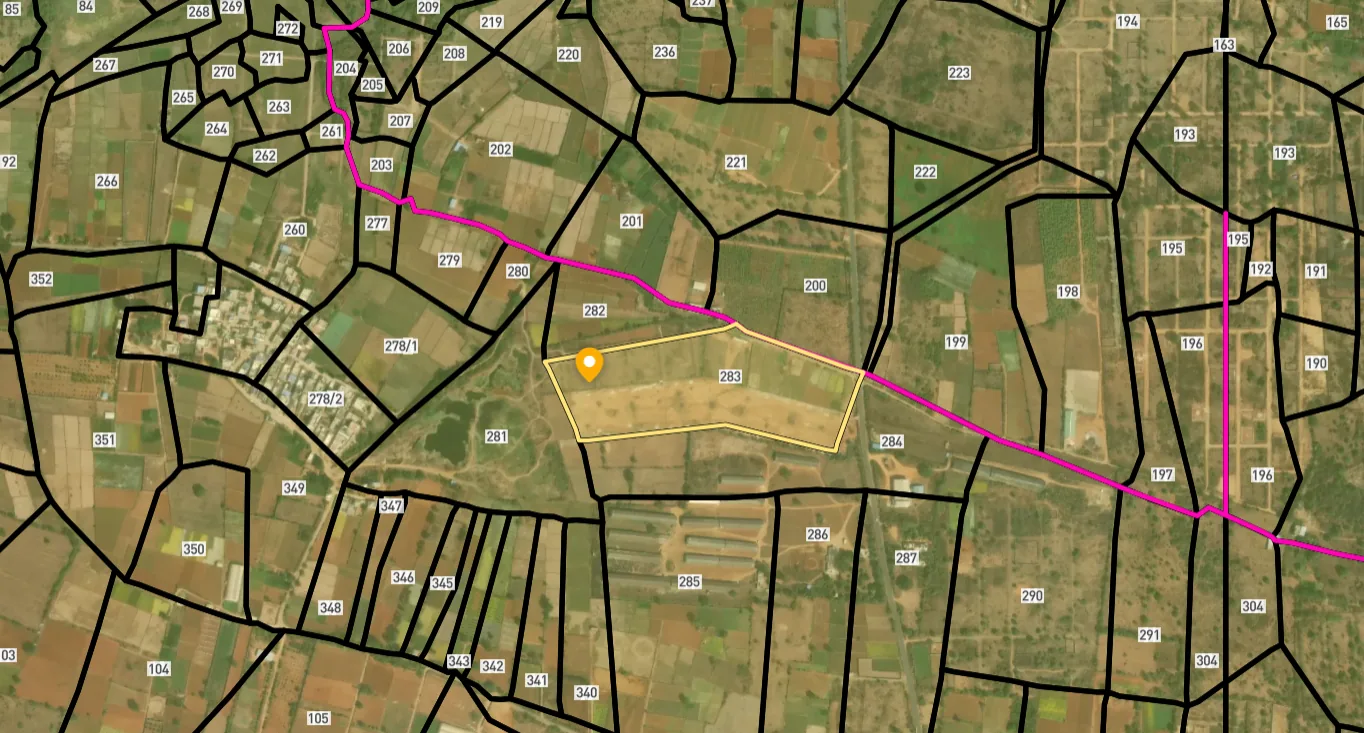
Survey Numbers View on Map Boundaries and numbers come from published state cadastral records. See all map layers.
Looking to sell your land in Karnataka?
Browse 1,300+ verified lands & plots in Karnataka
Frequently asked questions
Where do I get the EC in Karnataka?
What window should I request?
Does a nil EC mean clean title?
How does the EC relate to the RTC?
Are very old transactions on Kaveri 2.0?
What if the EC and RTC contradict?
Other Related Guides
Survey Sketch Mojini Karnataka: Complete Guide 2026
Survey Sketch Mojini Karnataka guide: understand hissa numbers, download 11E sketches on bhoomojini.karnataka.gov.in, verify plot boundaries, and avoid boundary fraud.
Read guide →Revenue Court Case Karnataka Land Buying: Complete Guide 2026
Check RCCMS Karnataka before buying land. A pending revenue court case on any survey number blocks mutation and puts your entire investment at risk. Here's how to verify.
Read guide →Gram Panchayat NOC Karnataka: Land Buying Guide 2026
Need a Gram Panchayat NOC in Karnataka? Learn what it proves, when it's mandatory for land conversion, how to apply online via e-Swathu, and how to spot a fake certificate.
Read guide →Land Use Certificate Karnataka BDA: Complete Guide 2026
Land Use Certificate Karnataka guide: check BDA zone codes under RMP 2015, verify before commercial purchase, apply for CLU online, and avoid demolition risk in Bangalore.
Read guide →Khata Extract Karnataka: Complete Guide 2026
Understand Khata Extract in Karnataka, what it proves, how to get it online via BBMP e-Aasthi, key fields, B Khata risks, and why every buyer must verify it before purchase.
Read guide →DC Conversion Karnataka: Section 95 Certificate Guide 2026
DC Conversion Karnataka guide: apply under Section 95, check status on Bhoomi, verify the conversion order, and understand what the 2025 amendment changed for buyers.
Read guide →