
Ranchi-Dhanbad Expressway
Overview
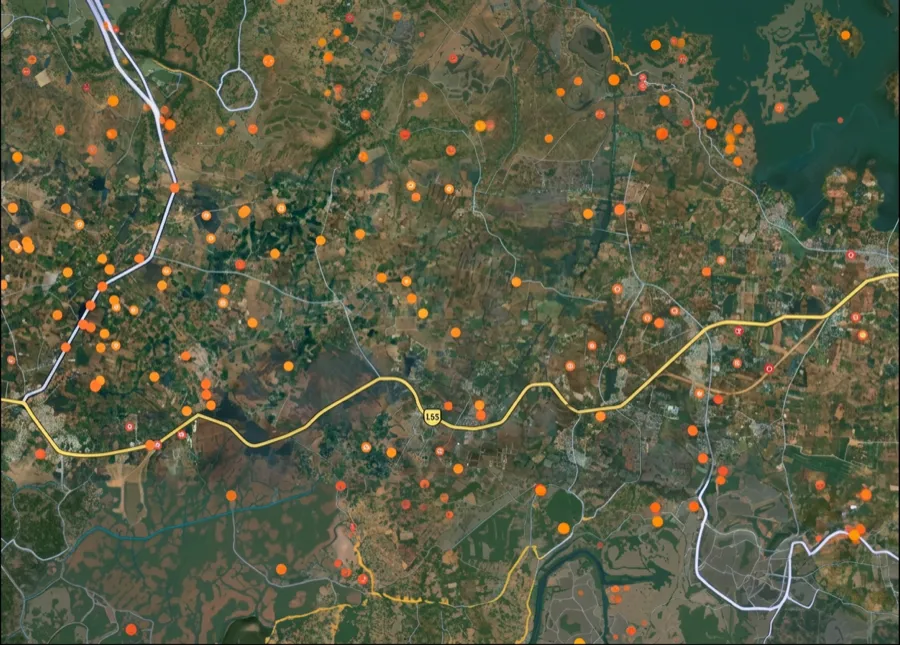
The Ranchi-Dhanbad Expressway land records question genuinely starts with understanding what this road actually is today, since the name itself covers two very different things layered on top of each other. The stretch connecting Ranchi to Dhanbad, running through Ramgarh and Bokaro, is largely built on NH-33, much of which is already a functioning four to six-lane highway carrying real daily traffic, even as its western continuation toward Raipur remains under active construction as part of a much longer national corridor still years from completion. Land here sits inside Jharkhand's own revenue system, checked through JharBhoomi rather than a Bhulekh-style portal the way most other states in this series operate, and it comes bundled with a layer of legal protection that simply does not exist across most of the rest of India: large parts of this exact route, including Ranchi, Ramgarh, and Bokaro districts, fall under a tenancy law written specifically, over a century ago, to stop tribal land from quietly passing into non-tribal hands. This layer on 1acre marks the corridor carefully, so you can genuinely check both the physical road's real progress and the land's own legal classification before buying anywhere near it.
Regulatory Red Flags Along the Ranchi-Dhanbad Corridor
Start with ownership verification itself, since this is where most buyers assume the check ends when it genuinely does not. JharBhoomi, run by Jharkhand's Department of Revenue, Registration and Land Reforms, gives free public access to the Khata, the core ownership account, and Register-II, the fuller record of rights showing ownership history alongside any encumbrances attached to the plot. Both are genuinely useful for a first pass, but a certified copy obtained from the local Circle Office is still what banks and courts actually rely on when a transaction genuinely matters. Before looking at anything else, pull the Khatian and look closely at the land classification column specifically. That single entry alone decides whether the plot is freely transferable in the ordinary sense, or whether it triggers a considerably stricter set of rules that most buyers from outside Jharkhand have simply never encountered before.
Jharkhand's tribal land protections are genuinely unusual in their strength, and this specific corridor happens to run directly through the districts where they apply most forcefully. The Chotanagpur Tenancy Act, 1908, governs North Chotanagpur, South Chotanagpur, and Palamau, a zone that includes Ranchi, Ramgarh, and Bokaro, all three sitting directly along the Ranchi-Dhanbad route itself. Section 46 of the Act forms the core rule here: land held by a Scheduled Tribe member can only be sold to another Scheduled Tribe member living within the same revenue Thana area, and even that narrow transfer still needs the Deputy Commissioner's prior written approval before it can legally proceed. Section 49 opens things slightly wider for Scheduled Caste and Other Backward Class raiyats, permitting buyers from within the same district, and it separately permits a narrower route for non-tribal buyers, but only for genuine industrial purposes, processed entirely through the Revenue Department's own sales branch rather than through an ordinary sale deed the way most transactions work elsewhere. A sale completed outside these specific conditions is not simply risky in some vague sense. It is void from the very moment it is signed, meaning the transfer never legally happened at all, regardless of what the paperwork itself claims or how many years have quietly passed since.
This is genuinely not a rule that gets quietly ignored in practice, and its real enforcement history is worth knowing. In 2010, the Jharkhand government issued a circular reaffirming that Section 46 approval was required for these transfers, then turned around and suspended that same protection within a week through a second, separate circular. The Jharkhand High Court, in Salkhan Murmu v. State of Jharkhand, struck down that suspension entirely, ruling clearly that the executive had acted beyond its own authority and against the basic rule of law. The Chotanagpur Tenancy Act sits inside the Ninth Schedule of the Indian Constitution, which places it largely beyond ordinary judicial review, and it has been amended 26 separate times since 1908, genuine evidence of how actively contested this rule remains even well over a century after it was first written into law. Section 71 of the same Act adds a further layer that buyers frequently miss entirely: even a transfer that looked perfectly clean on paper at the time can be reopened and reversed years later, if it later turns out that proper sanction was never actually obtained in the first place.
Regulatory Red Flags Along the Ranchi-Dhanbad Corridor
Land Record Term
What It Proves
Needs Separate Approval?
Blocks Registration Without It?
Commonly Misused?
Khata / Register-II
Ownership account and full record of rights
No
Yes
Older records may not be fully digitised yet
Khatian land classification
Whether a plot is tribal, SC/OBC protected, or freely transferable
Varies by classification
Yes
Sellers sometimes describe protected land as ordinary
CNT Act Section 46 sanction
DC approval for a tribal-to-tribal transfer
Yes, Deputy Commissioner
Yes, transfer is void without it
Frequently skipped, especially in older deals
CNT Act Section 49 route
Non-tribal purchase for industrial purpose only
Yes, Revenue Department sales branch
Yes
Sometimes used to disguise an ordinary residential sale
Jharnibandhan registration
Records the transaction itself
No
Records but does not verify legal transferability
A registered deed does not confirm the underlying sale was valid
Land Record Term
What It Proves
Needs Separate Approval?
Blocks Registration Without It?
Commonly Misused?
Khata / Register-II
Ownership account and full record of rights
No
Yes
Older records may not be fully digitised yet
Khatian land classification
Whether a plot is tribal, SC/OBC protected, or freely transferable
Varies by classification
Yes
Sellers sometimes describe protected land as ordinary
CNT Act Section 46 sanction
DC approval for a tribal-to-tribal transfer
Yes, Deputy Commissioner
Yes, transfer is void without it
Frequently skipped, especially in older deals
CNT Act Section 49 route
Non-tribal purchase for industrial purpose only
Yes, Revenue Department sales branch
Yes
Sometimes used to disguise an ordinary residential sale
Jharnibandhan registration
Records the transaction itself
No
Records but does not verify legal transferability
A registered deed does not confirm the underlying sale was valid
That last point genuinely deserves repeating clearly, since it is exactly where buyers get caught out along this corridor: Jharnibandhan, the state's registration portal, simply records that a transaction happened, it does not confirm the land was legally transferable in the first place. A buyer who registers a sale on a Khatian that was never properly cleared under CNT or SPT rules ends up holding a stamped, officially registered document and, quite genuinely, no actual title to the land at all. The deed chain, meaning who sold to whom and under exactly what approval going back at least thirty years, is what genuinely protects a buyer along this route, not simply the registration date sitting on a certificate.
Growth Corridors Along the Ranchi-Dhanbad Route
The road itself genuinely tells a story of two entirely different projects layered on top of one another, and separating them matters considerably for anyone weighing land value here today. What functions today as the Ranchi-Dhanbad connection runs largely along NH-33, already widened to four and, in several stretches, six lanes, with the Ranchi Ring Road feeding directly into it at the Ranchi end of the corridor. Specific segments have already seen recent, genuinely targeted upgrades: a 14-kilometre stretch of the old NH-33 through Ramgarh is currently being converted into a four-lane superhighway at a cost of roughly 277 crore rupees, running parallel to a newer bypass built specifically to avoid demolishing existing commercial buildings along the historic route. This is a corridor being actively maintained and genuinely improved right now, not one still waiting years for its first shovel to hit the ground somewhere.
Layered on top of that already-functioning road sits a considerably larger ambition: the Raipur-Ranchi-Dhanbad Expressway, a full 707-kilometre corridor connecting all the way back to Chhattisgarh's own capital as part of the wider Raipur-Dhanbad Economic Corridor. This is explicitly a genuinely mixed project, converting the existing brownfield stretch near Raipur into a six-lane road while building the entire Bilaspur-to-Dhanbad section as new, greenfield construction from scratch. Work has been progressing in distinct stages since 2021, with different contractors awarded separate packages along the route, the Bilaspur-Urga stretch already under active construction and the Urga-Pathalgaon section following closely behind it, with full commissioning currently targeted for the final quarter of 2026. In other words, the Ranchi-Dhanbad end of this much larger corridor is genuinely live and usable today, while the far western Chhattisgarh stretch remains under construction, being built out piece by piece over the coming years.
Growth Corridors Along the Ranchi-Dhanbad Route
Location
Growth Driver
Known Consideration
Ranchi Ring Road and NH-33 approach
Already operational, feeds directly into the Ranchi-Dhanbad stretch
CNT Act applies to any tribal-classified land nearby
Ramgarh
Active 14 km four-lane conversion project, parallel bypass built
Section 46 DC sanction needed for any tribal land purchase
Bokaro Steel City
Established industrial anchor along the corridor
Part of the CNT Act's core coverage area
Dhanbad (eastern terminus)
Coal belt industrial base, connects to the wider EC-07 corridor
Confirm which stretch of the larger 707 km project is actually complete near any specific plot
Location
Growth Driver
Known Consideration
Ranchi Ring Road and NH-33 approach
Already operational, feeds directly into the Ranchi-Dhanbad stretch
CNT Act applies to any tribal-classified land nearby
Ramgarh
Active 14 km four-lane conversion project, parallel bypass built
Section 46 DC sanction needed for any tribal land purchase
Bokaro Steel City
Established industrial anchor along the corridor
Part of the CNT Act's core coverage area
Dhanbad (eastern terminus)
Coal belt industrial base, connects to the wider EC-07 corridor
Confirm which stretch of the larger 707 km project is actually complete near any specific plot
The genuinely practical lesson here is to separate clearly what already works today from what is still coming years down the road. The Ranchi-Dhanbad stretch itself is a mature, actively upgraded road right now, which is exactly why demand along it is real and grounded rather than purely speculative. The much broader promise, of an unbroken expressway running all the way to Raipur, remains genuinely years from completion further west, and treating that larger headline project as already delivering value to a specific plot near Dhanbad today would be getting meaningfully ahead of the actual facts on the ground. Whatever the road's own status happens to be at any given moment, the land classification question stays entirely constant regardless: confirm the Khatian, confirm whether Section 46 or Section 49 genuinely applies, and never simply assume that a registered deed alone proves clean title anywhere along this particular corridor.
Was this layer helpful?
Anything wrong, outdated, or missing we want to hear it.
For Land Owners & Agents
Looking to sell your land in Jharkhand?
I want to sell my land in Jharkhand
10:32
Plz share your Land's location - We will list it on 1acre map, for Free.
10:32

For Land Buyers
Browse all verified lands & plots in Jharkhand
Every listing goes through our Preliminary Verification Process.