How to Buy Land in
Tamil Nadu:
Complete Property Buyer's Guide 2026
Tamil Nadu carries India's highest combined property transaction cost: 7% stamp duty with no concession for any buyer category, and 4% registration with no ceiling cap, totalling 11% of the full property value. The state is fully open to all Indian citizens, with active markets from Chennai through Coimbatore and Madurai. But that 11% must be the first number in any purchase budget, and it applies equally to every buyer without exception.
Why Buying Land in Tamil Nadu Costs More Than Most States
Tamil Nadu is one of India's most developed states and a major industrial and IT corridor stretching from Chennai through Coimbatore, Madurai, Trichy, and the entire eastern seaboard. It is fully open to all Indian citizens. Major markets include Chennai, Coimbatore, Madurai, Tiruchirappalli, Salem, Vellore, Erode, Tirupur, Hosur, Thanjavur, and Tirunelveli.
The single most important financial fact for any Tamil Nadu buyer is this: Tamil Nadu has the highest combined property transaction cost of all 36 states and Union Territories in India. There is no female concession anywhere in the state. The registration fee has no upper ceiling. Budget the full 11% before any negotiation begins.
Yes. Any Indian citizen. No domicile restriction. 38 districts.
7% for ALL buyers - no gender concession, no category exception
4% - no upper ceiling cap. Applied to the full property value.
11% of the full property value. Highest in India.
11% combined - the highest of any state in India. Tamil Nadu charges 7% stamp duty with no concession for women, joint buyers, or any other buyer category, plus 4% registration with no ceiling cap. On a Rs 50 lakh property, the government takes Rs 5.5 lakh. On a Rs 1 crore property, Rs 11 lakh. On a Rs 2 crore property, Rs 22 lakh. This is not negotiable, not reduceable by structure, and not an estimate - it is the baseline. Plan the full acquisition cost accordingly before committing to any transaction.
What Types of Properties Are Safe to Buy in Tamil Nadu
A Tamil Nadu property is safe when the Patta stands in the seller's name, the Chitta confirms the land classification, the FMB Sketch matches the physical site boundaries, and the EC from TNREGINET shows no encumbrances.
Patta transfer after registration is mandatory - do not skip this step. After the sale deed is registered at the Sub-Registrar office, the buyer must separately apply for a Patta Transfer at the relevant Taluk office. Until the Patta is transferred, the official revenue records still show the previous owner. This is a separate process from registration and carries its own fees and timeline.
Types of Property to Avoid in Tamil Nadu
These are the most commonly problematic property types in Tamil Nadu. Knowing them before visiting sites will save significant time and money.
Nanjai land is classified as agricultural wetland and used for paddy cultivation. Converting it for residential or commercial use requires a conversion order from the Revenue Department. Without it, construction is illegal and the land is subject to restoration orders.
The Tamil Nadu coastline from Chennai through Rameswaram, Kanyakumari, and up the western side falls under CRZ notifications. CRZ-I areas cannot be developed. CRZ-II and III have restrictions. Always obtain the current CRZ status certificate before any coastal or beach-adjacent purchase.
Chennai Metro Development Authority approval is mandatory for layouts within Chennai's metropolitan planning area. Outside Chennai, DTCP approval is required. An unapproved layout may have roads and utilities but no legal building permission.
Tamil Nadu has an extensive heritage landscape. Properties near protected monuments have construction buffers. Proximity to major temple complexes in cities like Madurai, Tanjavur, and Chidambaram can create planning restrictions.
The Western Ghats districts - Nilgiris, Coimbatore, Dindigul, Tirunelveli - have significant forest and eco-sensitive zone land adjacent to agricultural parcels. Verify forest proximity and ESZ status before any purchase near forest boundaries.
Tamil Nadu's guideline values are generally set conservatively. A transaction price significantly below the guideline value almost always signals either a title problem or an attempt to suppress the declared value for stamp purposes. Stamp duty is on the guideline value regardless.
Tamil Nadu Land Records: Patta, Chitta, FMB, and TNREGINET
Tamil Nadu operates two separate systems for land verification. Revenue records - Patta, Chitta, FMB, and A-Register - are maintained by the Revenue Department and accessible via eServices TN. Registration records, EC, and guideline values are on TNREGINET.
Primary ownership document. Patta number, owner name, survey number, area, land type. Access: eservices.tn.gov.in.
Land classification record: Nanjai (wet), Punjai (dry), or settlement. Must match Patta.
Field Measurement Book - official plot boundary map. Critical for physical site boundary verification.
More detailed rural land ownership register. Contains additional information beyond the Patta. Available from Taluk office.
The TNREGINET portal (tnreginet.gov.in) is used for EC search, guideline value lookup, e-stamp payment, SRO appointment booking, and registered deed search. The Sub-Registrar office conducts the actual deed registration. Post-registration, the Patta Transfer application goes to the Taluk office separately.
Verification sequence: (1) Patta on eServices TN - seller as owner, survey number, land type confirmed. (2) Chitta - classification confirmed. (3) FMB Sketch - boundaries match site. (4) TNREGINET EC - 30 years minimum, no mortgage. (5) Guideline value confirmed. (6) Calculate 7% + 4% on higher of guideline or value. (7) TNREGINET e-stamp and SRO appointment. (8) SRO visit with all parties and witnesses. (9) Patta Transfer application at Taluk post-registration.
Stamp Duty and Registration Charges in Tamil Nadu
Tamil Nadu offers no concession on stamp duty for any buyer category. The 7% applies equally to male, female, joint, senior citizen, and first-time buyers. The 4% registration fee also has no ceiling.
| Category | Stamp Duty | Registration Fee | Total Cost |
|---|---|---|---|
All buyers (male/female/joint) | 7% on higher of guideline value or actual transaction value. No concession for any buyer category whatsoever. | 4% - no Rs 25,000 ceiling cap anywhere in TN | 11% |
Gift deed to blood relative | 1% for residential property | 1% | ~2% |
Settlement deed within family | 1% | 1% | ~2% |
For income tax purposes, the stamp duty and registration paid on a property purchase are deductible under Section 80C up to the overall limit of Rs 1.5 lakh. TDS of 1% applies on transactions above Rs 50 lakh - the buyer deducts and deposits with the Income Tax department. Form 26QB and TDS certificate (Form 16B) must be obtained.
Chennai-Specific Checks: CMDA, DTCP, and OC
Chennai and its metropolitan region have an additional layer of approvals that buyers must verify. The Chennai Metropolitan Development Authority (CMDA) governs planning permissions within the Chennai Metropolitan Area. DTCP governs areas outside.
Red Flags When Buying Property in Tamil Nadu: Walk Away Immediately
Each situation below represents either a title defect or a seller behaviour pattern that experienced Tamil Nadu buyers associate with problematic transactions.
Tamil Nadu Land Buyer Checklist: Documents to Verify Before You Buy
Verification: Government Portals & Links
You can verify most Tamil Nadu land records online. For revenue records you need the district, taluk, village, and survey subdivision number. For registration you need the same plus the Sub-Registrar Office code.
| Portal | What you get | URL |
|---|---|---|
eServices TN | Patta, Chitta, FMB Sketch, A-Register search. | |
TNREGINET | EC, guideline value, e-stamp, SRO appointment, registered deed search. | |
TNRERA | Builder project registration, OC status, complaints. | |
CMDA Chennai | Layout approvals, building plan sanctions, OC for Chennai Metro area. | |
DTCP Tamil Nadu | Town and Country Planning approvals outside Chennai. |
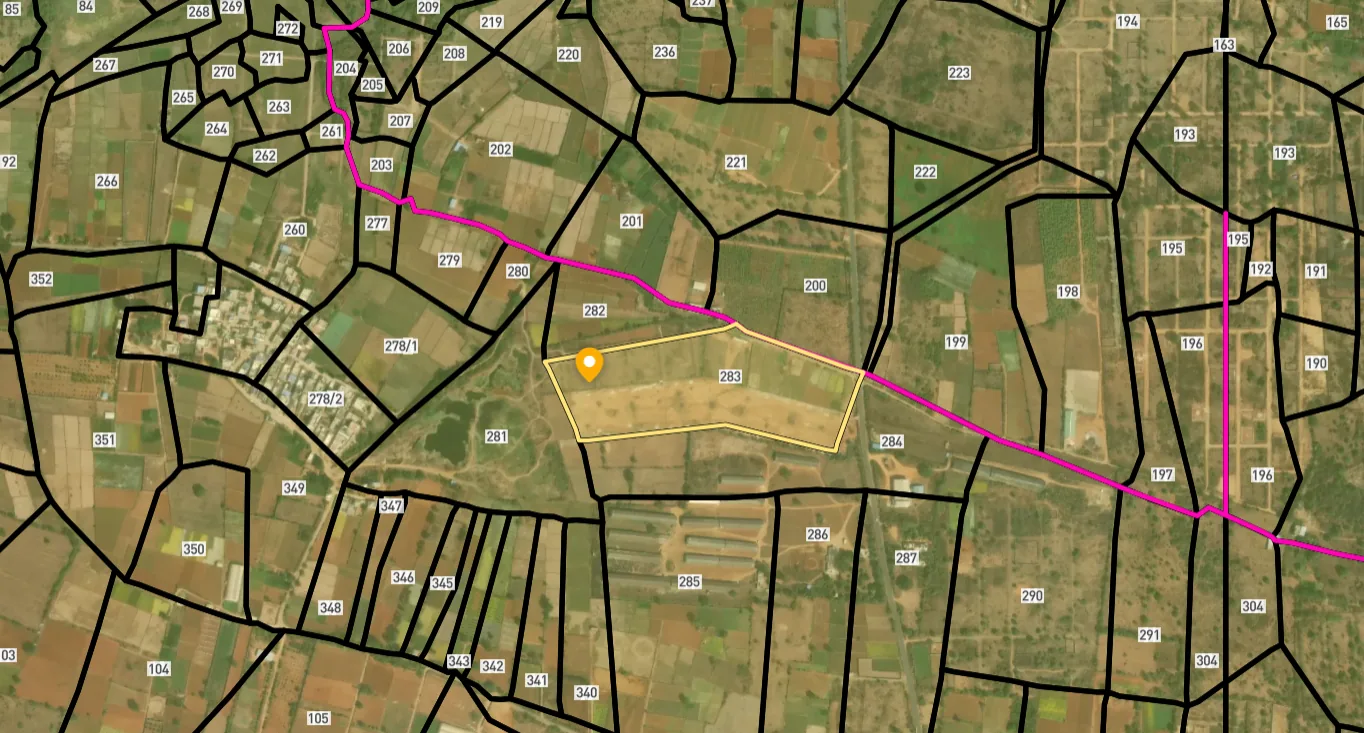
Survey Numbers View on Map Boundaries and numbers come from published state cadastral records. See all map layers.