
TSLR Extract Telangana: Town Survey Land Register Guide
The TSLR extract is a certified copy of a property's entry in the Town Survey Land Register. Here is what it shows and how to request one through MeeSeva.
A TSLR extract is the certified copy of an entry in the Town Survey Land Register, the government's survey record for land inside urban and municipal survey limits in Telangana. In Telangana, you obtain it through MeeSeva. It matters more than most buyers realise, because the State itself uses TSLR entries as evidence of what land it owns.

- TSLR covers property inside town survey limits, not agricultural land in revenue villages
- Certified copies are requested through MeeSeva
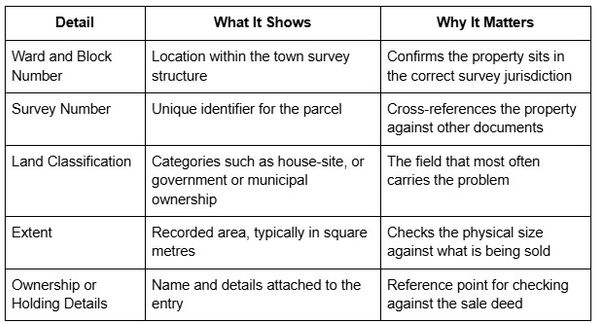
- The extract shows ward, block, survey number, classification, and extent
- A classification entry showing government land is a serious red flag
- Telangana's survey system dates to 1875 and has since been through a statewide re-survey
- The TSLR needs reading alongside the EC, the RoR, and the Section 22A check
What Is a TSLR Extract
A TSLR extract is a certified copy of an entry from the Town Survey Land Register, the official record maintained for land within urban or municipal survey limits in Telangana. It records the survey number, classification, and extent for a specific property.
If your property sits inside a city or town survey zone rather than a revenue village, the TSLR, not the rural Pahani, holds your land's official survey history. It is issued as a certified extract, signed off by the relevant authority, and can be produced as evidence of what the register records.
That last point deserves emphasis. It is evidence of what the register says, which is not the same as evidence that the register is right about you.
TSLR vs Other Telangana Land Records
Telangana runs two parallel tracks, and knowing which governs your property saves a great deal of confusion.
The Record of Rights and Pahani cover agricultural and rural land, tracking ownership, cultivation, and revenue for parcels recorded in rural surveys. Those now sit on the Bhu Bharati portal, which replaced Dharani in 2025. TSLR covers land inside town survey limits, focusing on survey numbers, blocks, and urban classification. Urban and non-agricultural transactions run through the IGRS registration portal.
A property normally falls under one system or the other, depending on whether it sits inside a designated town survey area or a revenue village. Converted land is the exception, and it needs to be checked. The Telangana land buying guide sets out the two verification tracks in full.
Two other records appear alongside TSLR in disputes. Sethwar is the original settlement register from Telangana's early survey operations. RSR, the Re-Survey and Re-settlement Register, records the results of later re-survey work. Both are referenced in court matters together with TSLR when a parcel's history is contested.
History of Survey and Land Records in Telangana
Telangana's formal survey system traces to 1875, when the Survey and Land Records Department was established. Survey work under what was known as the Bombay System assigned each field a number called a Teepan and produced village maps and foundational records for every revenue village.
These records were built to settle boundary disputes between landholders and between villages, and they remain the base layer under everything digitised since. It is also why older TSLR entries can reference decades-old data, and why a mismatch against newer records needs resolving rather than ignoring.
Why the State Undertook a Fresh Re-Survey
Telangana has carried out a large-scale re-survey aimed at cleaning up and digitising ownership records. Officials reported finding parcels where ownership was unclear, whether through pending court disputes, boundary conflicts, competing claims or missing records. The state described the exercise as a purification process intended to produce a verified record for every holding.
For a buyer, the useful takeaway is not the reform itself but what it implies: a meaningful number of urban parcels carry unresolved history, and the TSLR is one of the places where history surfaces.
What Information Does a TSLR Extract Contain
Read the classification field first, not last. It is where a government or municipal ownership entry appears, and that entry changes the nature of the transaction entirely.
How to Obtain a TSLR Extract in Telangana
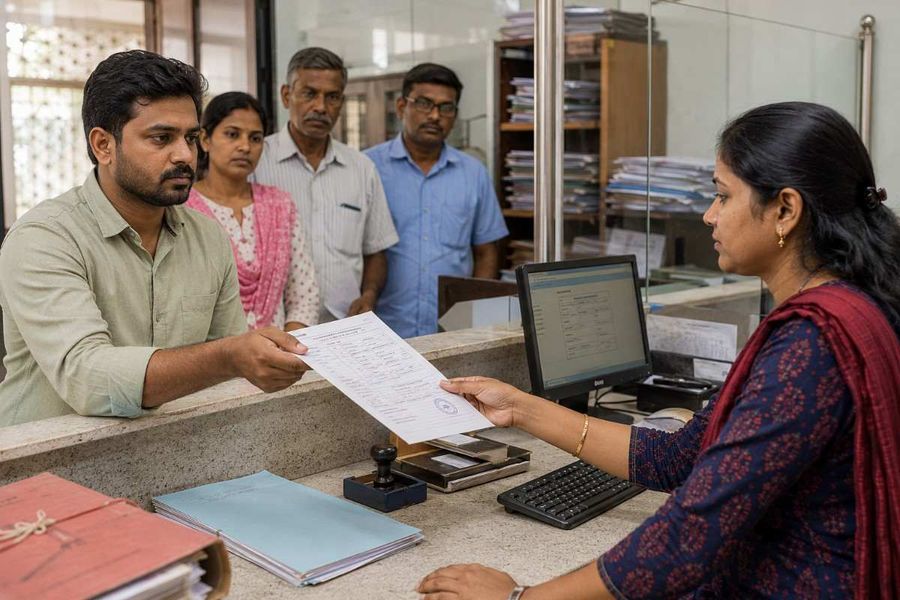
Certified copies are requested through MeeSeva, Telangana's citizen services network, which hosts the Certified Copies of the TSLR application form.
Gather the property details: location, ward, block, and survey number
Visit a MeeSeva centre or use the online service and select the Certified Copies of TSLR application
Submit the application with the property identification details and the applicable fee
Collect the certified copy once the municipal or revenue authority has processed it
The certified copy reflects the current entry in the register and carries the issuing authority's certification, which informal copies and photographs of old register pages do not.
If you do not have the survey number to start with, you can locate a parcel boundary from the map and work backwards, though coverage is stronger for agricultural and peri-urban land than for parcels deep inside municipal limits.
Why the TSLR Extract Matters in Property Transactions
Telangana High Court records show the State claiming ownership of land on the basis of entries in the Town Survey Land Register, in some matters relying on extracts going back to the early 1980s. Related records such as the Re-Survey and Re-settlement Register are cited alongside it.
So the TSLR is not merely supporting paperwork for your claim. It can be the government's evidence against it. If the register classifies a parcel as government or municipal land, a seller's deed, possession, and tax receipts do not resolve that. It has to be dealt with directly before money moves.
Run the Section 22A prohibited property check on the IGRS portal at the same time. Section 22A covers government, endowment, wakf, and forest land, which cannot be legally registered. A parcel flagged there and a parcel showing government classification on the TSLR are two views of the same problem.
Common Issues to Watch For
Survey number mismatches between the TSLR, the sale deed, and the encumbrance certificate, particularly on older properties. Resolve before proceeding, not after.
Outdated extracts that miss recent mutations or corrections. Confirm you are holding the current certified copy rather than an archived one.
Wrong system entirely. Using TSLR for a parcel under rural survey jurisdiction, or the reverse, wastes time and leaves a real gap in verification.
Classification entries treated as formalities. A government or municipal classification is a finding, not a technicality.
Reading the TSLR alone. It records surveys and classifications. It does not record transfers. The Telangana encumbrance certificate guide covers the transaction history side, including the 1983 digital record limit and why a Nil EC is not automatically good news.
Reading the Survey Record Against the Ground
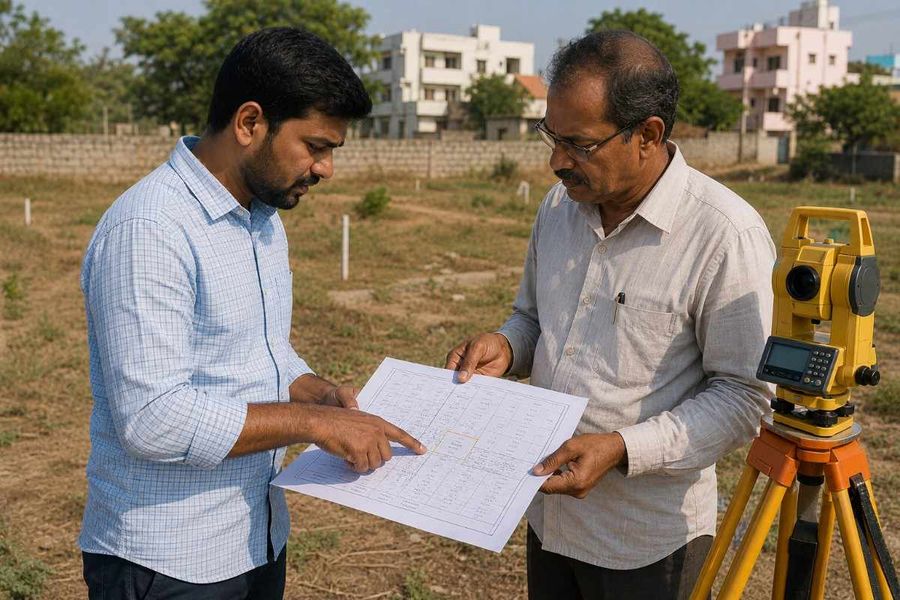
A TSLR entry describes a parcel as the register has it. Whether that description matches the land you were shown is a separate question, and in urban Telangana the two diverge more often than buyers expect, because parcels have been subdivided, encroached and re-surveyed across a century of records.
1acre maintains Telangana guides covering the urban and agricultural verification tracks, the encumbrance certificate, and the building plan approval process that a classification entry can block outright. Reading the survey record alongside the transaction history is what turns two partial views into one usable picture.
The honest limits. Mapped survey-number layers draw on revenue records and cover agricultural and peri-urban land better than dense municipal areas, which is precisely where TSLR applies. And no map view or private platform substitutes for the certified extract from MeeSeva. That is the document that carries weight.
Conclusion
A TSLR extract is narrow in scope but heavy in consequence. It covers property inside town and municipal survey limits; it comes from MeeSeva, and it sits alongside the RoR, the encumbrance certificate, and the Section 22A check rather than replacing any of them.
Confirm first whether your property falls under town survey or rural jurisdiction, since that decides which record governs. Pull the certified extract rather than working from an old copy. Read the classification field before anything else. Match the survey number across the TSLR, the deed, and the EC. And if the register shows government or municipal classification, treat that as the finding it is, and resolve it before any advance changes hands.


-900x600.jpg)
-900x600.jpg)
-900x600.jpg)