
Land vs Plot vs Apartment: Appreciation and Risk Compared (India 2026)
Before you put money into property in India, it helps to be clear that "real estate" is not one decision. Raw land, a sanctioned plot and an apartment are three different assets doing three different jobs, and the one that is right for you depends on whether you want growth, flexibility or a monthly cheque. This guide compares all three on appreciation, income, risk and tax, so you can match the asset to your goal instead of chasing a headline return.
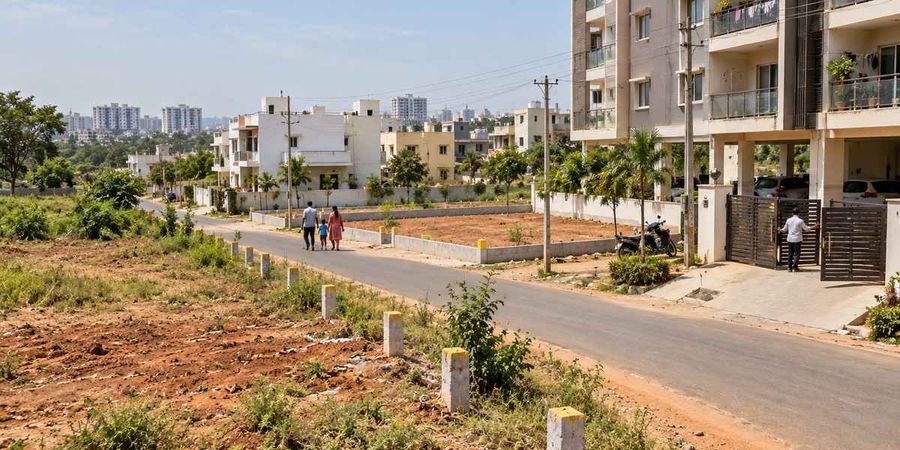
- Raw land, sanctioned plots and apartments do different jobs: growth, flexibility and income.
- Plots and land can appreciate faster in the right corridor, but the numbers are less reliable and more variable.
- Apartments give rent and easier resale, but rent after costs is smaller than it looks.
- The main risks are title and approvals for land and plots, and delivery and ageing for apartments.
- Tax is similar across all three, but the exemptions differ.
- Choose by goal and holding period, not by headline returns.
Land, plot and apartment: what you are comparing
In the land vs plot vs apartment debate, the three assets are not interchangeable. Raw land is unlicensed or agricultural parcels, a plot is a demarcated lot in an approved layout, and an apartment is a built unit with a share of the land beneath it.
You are mostly choosing between land value and building value. Land is the part that tends to grow. The building is the part that ages.
Appreciation: land appreciation vs flat
Land appreciation vs flat comes down to location and timing. In growth corridors, land and plots have more upside, while apartments grow more steadily.
What the apartment data shows
For apartments, there is solid data. ANAROCK's study of 11 cities from 2019 to Q2 2026 found prices in Bengaluru and Hyderabad up around 90%, with rental yields up about 100 basis points. Noida and Gurugram led on price growth at 125% and 117%, while Delhi grew 47%.
Ninety percent over roughly seven and a half years works out to about 9% a year compounded. That is a useful benchmark when weighing land vs flat investment. You can see what land in these same markets looks like on 1acre for Hyderabad and Bengaluru.
Why plot return figures need caution
Plot data is patchier. One 2026 plotted-development report says plots in well-connected growth corridors have outperformed a broader residential average of 6 to 8%, with premium gated communities in southern metros reaching 25 to 30% annualised in selected corridors. A Bengaluru guide cites 12 to 18% for villa plots against 8 to 12% for apartments, while noting that plot appreciation is more variable and depends on infrastructure delivery.
These are developer and portal figures, not audited indices, and "selected corridors" means the winners. Treat them as a ceiling, not an expectation. The plot vs apartment appreciation gap is real in some corridors, but it is not guaranteed.
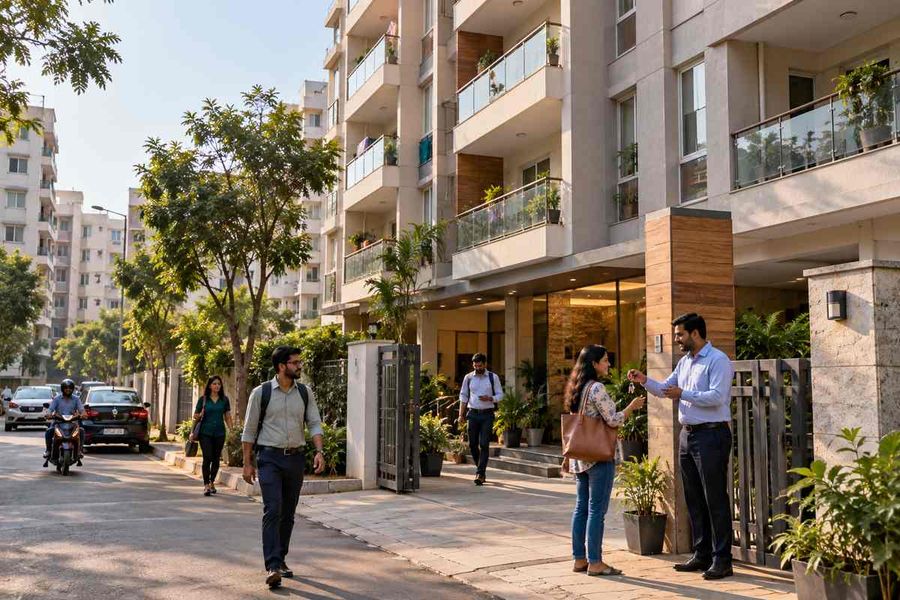
Income and running costs: where apartments catch up
Apartments earn rent, while plots and raw land usually do not. That changes the maths for land vs flat investment.
Headline yield also overstates what you keep. For a ₹1.5 crore property renting at ₹50,000 a month, the gross yield is 4%. After roughly 30% in maintenance, tax, vacancy and repairs, it falls to about 2.8%.
A simple illustration: if an apartment appreciates 6% a year and nets 2.5% in rent, its total return is about 8.5%. A plot earns no rent, so it needs to appreciate around 8.5% a year just to match, before counting holding costs. In short, total return is appreciation plus net rent, not appreciation alone.
Risk compared
Each asset has a different main risk, and that is often more useful to know than the return figure.
Land vs plot vs apartment at a glance
Factor
Raw land
Plot
Apartment
Appreciation potential
Rental income
Entry cost
Liquidity
Regulation
Main risk
Highest in growth corridors, most variable
Minimal (agricultural use at best)
Often lowest per sq yd on the outskirts
Lowest
Raw land with no development is generally outside RERA
Title, zoning, land-use restrictions
High in approved layouts near infrastructure
None until built
Mid
Moderate
RERA applies to layouts over 500 sq m or more than 8 plots
Approvals, access, layout legality
Moderate, steadier
Yes, but net yield is modest
Highest per sq ft in prime areas
Highest
RERA applies to projects over 500 sq m or more than 8 units
Delivery delays, ageing, redevelopment
On RERA, projects above 500 sq m or with more than eight units generally need registration, while raw land sold without any development is usually outside it. That means a raw land buyer carries more of the legal checking.
For plots and land, verify title, zoning, layout sanction and an encumbrance certificate before paying. For apartments, check the RERA registration and the developer's delivery record. Structure matters too: a flat's building ages, and after a few decades the value sits increasingly in the land share, whereas a plot has no building to depreciate and no income either.
Tax: what changes your actual return
The tax rules are similar across all three, which makes the exemptions the real difference. Since Budget 2024, long-term gains on land and buildings are taxed at 12.5% without indexation for transfers on or after 23 July 2024.
Capital gains tax on property, quick view
Situation
Rate
Note
Land or building sold on or after 23 July 2024
Resident individual / HUF, property acquired before 23 July 2024
Reinvesting gains
Rural agricultural land
12.5% without indexation
Lower of 12.5% (no indexation) or 20% (with indexation)
Exemption possible
Generally outside capital gains
Default rule
Option available
Sections 54, 54F, 54EC, 54B cited in guides
Different rules apply near towns
Section 54 relates to reinvesting in residential property, while Section 54F covers sales of other assets, such as land, when the proceeds go into a residential house. Section numbers may have been renumbered under the Income-tax Act, 2025, so confirm the current references with a chartered accountant.
Which is the best real estate investment in India for you?
There is no single best real estate investment in India. It depends on what you need. Each option suits different priorities, depending on your budget, investment horizon and risk tolerance.
You want rent and easy resale: an apartment in a job-driven micro-market suits you best.
You can hold 7 to 10 years and tolerate variability: a sanctioned plot near confirmed infrastructure fits.
You want the highest upside and can do legal checks: raw land in a corridor can work, but it needs expert due diligence.
You need liquidity: apartments generally sell fastest.
Whatever you pick, the micro-market matters more than the label. A weak location in any category underperforms.
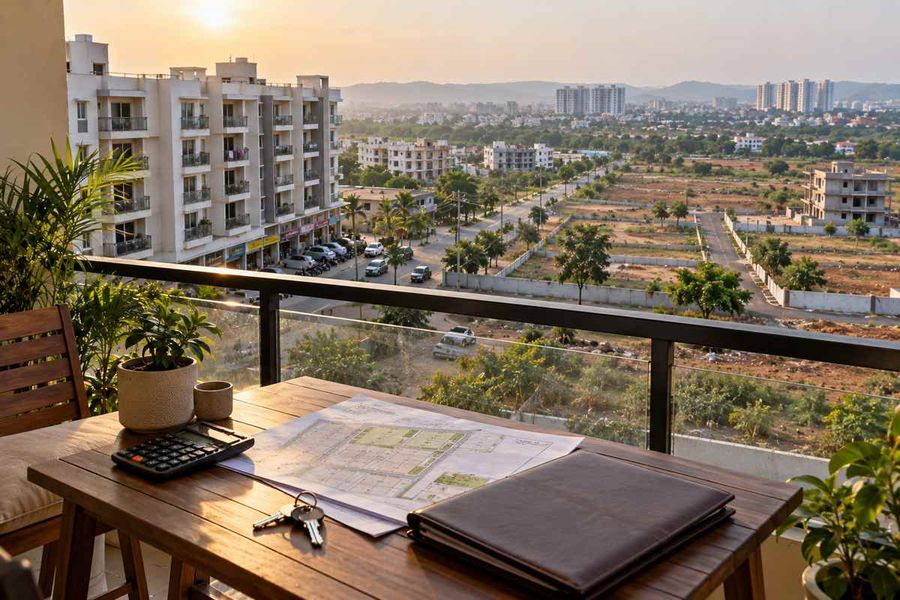
How 1acre helps with the land and plot decision
If your comparison lands on raw land or a sanctioned plot, that is exactly the side 1acre is built for. It is a land and plot marketplace, not an apartment portal, so it goes deep where apartment sites do not.
See the land, not just a price. You can look up a survey number and view the parcel on satellite with master plan and road layers, which is how you judge whether a corridor's appreciation story is real. Start on the 1acre map.
Verified listings across growth corridors. Every parcel goes through a preliminary verification process, so you compare real land. Browse Telangana or Karnataka, the southern markets where plot appreciation claims cluster.
Guides for the legal checks land demands. The guide to buying land in India walks through title, zoning, layout approval and encumbrance, which is precisely the due diligence that separates a good plot from a bad one.
For the apartment leg of your decision, you will still want a project-and-developer platform; 1acre's value is on the land and plot side.
Conclusion
The three assets reward different goals, and the label matters far less than location and legal clarity. Decide first whether you need rent, growth or liquidity, then compare on total return, meaning appreciation plus net rent rather than appreciation alone. For plots and land, verify title, zoning, layout approval and an encumbrance certificate before you pay. For apartments, check RERA registration and the developer's track record. Run the tax maths, exemptions included, with a chartered accountant, and plan to hold for at least five years in any category.


-900x600.jpg)
-900x600.jpg)
-900x600.jpg)
-900x600.jpg)