
The Encumbrance Certificate in Andhra Pradesh
Andhra Pradesh keeps land truth in two ledgers. Revenue holds the who-and-where; registration holds the money. The encumbrance certificate is the registration ledger's testimony, every deed, mortgage and release recorded against the property across the window you request, issued through IGRS AP. Learning to request the right window and read the chain is the skill.
What the encumbrance certificate testifies to
Definition
An encumbrance certificate is the registration department's extract of registered dealings on a property for a stated period: transfers, mortgages, releases, gifts, attachments. In Andhra Pradesh it issues through IGRS AP, the registration portal, and covers only what reached a sub-registrar's book.
Read it as a chain, not a list. Each entry hands the property forward or loads a charge onto it, and a sound title is a chain with no missing links and no unclosed charges: every transfer connecting to the next, every mortgage answered by a release.
Its silences are structural. Money lent against the land without registration, suits pending in court, possession quietly held by a third party, none of this reaches the certificate. That is why the EC and the revenue records are read as a pair, never as substitutes.
The window you request decides what you see. Registration history predating your window simply does not print, and AP's older entries may predate digitisation, needing a manual sub-registrar search to complete the chain.
Requesting the encumbrance certificate on IGRS AP
Minutes online. A prior deed's document number gives the cleanest pull.
On IGRS AP
Anatomy of an EC entry
Each row carries the same skeleton. Here is how to dissect one.
| Part of the entry | What it records | Buyer's question |
|---|---|---|
| Document no & year | The registered instrument | Can I pull this deed if needed? |
| Nature of deed | Sale, mortgage, gift, release, lien | Does this load or lift a burden? |
| Parties | Executant and claimant | Do these link the chain correctly? |
| Schedule | The property description | Is this truly my parcel, not a neighbour? |
| Consideration / amount | Value or loan figure | Does an open mortgage remain unreleased? |
Common encumbrance certificate issues in AP, and the fix
The certificate misleads the unwary in four ways.
Reading the encumbrance certificate like a financier
Loan officers do not read ECs hopefully; they read them adversarially, hunting the unreleased mortgage and the unlinked transfer.
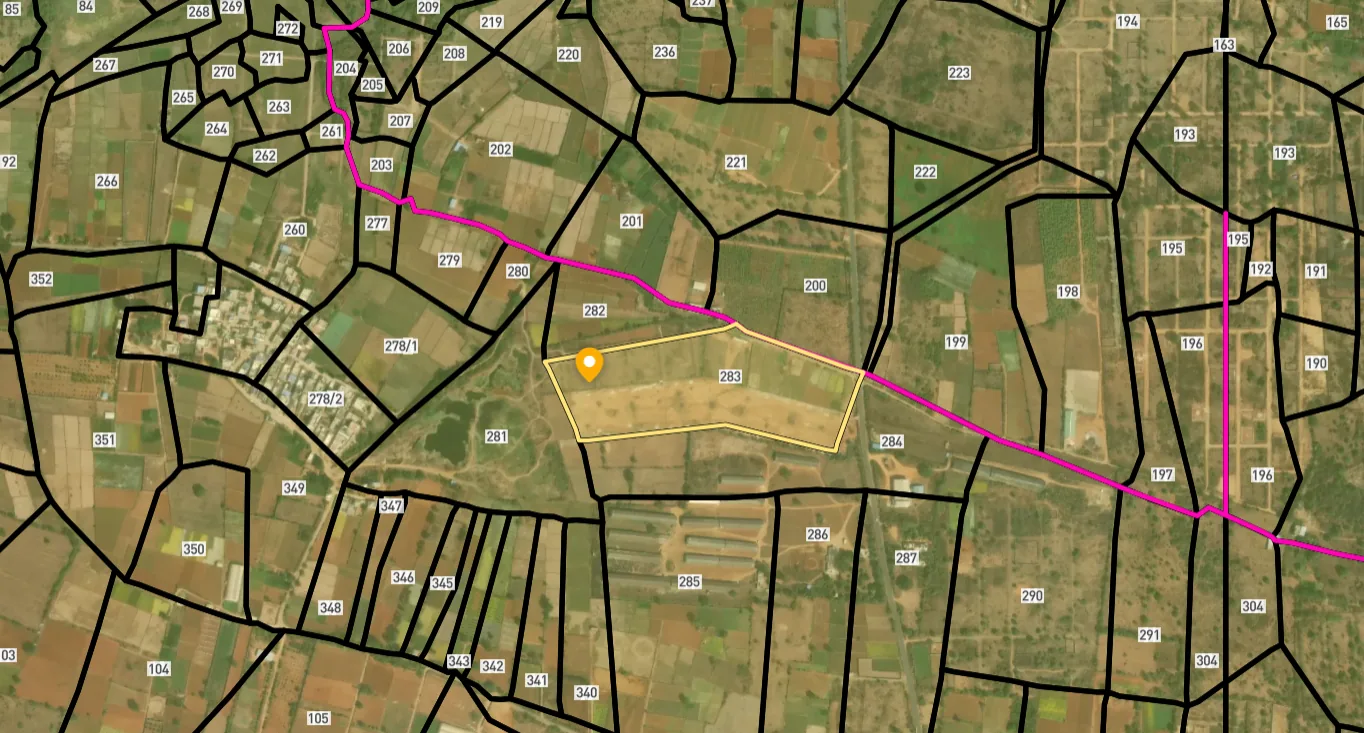
Survey Numbers View on Map Boundaries and numbers come from published state cadastral records. See all map layers.
Looking to sell your land in Andhra Pradesh?
Browse 1,300+ verified lands & plots in Andhra Pradesh
Frequently asked questions
Where does the AP encumbrance certificate come from?
What search window should I request?
The certificate is blank. Am I safe?
Which search key should I use?
Do very old transactions appear online?
Lender rejected my EC. Why?
Other Related Guides
Mutation Andhra Pradesh Land Records: Complete Guide 2026
How mutation Andhra Pradesh land records works, why buyers must verify within 90 days, how auto mutation updates 1B, and what to do when mutation is pending or rejected.
Read guide →Land Conversion NA Order Andhra Pradesh: 2026 Guide
How to get land conversion NA Order in Andhra Pradesh, OTC tax rates, what documents are needed, and why building without conversion brings a 50% penalty and demolition.
Read guide →Deed Mother Deed Andhra Pradesh: 2026 Guide
Understand Title Deed and Mother Deed in Andhra Pradesh, how to verify the 30-year chain on IGRS AP, and why a missing link costs you the deal.
Read guide →Meebhoomi
Every AP land record service in one place, with a guide for each.
Read guide →Pahani ROR 1B Andhra Pradesh: Complete Guide 2026
Check Pahani ROR 1B Andhra Pradesh free on Meebhoomi. Learn what it contains, why it must match the Pattadar Passbook, and how to fix errors before buying land.
Read guide →Adangal Andhra Pradesh Land Records: 2026 Guide
Check Adangal Andhra Pradesh free on Meebhoomi. Learn what wet, dry and waste classification means, how it affects your purchase, and how to spot land use problems.
Read guide →