
The AP e-Passbook: One Holder, Every Parcel
Records answer parcel questions; the e-Passbook answers holder questions. Assembled from the same database that feeds the Adangal, keyed by Aadhaar, it lays a farmer's entire portfolio, every survey number, extent and class under the khata, into a single view. Lenders read it for exposure; buyers read it for honesty.
What the e-Passbook assembles
Definition
The e-Passbook is Meebhoomi's holder-level composition: all parcels registered under one khata, presented as a single Aadhaar-linked document with survey numbers, extents and classifications. It composes from the live records database, so it inherits both the database's truth and its gaps.
Its native audience is the farm economy. Crop loan desks price exposure off the consolidated extent; scheme eligibility reads acreage from it; a season's paperwork that once meant a folder of extracts now means one pull.
Its second audience is anyone doing diligence on a person rather than a parcel. A seller's e-Passbook, shown live, either corroborates the portfolio they described or quietly enlarges it, and undisclosed parcels, particularly assigned ones, reshape the risk conversation.
Its dependency is linkage. Parcels reach the view through Aadhaar eKYC, so an incomplete linkage produces an incomplete portfolio. Absence from the passbook therefore means unlinked-or-unowned, and telling those apart takes a direct record search.
Pulling and reading the e-Passbook
Free for linked holders; revealing for everyone else in the deal.
Holder's method
Closing the gaps
Reading the portfolio like a lender
What each element of the view signals.
| Element | Signal | Follow-up |
|---|---|---|
| Parcel count | Breadth of holdings | Compare with the story told |
| Total extent | Exposure / eligibility base | Cross-check key parcels' records |
| Class mix | Wet-dry composition | Water rights and value texture |
| Khata consistency | One holder, one account | Multiple khatas need explaining |
| Absent parcels | Linkage gap or non-ownership | Direct record search settles which |
Common e-Passbook issues, and the fix
Four situations complicate passbook reading.
Making the portfolio view work for you
Owners: treat linkage as maintenance.
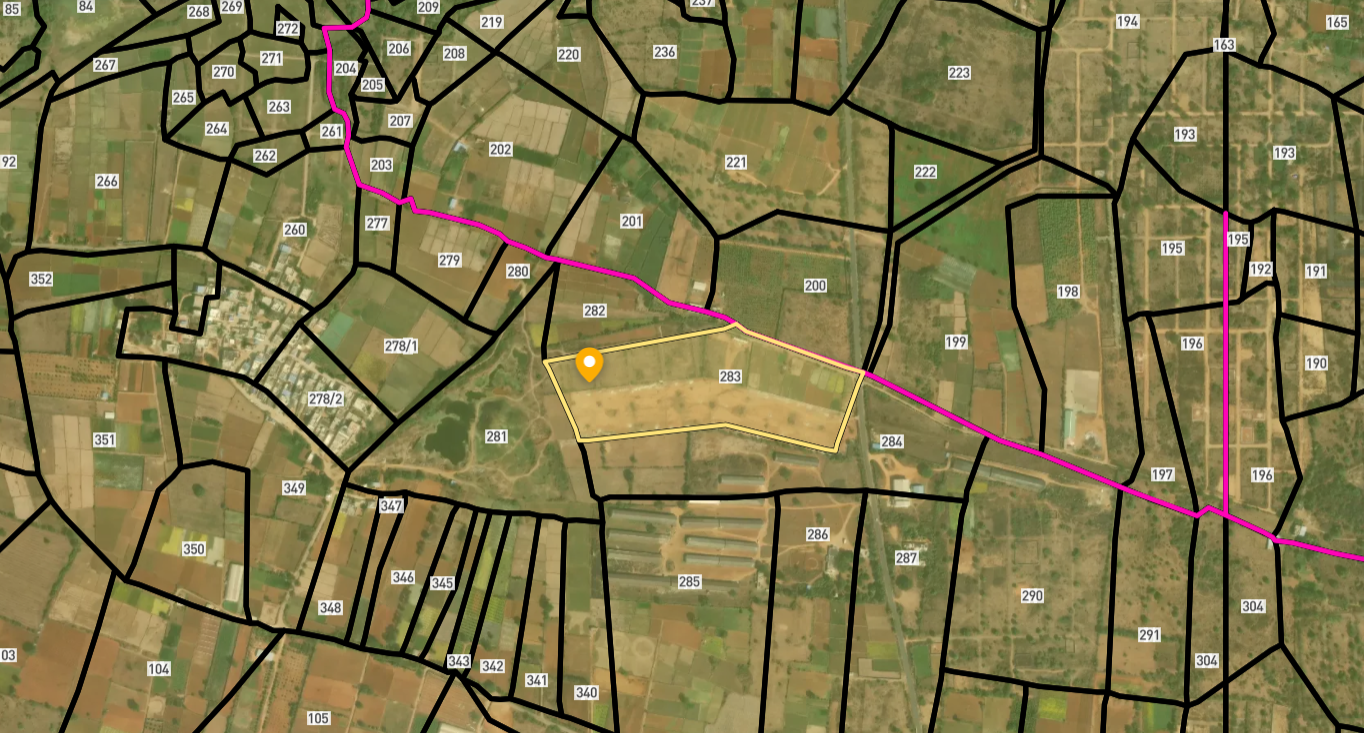
Survey Numbers View on Map Boundaries and numbers come from published state cadastral records. See all map layers.
Looking to sell your land in Andhra Pradesh?
Browse 1,300+ verified lands & plots in Andhra Pradesh
Frequently asked questions
What is the AP e-Passbook exactly?
How do I open mine?
A parcel of mine is missing. Lost?
Can the passbook itself be corrected?
Why would a buyer ask to see it?
Does it replace the physical passbook?
Other Related Guides
Meebhoomi
Every AP land record service in one place, with a guide for each.
Read guide →Pahani ROR 1B Andhra Pradesh: Complete Guide 2026
Check Pahani ROR 1B Andhra Pradesh free on Meebhoomi. Learn what it contains, why it must match the Pattadar Passbook, and how to fix errors before buying land.
Read guide →Adangal Andhra Pradesh Land Records: 2026 Guide
Check Adangal Andhra Pradesh free on Meebhoomi. Learn what wet, dry and waste classification means, how it affects your purchase, and how to spot land use problems.
Read guide →Pattadar Passbook Andhra Pradesh: Complete Guide 2026
What Pattadar Passbook Andhra Pradesh contains, why banks need it for agri loans, how to download it on Meebhoomi, and why transfer after purchase is mandatory.
Read guide →Deed Mother Deed Andhra Pradesh: 2026 Guide
Understand Title Deed and Mother Deed in Andhra Pradesh, how to verify the 30-year chain on IGRS AP, and why a missing link costs you the deal.
Read guide →Mutation Andhra Pradesh Land Records: Complete Guide 2026
How mutation Andhra Pradesh land records works, why buyers must verify within 90 days, how auto mutation updates 1B, and what to do when mutation is pending or rejected.
Read guide →