
Adverse Possession: Claims, Proof and Prevention
Adverse possession can turn hostile occupation of private land into an ownership claim, so owners should inspect and buyers should check occupation history.

- Adverse possession lets someone acquire legal ownership of private land after 12 years of open, hostile, and uninterrupted possession under Article 65 of the Limitation Act, 1963.
- Courts require proof of hostile, visible, exclusive, and continuous possession, mere occupation without these elements does not establish property rights.
- Tenants generally cannot succeed with an adverse possession claim while paying rent, since that occupation stays permissive.
- Government land follows a longer 30-year period under Article 112, and courts have grown increasingly skeptical of such claims against the state.
- The Supreme Court's 2019 ruling in Ravinder Kaur Grewal confirmed that a perfected adverse possession claim can be used to actively assert land ownership, not just as a defence.
What Adverse Possession Is
Adverse possession is a legal doctrine under which a person occupying someone else's immovable property without permission, for a set statutory period, can acquire legal ownership of it. Under Indian law, Article 65 of the Limitation Act, 1963 sets that period at 12 years for private property, and Section 27 of the same Act extinguishes the original owner's right to recover the property once that period lapses without action.
Buyers and owners often confuse adverse possession with simple long-term occupation, but the two are not the same thing. Mere presence on land, however long it continues, does not by itself create property rights. What separates a valid claim is whether the possession was genuinely hostile to the true owner's title, not permissive, casual, or based on any understanding with the owner. This is also distinct from a regular title dispute, since adverse possession does not rely on any document of transfer at all, it relies entirely on conduct over time.
What an Adverse Possession Claim Must Show
Courts look for specific, provable conduct before accepting that possession has ripened into ownership. A valid claim generally needs to demonstrate:
Hostile possession: occupation that directly contradicts the true owner's title rather than existing with their consent.
Open and visible possession: conduct that isn't concealed, so the owner reasonably could have known about it.
Continuous possession: uninterrupted occupation for the full statutory period, without gaps or voluntary surrender.
Exclusive possession: the claimant alone controlling the land, not sharing it with the true owner or others.
Ownership-like conduct: acts such as erecting structures, fencing the land, or leasing it out, which is the kind of conduct courts look for, not quiet, unremarkable use.
Why Adverse Possession Matters for Land Ownership
Adverse possession becomes relevant at very different points depending on whether someone is an owner trying to protect land or a buyer trying to assess risk before purchase.
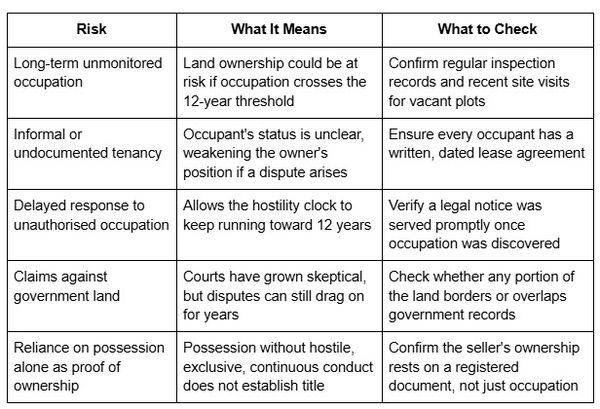
Pre-purchase: buyers should check whether any part of a plot is under long-term occupation by someone other than the seller, since that history can affect land ownership later.
During ownership: owners of vacant or infrequently visited land face the highest exposure, since claims depend on the true owner being unaware or inactive.
Post-dispute: once litigation starts, the burden of proving every element of adverse possession falls squarely on the person making the claim.
How Adverse Possession and Prevention Work
A claim of adverse possession does not activate automatically. The clock starts running from the point possession genuinely turns hostile to the true owner, a distinction the Supreme Court clarified in Neelam Gupta v. Rajendra Kumar Gupta, and not from whenever the owner's own title first arose. If 12 years pass on private property without the owner taking legal action, the claimant may approach a court to seek a declaration of ownership, and following the 2019 Ravinder Kaur Grewal ruling, this can be pursued as an affirmative claim rather than only raised as a defence.
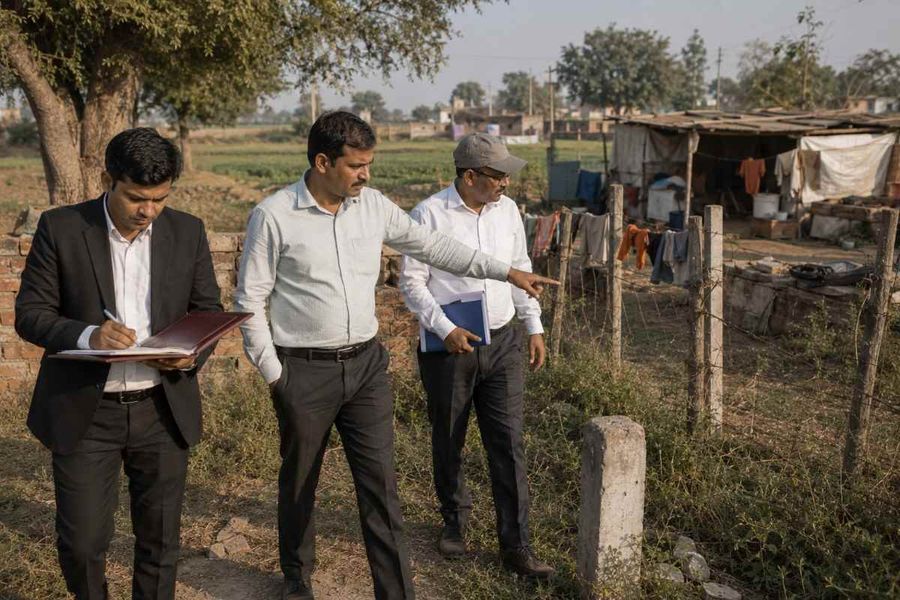
Preventing a claim from maturing works in the opposite direction. Owners should physically inspect vacant or infrequently visited land on a regular basis, since unawareness is what allows adverse possession to take hold. Any occupant should be under a written, dated lease agreement rather than an informal arrangement. The moment unauthorised occupation is discovered, a formal legal notice followed by a timely eviction suit interrupts possession and resets the limitation clock.
Where a genuine claim does proceed, it typically takes years of litigation to establish in court, since courts require detailed documentary and conduct-based evidence. Prevention, by contrast, generally costs an owner only the price of periodic inspection, a lease agreement, and legal notice fees.
Regulatory Red Flags
Adverse Possession vs a Regular Title Suit
A regular title suit relies on documentary proof of land ownership, while an adverse possession claim substitutes years of hostile, visible conduct for that paper trail. Buyers assessing a specific plot should treat any sign of long-term third-party occupation as a reason to dig deeper, not a reason to assume it is harmless.
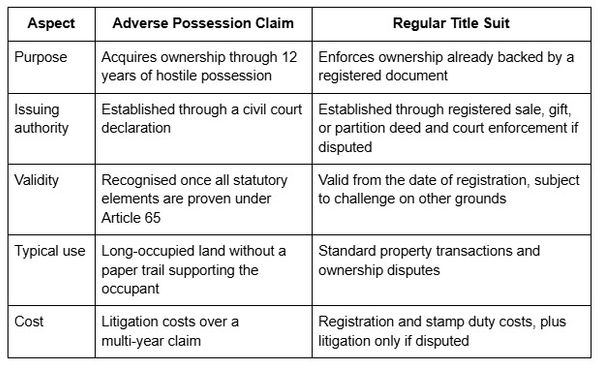
Is an Adverse Possession Claim Reliable or Valid

How 1acre.in Supports Adverse Possession Risk Checks
Assessing whether a plot carries hidden adverse possession risk requires checking occupation history alongside ownership records, and that gap is where buyers often get caught off guard.
Verified Listings: 1acre.in surfaces listings with pre-checked ownership and occupation history, flagging where long-term third-party possession could affect land ownership.
Document and Compliance Guidance: The platform helps buyers understand what documentation supports a seller's title and identifies gaps that could point to an unresolved possession dispute.
Expert and Advisory Support: buyers get guidance on site inspection practices, lease documentation, and next steps if a plot shows signs of unauthorised long-term occupation.
Confirm the seller's land ownership rests on a registered document, not occupation alone.
Check whether any part of the plot has been under long-term third-party occupation.
Ask for records of periodic site inspection if the land was vacant for extended periods.
Verify any past occupant had a written lease agreement, not an informal arrangement.
Confirm no unresolved adverse possession dispute or eviction case is pending on the property.
Consult a property lawyer if occupation history on the plot looks unclear or undocumented.
Conclusion
Adverse possession remains a real risk for owners who leave land unmonitored for years, but it is far from automatic, courts demand proof of hostile, open, and continuous conduct before recognising it. Buyers who check occupation history alongside title documents, and owners who inspect and act promptly, rarely need to worry about this doctrine affecting their property rights.
-900x600.jpg)
-900x600.jpg)
-900x600.jpg)
-900x600.jpg)
-900x600.jpg)