
Gift Deed for Property: What It Is and How It Works
Understanding the Legal, Financial, and Tax Implications of Property Gifting

- A gift deed transfers property immediately and without payment, which sets it apart from both a sale deed and a will.
- The gift deed process is only complete once the deed is registered at the Sub-Registrar's office under Section 123 of the Transfer of Property Act.
- Stamp duty applies to every gift deed, though most states charge a sharply reduced rate for transfers between close relatives.
- Tax on a gift deed has two parts: income tax turns mainly on the relationship between donor and donee, while stamp duty is charged on the value of the property.
- An unregistered gift deed for immovable property carries no legal weight at all, it is void rather than merely weak.
What a Gift Deed Is
A gift deed is the legal document used to transfer ownership of property from one person to another voluntarily, with no money or consideration involved. It falls under Section 122 of the Transfer of Property Act, 1882, and takes effect as soon as it is executed and accepted, not at some later date.
Buyers and family members often mix this up with two related documents. A will only takes effect after the person who wrote it passes away, while a gift deed transfers the property immediately during the donor's lifetime. A sale deed, on the other hand, involves money changing hands as part of a commercial transaction, whereas a gift deed by definition excludes any consideration. Getting this distinction right matters because it changes which tax provisions and registration rules actually apply.
What a Gift Deed Covers
A properly drafted gift deed should record specific details clearly, since gaps here are a common source of later disputes. It typically includes:
Donor and donee details: full names, addresses, and relationship between the two parties.
Property description: survey number, boundaries, and area as reflected in revenue records.
Consideration clause: an explicit statement that the transfer is voluntary and without payment.
Acceptance clause: confirmation that the donee has accepted the gift, which the Transfer of Property Act requires for validity.
Stamp duty details: the value on which stamp duty has been calculated and paid.
Witness attestation: signatures of at least two witnesses, a requirement under Section 123.
Why the Gift Deed Process Cannot Be Skipped
Registration is not a formality that can be deferred or substituted with informal possession. Section 123 of the Transfer of Property Act requires a gift of immovable property to be made through a registered instrument, and Section 17 of the Registration Act, 1908 reinforces this mandate. Skip it, and title simply does not pass to the recipient.
This becomes relevant across different stages of a transfer:
Pre-registration: confirming the donor holds clear title before drafting the deed, since a gift cannot pass better title than the donor actually has.
At registration: having donor, donee, and two witnesses physically present at the Sub-Registrar's office for biometric verification.
Post-registration: applying for mutation with the local municipal or revenue authority so property tax records reflect the new owner.
How the Gift Deed Process Works
The sequence is fairly consistent across states, though stamp duty rates and appointment systems differ. The deed is first drafted on stamp paper of the appropriate value, describing the property, the relationship between donor and donee, and the voluntary nature of the transfer. Both parties sign in front of two witnesses, who also sign the document.
Next, all parties appear at the Sub-Registrar's office with identity proof, original title documents, and an encumbrance certificate. Biometric verification is completed there, after which the deed is formally registered and a certified copy is issued to the donee. The donee still needs to apply separately for mutation afterward, since mutation updates local tax records but does not by itself confer ownership.
Timelines generally run from same-day to a couple of weeks depending on the state and how prepared the documents are. Cost includes stamp duty, which is sharply reduced for close relatives in most states, plus a smaller registration fee on top.

Regulatory Red Flags
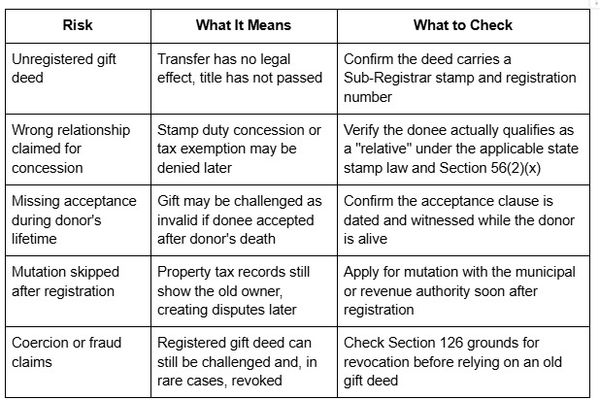
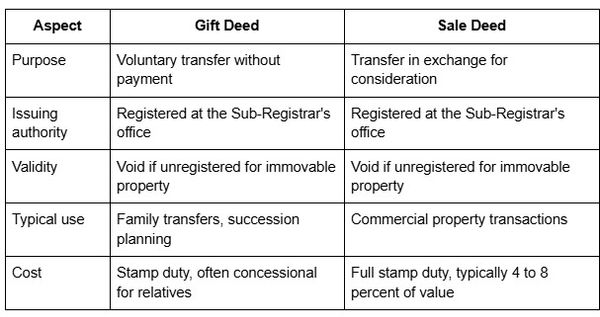
Gift Deed vs Sale Deed: Key Differences
Both documents require registration to have legal effect, but they serve different purposes. A gift deed suits family transfers where no money is meant to change hands, while a sale deed applies wherever the transaction involves an actual purchase price.
Is a Gift Deed Reliable or Valid
A registered gift deed is legally sound, but only when a few things line up correctly. The stamp duty must be paid at the correct rate for the state and the claimed relationship, since an incorrect concession claim can invite scrutiny later. The acceptance clause must be properly executed while the donor is still alive, as acceptance after death does not satisfy the Transfer of Property Act. Buyers relying on a previously gifted property should also check whether the original gift deed was registered and whether any Section 126 revocation grounds, such as fraud or coercion, were ever raised against it.
How 1acre.in Supports Gift Deed and Verification
Checking whether a property's ownership history includes a valid gift deed takes time, and that is where many buyers and family members get stuck.
Verified Listings: 1acre.in surfaces properties with pre-checked ownership records, including whether a prior transfer happened through a gift deed or a sale deed.
Document and Compliance Guidance: the platform helps users understand what a registered gift deed should contain and flags mismatches against mutation and encumbrance records.
Expert and Advisory Support: users get guidance on stamp duty calculation, gift deed tax exemptions under Section 92 of the Income-tax Act, 2025 (Section 56(2)(x) of the 1961 Act), and next steps if mutation was never completed.

Pre-Purchase Checklist
Confirm the donee's relationship to the donor qualifies for the stamp duty concession and income tax exemption.
Check the current stamp duty rate for gift deeds in the relevant state before drafting.
Gather title documents, encumbrance certificate, and identity proof ahead of the Sub-Registrar appointment.
Ensure donor, donee, and two witnesses are all available for registration.
Apply for mutation with the local authority immediately after registration.
Consult a property lawyer if NRI status, minors, or agricultural land restrictions are involved.
Conclusion
A gift deed offers a straightforward way to move property within a family, provided each step is followed correctly, from drafting through registration and mutation. Skipping registration or misjudging who qualifies for a concession can turn a simple transfer into a legally void or expensive one.
-900x600.jpg)
-900x600.jpg)
-900x600.jpg)
-900x600.jpg)
-900x600.jpg)