
Partition Deed: How Ancestral Property Is Divided
A partition deed divides jointly held ancestral property into separate shares, and it needs every legal heir's consent and proper registration to hold up.
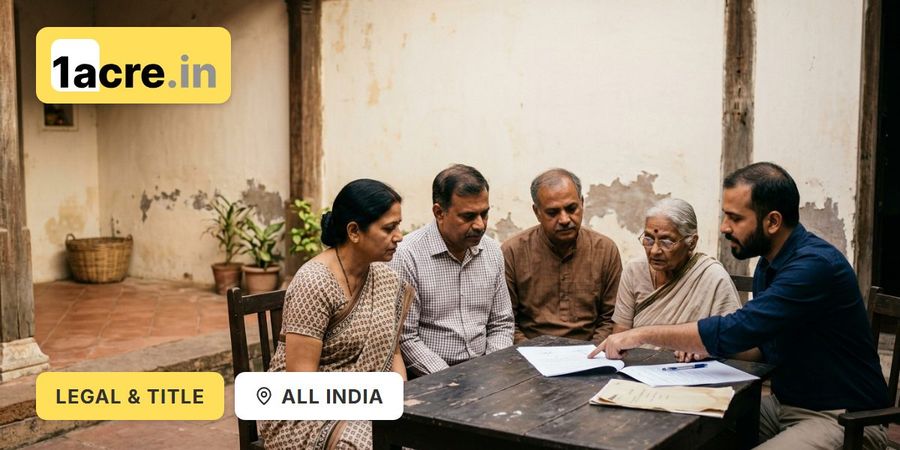
- Partition of property divides ancestral property that has stayed undivided across four generations of the paternal line into individual shares.
- Daughters hold equal coparcenary rights in ancestral property since the 2005 amendment to the Hindu Succession Act, and their consent cannot be skipped.
- A partition deed that itself divides the property must be registered under the Registration Act, 1908, or it generally cannot be used in court as proof of the division.
- Stamp duty on a partition deed is generally much lower than on a sale deed, since the division formalises an existing share rather than creating a new one, though the rate and any cap vary by state.
- Where heirs disagree, a partition suit in civil court remains the fallback route, though it typically takes years longer than a mutual deed.
What Partition of Property Is
Partition of property is the legal process of dividing jointly held ancestral property among co-owners so that each person's undivided share becomes a separate, self-acquired holding. Ancestral property itself is a specific category under Hindu law, property that has remained undivided across four generations of the paternal line, where every family member acquires a right to it by birth rather than through a separate act of inheritance.
Buyers and heirs often confuse a partition deed with a family settlement agreement. A partition deed formally divides property that hasn't yet been split. A family settlement, or Memorandum of Family Settlement, typically records a division that has already happened informally between family members. The distinction matters because the two can attract different stamp duty treatment. It's also worth noting that ancestral property doesn't exist in the same form under Muslim or Christian personal law, and property from the maternal side does not qualify as ancestral property under Hindu law.
What a Partition Deed Covers
A partition deed needs to record specific details for the division to hold up legally. It typically includes:
Co-owner details: names and relationship of every heir entitled to a share.
Property description: survey number, boundaries, and total area being divided.
Share allocation: each party's specific share, described by metes and bounds where physically divided.
Consent clause: confirmation that every legal heir, daughters included, has agreed to the division.
Stamp duty details: the value on which duty has been calculated and paid.
Witness attestation: signatures of at least two witnesses at execution.
Why Partition of Ancestral Property Is Needed
Ancestral property held jointly across multiple heirs cannot be sold, mortgaged, or transferred cleanly by any one person without first separating out individual shares. Partition of property is what converts a joint, undivided interest into something each heir can independently deal with.
This becomes relevant at a few distinct points:
Pre-division: identifying every coparcener with a legal right, including daughters under the 2005 Hindu Succession Act amendment.
At execution: choosing between a mutual partition deed and a court partition suit, depending on whether heirs agree.
Post-partition: applying for individual mutation so revenue records reflect separate ownership before any future sale.
How the Partition Process Works
Where all heirs agree, the process starts with drafting the deed, listing each co-owner's share, the property details, and the relationship between parties. All parties sign in front of at least two witnesses. Stamp duty is then calculated based on the state's rate and the property's market value, after which the deed is submitted at the Sub-Registrar's office along with identity proofs and supporting title documents.
Once the Sub-Registrar verifies and registers the deed, each party receives a certified copy. Individual mutation applications should follow soon after, so property tax and revenue records reflect the new, separate ownership. Where heirs cannot agree, any one of them can instead file a partition suit in civil court, which may order division by metes and bounds or, where that isn't physically feasible, a sale with proceeds split among heirs.
Registration through mutual agreement can often be completed within a single day if documents are in order, and cost is limited to the applicable stamp duty plus a registration fee. A court partition suit, by contrast, can run into years through preliminary and final decrees.

Regulatory Red Flags
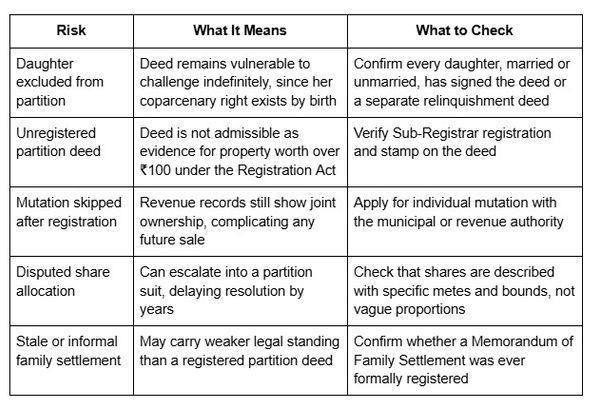
Partition Deed vs Sale Deed and Gift Deed
Stamp duty on a partition deed is generally well below what a sale deed attracts, largely because the co-owners already held an undivided interest in the ancestral property before the division. The exact rate, and any cap per share, varies by state. A partition deed applies specifically where heirs are separating an existing joint share, not where ownership is changing hands between unrelated parties.
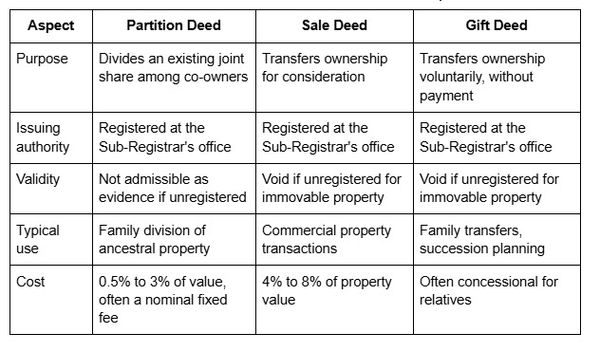
Is a Partition Deed Reliable or Valid
A registered partition deed generally holds up well, but a few gaps can weaken it later. Deeds executed without a daughter's consent remain open to challenge years afterward, since her right existed by birth regardless of whether she was consulted at the time. Buyers looking at a property that changed hands through a past partition should confirm the deed was actually registered, since an unregistered partition deed generally cannot be received as evidence of the division under Section 49 of the Registration Act, though courts may allow it for limited collateral purposes such as showing the family had separated. It's also worth checking whether any heir has since raised a dispute, since courts allow a fairly long window, generally up to 12 years, for a suit to recover possession.

How 1acre.in Supports Partition of Property Verification
Tracing whether a property's ownership history includes a valid, fully consented partition takes real effort, and that gap is where buyers often get exposed.
Verified Listings: 1acre.in surfaces properties with pre-checked ownership records, flagging where a past partition of ancestral property forms part of the title chain.
Document and Compliance Guidance: the platform helps buyers understand what a registered partition deed should contain and checks for missing heir consents or unregistered settlements.
Expert and Advisory Support: buyers get guidance on stamp duty calculation for partition transactions and next steps if a co-owner or excluded heir later raises a claim.
Pre-Purchase Checklist
Confirm every legal heir, including daughters, was included and consented to the partition.
Verify the partition deed is registered at the Sub-Registrar's office, not just informally agreed.
Check that individual mutation was completed after the partition deed was registered.
Calculate stamp duty against the state's current rate for family partitions.
Review whether any heir has raised a dispute within the applicable limitation period.
Consult a property lawyer if the ownership chain includes an old or informal family settlement.
Conclusion
Partition of property converts a joint, undivided interest in ancestral property into individual, legally secure shares, but only when every entitled heir has consented and the deed is properly registered. Buyers and family members alike benefit from confirming that stamp duty was correctly calculated and that mutation followed registration before treating the division as final.
-900x600.jpg)
-900x600.jpg)
-900x600.jpg)
-900x600.jpg)
-900x600.jpg)