
Khatiyan vs Jamabandi vs RoR: Land Records Compared Simply
Khatiyan, jamabandi and Record of Rights are stages of one land record. Here is what each shows, why none proves ownership alone, and how to check yours.
Khatiyan is the original survey record. Jamabandi is the periodically updated version showing who holds the land now. Record of Rights is the umbrella term both sit under. They are three stages of the same document, not three different documents, and none of them proves ownership on its own.
- Khatiyan records the land as it stood at the first survey and settlement
- Jamabandi is revised periodically, commonly every four years
- RoR is the category term, named differently in almost every state
- All three are presumptive evidence, not conclusive title
- West Bengal runs three khatiyan generations that must match
- Checking any of them online needs only a khata, khasra or plot number
What Is Khatiyan
A khatiyan is the original record of a parcel of land, created when a survey and settlement operation first formally recorded rights over it. It shows the earliest recorded holder, the extent of the land, and how it was classified at that time.
It was prepared by the government during cadastral survey operations, not issued by landlords. Zamindars appear in it as recorded holders, and tenants appear separately, which is exactly why the document has evidentiary standing: it was a state record of who held what, made for revenue purposes.
A khatiyan tells you what the land looked like on paper decades ago. It was a one-time document with no built-in updating mechanism, so an old khatiyan alone will not tell you who holds the land today. What it does tell you, and nothing else can, is where the title chain begins.
What Is Jamabandi
Jamabandi is the updated, current version of the land record, showing the present holder along with revenue and cultivation details.
It is revised on a fixed cycle, commonly every four years, absorbing all mutations recorded in the intervening period. Mutation, the process of formally updating ownership after a sale or inheritance, is what feeds it. Where khatiyan tells you where the record started, jamabandi tells you where it stands.
This is why the jamabandi is the working document for verifying current status, while the khatiyan remains the reference for tracing the root of title.
What Is Record of Rights (RoR)
The same underlying record appears under different names by state. Bihar appears twice below because it uses Khatiyan for the survey record and Register-II for the updated register:
Jamabandi, in Punjab, Haryana, Himachal Pradesh and Jammu and Kashmir
Khatiyan, the original survey record, in West Bengal, Bihar and parts of eastern India
Register-II, the updated jamabandi register in Bihar and Jharkhand
Pahani or Adangal, in Telangana and Andhra Pradesh
RTC or Pahani, in Karnataka
7/12 extract, in Maharashtra
Khatauni, in Uttar Pradesh
Patta Chitta, in Tamil Nadu
Khatian and Patta, updated via Dasakhata, in Odisha
B-1 Khatauni, in Chhattisgarh
Three terms recur inside these records and are worth knowing. Khasra is the number for an individual field or plot. Khewat identifies a holder's account or share in the village records. Khatauni is the holding account tying a cultivator to the plots they work.
West Bengal: Three Generations of Khatiyan
West Bengal deserves separate treatment because it runs three khatiyan generations simultaneously, and buyers routinely check only the newest.
CS Khatian is the British-era Cadastral Survey record. RS Khatian is the Revisional Survey of the 1950s and 60s. LR Khatian is the post-reform Land Reforms record and the current active one.
All three should match for a clean title. The CS Khatian closes the chain at its deepest level and is what protects against heirs surfacing years later. Civil courts treat a missing CS as a serious gap in family property disputes, and many banks ask for it on ancestral or partitioned land. The RS Khatian bridges registration and title. A buyer holding only a recent LR extract is carrying risk they cannot see.
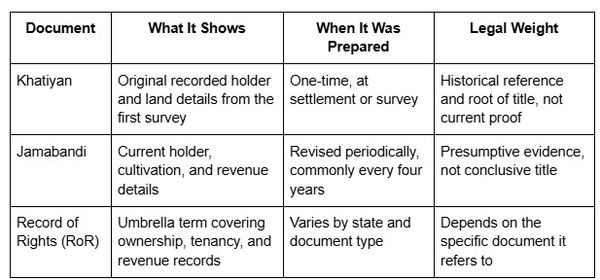
Khatiyan vs Jamabandi vs RoR: Key Differences
If someone asks for your RoR, they usually mean whichever current record your state maintains, most often the jamabandi, rather than the older khatiyan.
Why None of These Documents Proves Ownership Alone
None of these records gives conclusive legal title. They are presumptive evidence: they support a claim without settling it.
The courts have been explicit. In Sawarni v. Inder Kaur, the Supreme Court held that a mutation entry neither creates nor extinguishes title, and only enables the recorded person to pay land revenue on the property.
The structural reason is that these are two separate systems. Jamabandi and RoR data come from the revenue department's records. Actual transfers are recorded by the registration department through sale deeds. The two should always agree. They frequently do not, most often where a mutation was never completed, leaving the jamabandi showing one name and the registered deed another.
That does not make the revenue record unimportant. Quite the opposite: banks lend against it, and courts open it first. It means the record and the deed have to be read together. Before any transaction, cross-check the RoR against the encumbrance certificate and the sale deed chain, and confirm that the mutation has actually closed.
How to Check Your Khatiyan, Jamabandi, or RoR
Identify your state's land records portal, then select district, tehsil or circle, and village. Search using the khata number, khasra or plot number, or, in some states, the jamabandi number.
Bihar's portal, for instance, moves through district, circle, and mauza before searching by khata, plot or landholder name. The Bihar mutation guide covers how Register-II is updated there.
When the record opens, read three things. The khewat identifies the holder's account. The khasra or plot number confirms you have the right parcel. And the remarks column, where mutation entries and objections are flagged. The remarks column is the one people skip and the one that most often carries the problem.
Common Mistakes People Make With These Records
Treating an old khatiyan as proof of current ownership is the most frequent error, when the jamabandi or updated RoR is what reflects today's position. Ignoring the remarks or mutation column runs a close second, since a recorded but unprocessed change lives there. Many buyers also assume that a name on a jamabandi means full legal title, without realizing that it is presumptive only. And relying on a single document rather than cross-checking against the encumbrance certificate and deed chain is where gaps between the two departments surface.
In West Bengal, specifically, checking only the LR Khatian and not the CS and RS behind it is the version of this mistake that costs the most.
Which Record Applies to Your Land
The practical difficulty with this topic is that the answer changes at every state border, and generic advice stops being useful the moment you have an actual parcel in front of you.
1acre maintains state-level guides covering the specific record name, portal, and update cycle for each state, from CS and RS Khatian in West Bengal to Register-II in Bihar and Jharkhand, ROR 1-B in Andhra Pradesh, and the Jamabandi in Jammu and Kashmir. Reading the guide for your state alongside this comparison is what turns the general framework into something you can act on.
The honest limit is that no guide substitutes for the certified copy. Portal downloads are for verification. For a loan, a registration, or a court filing, the certified extract from the revenue office is the document that carries weight.
Conclusion
Khatiyan, jamabandi, and RoR are not three unrelated documents. They are three points in the life of the same record, from its creation at survey through its ongoing revision. Knowing which one is in front of you, and what it can and cannot prove, is most of the difference between a clean transaction and a dispute.
Work out what your state calls its current record and pull it. Trace the older survey records behind it, particularly in West Bengal. Read the remarks column rather than skimming it. Cross-check against the encumbrance certificate and the deed chain. And treat every one of these documents as evidence supporting a claim, never as the claim itself.
-900x600.jpg)
-900x600.jpg)
-900x600.jpg)
-900x600.jpg)
-900x600.jpg)