
Stamp Duty by State 2026: How Rates Differ Across India
The same property can cost lakhs more in one state than another. Duty follows the higher of agreed price or circle rate, and registration is a separate cost.
Stamp duty is the state tax that makes your sale deed legally valid, and it varies enough across India that the same property can cost lakhs more or less depending purely on where it sits. It is calculated on whichever is higher, your agreed price or the government's circle rate, which means negotiating well does not reduce it.

- Stamp duty is levied by the state, so the rate depends entirely on location
- It is charged on the higher of the agreement value or the circle rate
- Registration charges are separate and range from a capped amount to a few percent of the property value
- Tamil Nadu charges around 9 percent combined: 7 percent stamp duty plus 2 percent registration
- Several states offer a concession for women buyers
- Underpaying can invalidate your deed and block loans and resale
What Is Stamp Duty and Why It Matters
Stamp duty is a state government tax that makes a property sale deed legally valid and admissible in court. Without it, your ownership document carries no legal weight, regardless of what you paid.
It is not an optional add-on. It is what converts a private agreement into an enforceable record of ownership. Because it is levied under the Indian Stamp Act, together with state-specific amendments, the rate depends entirely on where the property is, which is why identical properties cost very differently in different cities.
How Stamp Duty Is Calculated
Stamp duty is a percentage of property value, applied to whichever is higher between the agreement value and the government's circle rate, also called the guideline value or ready reckoner rate.
If a property's circle rate is ₹80 lakh but you agreed to ₹60 lakh, duty is charged on ₹80 lakh. State governments publish and revise these rates periodically, typically alongside budget cycles, and the revision date differs by state. The circle rate is the official reference regardless of what the parties privately agreed.
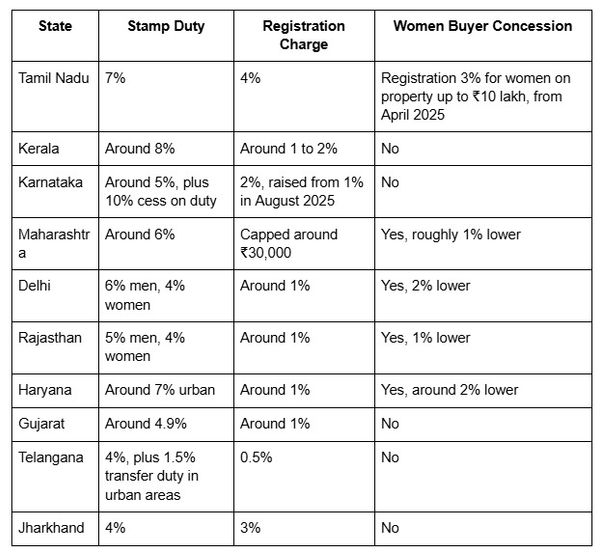
Stamp Duty Rates by State
Rates are revised at state discretion, sometimes mid-year. Confirm the exact figure on your state's Stamps and Registration or IGR portal before your appointment. State-level calculators such as those for West Bengal and Jharkhand work through the applicable slabs.
Registration Charges Explained
Registration charges are a separate fee paid to the sub-registrar for recording the transfer. They are not part of stamp duty, and they are where budgets most often go wrong, because the structure varies far more than the duty itself.
Three patterns exist. Some states charge roughly 1 percent uncapped. Some cap it, as Maharashtra does at around ₹30,000. And some charge a higher percentage with no cap, as Tamil Nadu and Karnataka do at 2 percent.
That third case matters most. On a ₹1 crore property in Chennai, registration alone is ₹2 lakh, against roughly ₹30,000 in Mumbai. Anyone assuming registration is "about 1 percent everywhere" can be off by a lakh or more. Karnataka also charges 2 percent, after doubling it from 1 percent on 31 August 2025.
Concessions for Women Buyers
Several states reduce stamp duty when property is registered in a woman's name. Delhi charges 4 percent for women and 6 for men. Rajasthan charges 4 against 5. Haryana and Maharashtra apply their own reductions.
On a ₹1 crore flat in Gurugram, a male buyer at roughly 7 percent duty plus 1 percent registration faces about ₹8 lakh in statutory charges. A female buyer at a reduced rate saves roughly ₹2 lakh, purely from the ownership name.
The concession is far from universal, and its shape varies. Tamil Nadu offers no gender concession on stamp duty at all, but does reduce registration from 2 to 1 percent for women buying property valued up to ₹10 lakh, since 1 April 2025. Telangana and Kerala offer no gender-based reduction. Check the specific form of the concession in your state rather than assuming a flat percentage off.
The Circle Rate Trap
Negotiating a lower price does not lower your stamp duty. If the circle rate is ₹80 lakh and you buy at ₹70 lakh, duty and registration are calculated on ₹80 lakh. Factor this in before you start negotiating, because a good deal on price does not translate into savings on statutory charges.
The reverse also holds. If you pay above the circle rate, duty follows your price.
How to Calculate Your Total Stamp Duty and Registration Cost
Stamp duty equals the applicable rate multiplied by the higher of the market value or agreement value. Registration follows the same base at its own rate, subject to any state cap.
Take an ₹80 lakh property in Tamil Nadu. Stamp duty at 7 percent is ₹5.6 lakh. Registration at 2 percent is ₹1.6 lakh. Total statutory cost is ₹7.2 lakh, or 9 percent.
The same ₹80 lakh property in Maharashtra at roughly 6 percent duty is ₹4.8 lakh, with registration capped near ₹30,000, for a total around ₹5.1 lakh. Same property value, roughly ₹2.1 lakh difference, purely on location.
Run the formula for your own state, then confirm against the official calculator before committing to a budget.

What Happens If You Underpay Stamp Duty
The consequences are structural, not a minor penalty. A sub-registrar is required to reject an insufficiently stamped document. If such a document is somehow registered, it remains inadmissible in court, meaning you cannot properly assert ownership, and banks will refuse to lend against it.
Deficient duty can attract penalties running to multiples of the shortfall, with criminal exposure in serious cases. Undervaluation also draws income tax scrutiny where the gap between declared and circle rate is wide.
Checking What You Are Buying Before You Budget
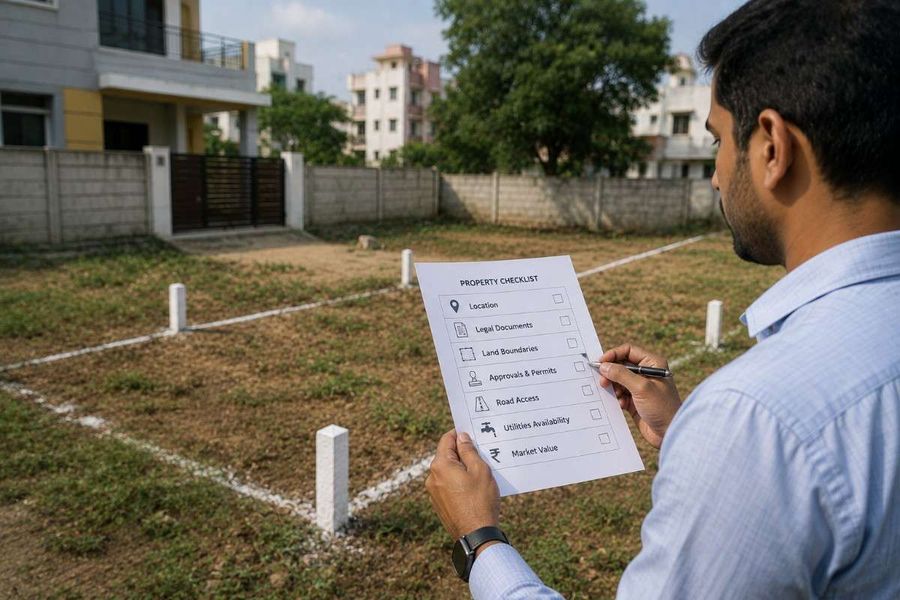
Stamp duty is the easiest cost to calculate and the least likely to derail a purchase. The problems that actually cost people money sit upstream: land that cannot legally be transferred, a mutation never completed by the seller, a classification that blocks construction.
1acre.in maintains state buyer guides covering those checks alongside the stamp duty position, from Telangana's two verification tracks to West Bengal's split between registration and title, and Jharkhand's tenancy act restrictions.
The honest limit on any rate published anywhere, including here, is that states revise without much notice. Treat every figure as a planning estimate and confirm the current rate at the sub-registrar before you pay.
Conclusion
Stamp duty varies enough that location alone can change your statutory cost by several percentage points, and registration charges vary even more. The combined figure is what to budget against, not the headline duty rate.
Find your state's current combined rate on the official portal. Check the circle rate for the specific locality before negotiating, since duty follows the higher figure. Confirm whether registration is capped or percentage-based in your state, because that distinction alone can be worth lakhs. Check the exact form of any women's concession rather than assuming. And never treat under-stamping as a saving.
-900x600.jpg)
-900x600.jpg)
-900x600.jpg)
-900x600.jpg)
-900x600.jpg)