
Assigned Land in India: Why It Cannot Be Sold Freely
Learn why assigned land in India cannot be freely sold, what void ab initio means, and how to check restrictions.

- Many states regulate assigned, granted, or government-allotted land through state-specific land reform laws that restrict or prohibit its transfer.
- A registered sale deed gives the buyer nothing here. Registration does not make the transfer valid.
- The government can resume the land at any point, and under Section 7 of the Andhra Pradesh Assigned Lands (Prohibition of Transfers) Act, 1977 (Telangana has its own version of the same Act) the buyer faces up to six months in jail, a fine, or both.
- Exceptions exist for good-faith purchases by landless poor persons and bank mortgages, and inheritance by legal heirs is generally allowed. Every other sale, gift or lease is barred unless the Collector first lifts the restriction, where state law allows that.
- Checking the revenue record and, in Andhra Pradesh and Telangana, the Section 22-A prohibited list under the Registration Act, 1908 before buying is the whole ballgame.
What Is Assigned Land in India?
Assigned land is government surplus or wasteland and handed to landless poor persons, typically agricultural labourers or SC and ST families, for cultivation or as a house site. The government transfers possession and limited use rights. Ownership stays conditional.
In many states, government-assigned land is allotted to eligible beneficiaries under land reform or welfare schemes, subject to conditions that restrict transfer or sale.
Why the Law Bans Its Sale
The transfer of assigned or government-allotted land is governed by state-specific land laws. In many states, beneficiaries receive only limited occupancy or cultivation rights rather than unrestricted ownership.
As a result, selling, gifting, leasing, or transferring such land without government permission may be prohibited or declared invalid under applicable law.
The section numbers used below (3, 5, 6 and 7) are from the Andhra Pradesh Assigned Lands (Prohibition of Transfers) Act, 1977. Telangana applies its own version of it, the Telangana Assigned Lands (Prohibition of Transfers) Act, 1977. Section 22-A is a provision of the Registration Act, 1908 as it applies in Andhra Pradesh and Telangana, and the Mandal Revenue Office is the local revenue office in those two states. Other states have their own assignment laws and records, so check the law of the state where the land lies.
What "Void Ab Initio" Actually Means
Void ab initio means the transaction is treated as if it never legally happened. No title passes. Even if the land has changed hands ten times through ten registered deeds, every one is equally invalid.
A registered document does not make you the owner here. The paper has no legal weight at all.
Section 3(5) says the prohibition does not apply where a landless poor person bought in good faith and for value from the original assignee before the Act commenced and was in possession on that date. It is narrow, and it protects the poor, not an investor.
In July 2026 a Full Bench of the Andhra Pradesh High Court held, by majority, that land bought on these conditions stops being assigned land and can be sold on; one judge disagreed, and the writ appeal is still to be finally decided. If a chain of title runs through such a purchase, get a revenue law advocate's written opinion before going further.
What Happens If It's Sold Anyway
The government can resume the land at any time and reassign it to another eligible landless person. The buyer gets no compensation, and a civil court will not uphold a sale that the law treats as never having existed.
There is also a criminal consequence your seller may not mention. Under Section 7, acquiring assigned land in breach of Section 3(2) carries up to six months' imprisonment, a fine, or both.
Transfer Rules for Different Types of Land
The table below compares common land categories in India and whether they can generally be transferred.
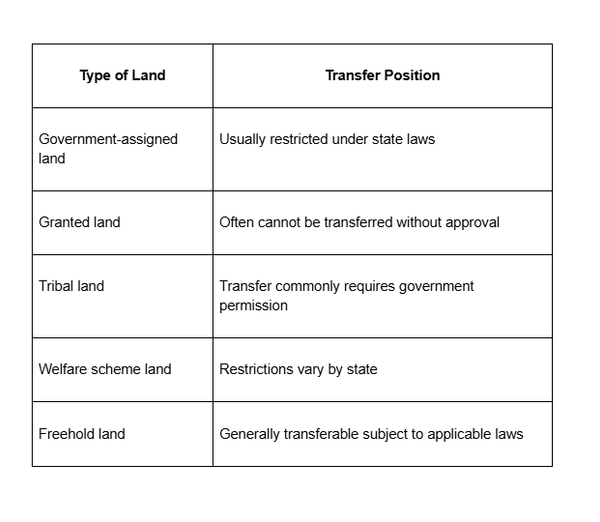
What an Assignee Can Actually Do
They can cultivate for family use. They can pass the land to legal heirs, since inheritance is generally not a prohibited transfer. Under Section 6, they can mortgage it to the Government, a local authority, a scheduled bank, a co-operative society or a notified financial institution, the one kind of security the Act exempts. Where the land was assigned as a house site, construction is usually allowed.
In some states they can apply to the Collector for de-restriction, converting the land into regular patta land eligible for sale.
Some states permit conversion of assigned land into transferable ownership after specific eligibility conditions are met. The rules vary and should always be verified with the relevant revenue authority.

How to Check If a Plot Is Assigned Land
Obtain the latest Record of Rights or official land ownership record issued by the relevant state revenue department. Review it carefully for remarks indicating that the property is government-assigned, granted, or subject to transfer restrictions.
Then check the government-maintained prohibited property or restricted land records, wherever applicable. Ask the local revenue authority directly, and read the assignment order. It states plainly whether transfer is prohibited. It is the difference between owning land and a legal dead end.

How 1acre.in Helps
Assigned land looks like any other parcel from the road, which is why this check happens on paper first. 1acre.in runs a preliminary verification matching a seller's stated ownership against the official land records maintained by the relevant state revenue department, and its listings carry verified survey numbers you can take straight to the Section 22-A list in Andhra Pradesh and Telangana.
The scope is narrow and matters more here than usual. A verification confirms the record matches the seller. It does not read the assignment order, it does not tell you whether a parcel sits on the prohibited list, and here the only answer that counts comes from the Mandal Revenue Office and a revenue law advocate.
What to Do Next
Assigned land is the one category where doing the homework late has no remedy. No cure, no compensation, no court that will help.
Pull the full Record of Rights and look for "assigned" or "granted" notations. In Andhra Pradesh and Telangana, check the Section 22-A list for the survey number. If the land is marked assigned, stop and get a written opinion from a revenue law advocate, and read the original assignment order for its conditions.
If you are an assignee wanting to sell, apply to the competent revenue authority for removal of transfer restrictions where permitted under applicable state law before entering any agreement. For SC/ST or tribal land, confirm whether Collector approval is mandatory in your state. Run these alongside the legal verification of land before buying checks.
Conclusion
Assigned land carries restrictions that no registered deed can override, and buying it while the restriction stands means acquiring nothing at all. Checking the Record of Rights and, in Andhra Pradesh and Telangana, the Section 22-A list before any transaction is the only real safeguard. When in doubt, a revenue law advocate's written opinion costs far less than a void purchase.



-900x600.jpg)
-900x600.jpg)
-900x600.jpg)