
Fard Jammu and Kashmir: Free Printout vs Certified Copy
A free portal printout of the Fard in Jammu and Kashmir carries no legal weight, so banks and Sub-Registrars check for a Tehsildar-countersigned copy.
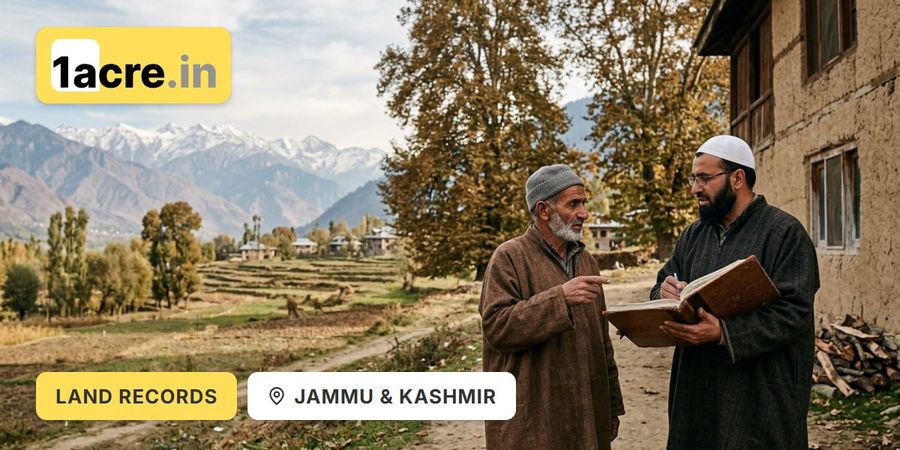
- A Fard records ownership, extent, and classification for a specific Khasra or Khewat number.
- The J&K Revenue Department runs services through jkrevenue.nic.in and the Aapki Zameen Aapki Nigrani portal
- A free portal printout is not a Fard Intikhab and has no legal standing.
- Certified copies are valid for one month only, so timing matters.
- Where digitization is incomplete, a written application at the Naib Tehsildar's office remains the route.
- A reference table below shows which document to request for which purpose
What Is a Fard in Jammu and Kashmir Land Records?
A Fard is a revenue extract showing who holds rights over a specific piece of land, along with its extent, classification, and any charges attached to it. It is drawn from the Jamabandi, the master Record of Rights maintained for each village, and issued against one particular Khasra or Khewat number.
The distinction that matters most is between two things people call "a Fard."
The portal printout is what you get for free from the LRIS system. It is genuinely useful for verification and preliminary checks. It carries no legal weight.
The Fard Intikhab is the certified version, issued under Rule 34 of the J&K Land Revenue Rules 1969. The Patwari prepares it, the Girdawar verifies it, the Naib Tehsildar attests it, and the Tehsildar countersigns it. That chain of four signatures is what banks and Sub-Registrars are checking for. It is valid for one month from issue, and an expired copy will be rejected.
Sellers sometimes hand over a free portal printout and present it as equivalent. It is not. Accept only a Tehsildar-countersigned, stamped copy carrying the issue date. The full Fard Intikhab guide covers what the document contains, field by field.
Understanding J&K Revenue and the J&K Revenue Department
jkrevenue.nic.in is the official website of the Revenue Department, Government of Jammu and Kashmir. It is the starting point for anything touching land records in the union territory, from digitization updates to acquisition notices to online Fard applications.
The department has been working through the Digital India Land Records Modernization Programme to scan and digitize Jamabandis, maps, and mutation registers. That effort feeds the Aapki Zameen Aapki Nigrani portal at landrecords.jk.gov.in, where citizens can view Jamabandi, Girdawari, mutation, and Bhunaksha records directly.
Two sites, two jobs. jkrevenue.nic.in is the department's main site and the application route. Aapki Zameen Aapki Nigrani is the citizen-facing portal where the actual record viewing happens.
How to Check Fard Online in J&K

Checking a record online takes a few minutes once you have the parcel details, though what appears still depends on how far digitisation has reached in that village.
Using the Aapki Zameen Aapki Nigrani Portal
Go to landrecords.jk.gov.in
Select division (Jammu or Kashmir), then district, tehsil, and village
Enter the Jamabandi year
Filter by Khasra number, Khewat number, Khata number or owner name
Click the record to open the full Record of Rights and its linked Bhunaksha map
Khasra number search is the most precise. Owner-name results vary by district because Urdu, Hindi, and English transliterations of the same name do not always match.
To order a certified copy, use the Get Land Record Copy option, select Map or Record of Rights or both, pay by UPI or card, and download the digitally signed PDF from My Orders. While you are on the portal, check the Girdawari to confirm who is in actual possession this season, and check mutation status against the sale deed.
Applying Through jkrevenue.nic.in's Online Fard Module
Visit jkrevenue.nic.in and open the online Fard application section
Enter district, tehsil, village, and the Khasra or Khewat number
Submit the request
Download the extract once processed
Time the request. Because the certified copy lapses after a month, applying too far ahead of your registration or loan date means paying twice.
How to Get a Fard Offline (Fard Intikhab)
Not every village has fully digitised records, so the offline route remains in regular use.
Submit a written application with the requisite fee to the concerned Naib Tehsildar
State the Khewat, Khata, or Khasra number of the land
The office processes it within a standard time limit of 10 days
Collect the certified copy, checking for the Tehsildar's countersignature and issue date
Key J&K Land Record Terms You Should Know
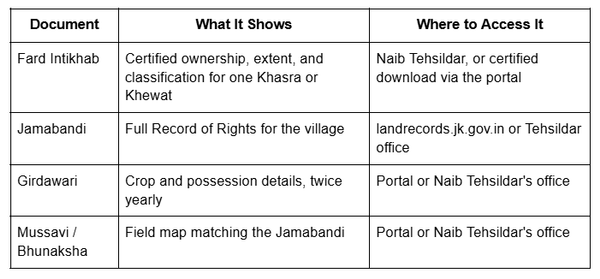
Jamabandi: the master Record of Rights for a village, maintained under the J&K Land Revenue Act Svt. 1996 and revised every four years, absorbing all mutations from the intervening period. The Fard is drawn from it.
Girdawari: the bi-annual harvest inspection record kept by the Patwari, confirming who is actually cultivating each field. If it shows a name other than the seller's, a third party is in possession.
Mussavi (Aks-Masavi): the field map matching the Jamabandi, showing the shape and layout of survey numbers.
Khasra: the number assigned to an individual field or plot within a village.
Khewat / Khata: the number identifying a landholder's share in the village records.
Mutation (Dakhil Kharij): the process of replacing a prior owner's name with the new owner's in the revenue record.
J&K Land Record Documents at a Glance
Common Issues When Accessing Fard Online
Village not yet digitised. Some areas are still being scanned. The record exists on paper. Apply offline.
Name search returns nothing. Transliteration differences between Urdu, Hindi and English defeat name searches in many districts. Use the Khasra number.
Unclear scans. Older registers digitised from paper can be hard to read. Order the certified copy instead.
Khasra number does not match. A past mutation may have changed it. Confirm the current number with the local Patwari.
Roshni Act entries in the mutation history. If any mutation traces back to the J&K State Lands (Vesting of Ownership to Occupants) Act, 2001, the title is compromised. Walk away. The J&K land buying guide sets out the full red-flag list.
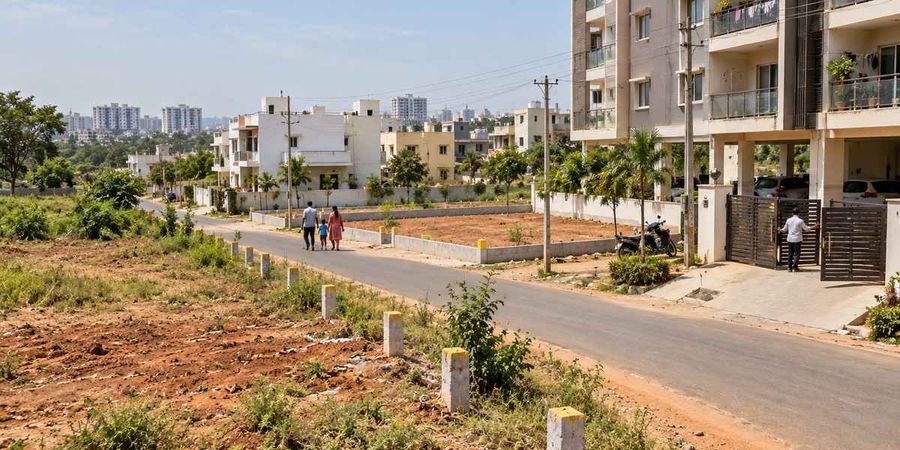
Private colony plots. A J&K Revenue Department circular acknowledges that revenue extracts were issued for land transfers without regard to the land laws, and that a large number of unauthorised colonies have come up in disregard of those laws. Plots in these can carry defective titles. Confirm layout approval with the development authority before buying.
Reading the Record Before You Commit
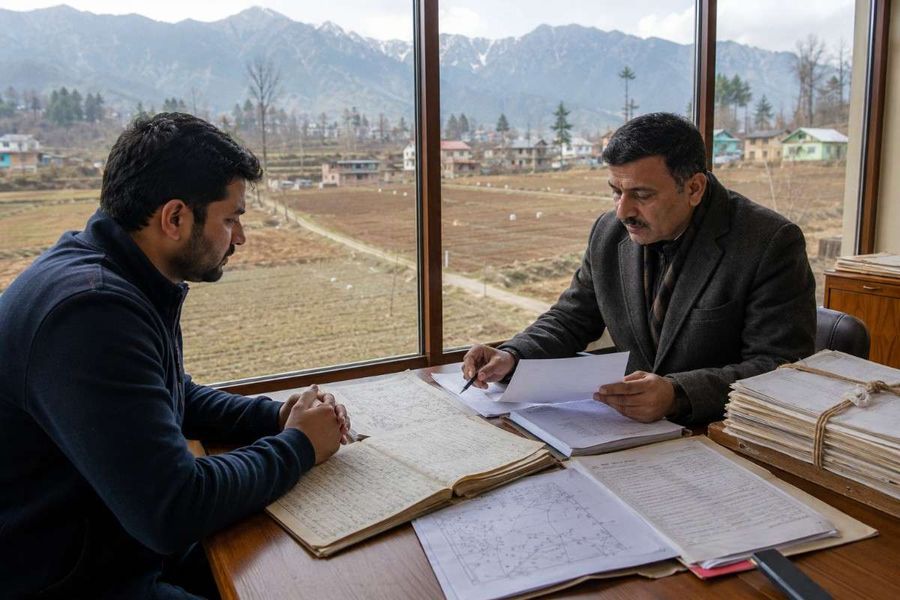
A Fard tells you what the register says. It does not tell you whether the register matches the ground, or what the surrounding parcels look like.
1acre maintains a J&K guide library covering the documents that sit around the Fard: the primary revenue record and Jamabandi, mutation, survey maps, encumbrance certificates, and NA conversion. Reading the Fard alongside the Girdawari and the mutation chain is what turns a single extract into an actual title picture.
One scope note, stated plainly. 1acre.in's survey-number map layers are concentrated in the southern states, and J&K parcels are not currently covered by that map view. For J&K, the platform's value is the written guide set, not a boundary lookup. The certified Fard Intikhab from the Tehsildar remains the only document that carries legal weight, and nothing on any private platform substitutes for it.
Conclusion
Fard access in Jammu and Kashmir has moved well beyond the counter queue. The portal will show you the Jamabandi, the Girdawari, and the map in a few minutes, for free. What has not changed is which piece of paper actually counts: the Tehsildar-countersigned Fard Intikhab, valid for one month, and nothing else.
Before you start, note your division, district, tehsil, village, and Khasra or Khewat number. Check the free record first on landrecords.jk.gov.in to confirm the details and read the mutation history. If your village is not digitised, file a Fard Intikhab application with the Naib Tehsildar and expect around 10 days.
Order the certified copy close to your transaction date, not months ahead. And read the Girdawari alongside the Fard, because the person holding the record and the person holding the land are not always the same.


-900x600.jpg)
-900x600.jpg)
-900x600.jpg)