
IGRS Telangana Explained: What It Covers and What It Misses
Market value, encumbrance certificates and registration for non-agricultural property sit on IGRS Telangana, while agricultural land has moved to Bhu Bharati.
IGRS Telangana, at registration.telangana.gov.in, is the Registration and Stamps Department's portal for non-agricultural property. It handles market value lookups, encumbrance certificate searches, slot booking, and registration. Agricultural land moved to Bhu Bharati in 2025, so which portal you need depends on what kind of land you hold.

- Official platform of the Registration and Stamps Department, Government of Telangana
- Market value, or circle rate, sets the floor on which stamp duty is calculated
- Encumbrance certificates cover records from 1 January 1983 onwards
- Total registration charges run to around 7.5 percent in GHMC and municipal areas
- The portal also covers marriage, firm and society registration, plus Section 22A checks
- Converted land needs both portals checked, not one
What Is IGRS Telangana
IGRS Telangana is the government's online system for property registration, encumbrance certificates, and related citizen services. It is run by the Registration and Stamps Department at registration.telangana.gov.in.
In practice, this means a buyer or seller can check land rates, search property history, book a registration appointment, and pay stamp duty without visiting a government office for each step.
Be careful which site you land on. Several private sites use variations of the department's name as their domain. Some are useful as explainers. None of them are the department, and none of them issue documents. Start from registration.telangana.gov.in.
Understanding Market Value in Telangana
Market value is the government-notified minimum rate for property in a locality, also called the circle rate or guidance value. It is not what you pay.
Stamp duty is calculated on whichever is higher: the notified market value or the sale consideration in the deed. If you are paying above the notified rate, duty follows your price. If you declare below it, duty is still charged on the government rate, and a large gap can also draw income tax scrutiny.
How to Check Market Value Online
Open the portal, select the market value search option, and choose district, mandal and village or locality. For land, use the land value option. For apartments, search by project name to get the composite rate covering land and construction.
Rates appear per square yard for plots and per square foot for built-up apartment area. One square yard is roughly 0.836 square metres, and mixing the units will throw your stamp duty estimate out by a meaningful margin.
How to Search and Download an Encumbrance Certificate
An encumbrance certificate records registered transactions, mortgages and charges on a property over a chosen period. It is the standard pre-purchase check.
The portal offers three search routes: document number with year of document, house number or apartment name in a city, town or village, or survey number in a revenue village with an optional plot number. District and Sub-Registrar Office selection is mandatory under all three. There is no owner or party name search, because an EC is indexed by property and document rather than by person.
Select the period, pay, and download once processed.
Two things the result will not tell you unless you know to look. First, the form matters. Form 15 is issued when registered transactions exist in the period searched. Form 16 is the Nil EC. Second, a Nil EC is not automatically good news. Property that has passed through family hands without formal registration produces a clean EC because nothing was ever filed, not because the title is sound.
Digital records run from 1 January 1983. Anything earlier sits in the Sub-Registrar's physical index books and needs a manual search there. A seller who bought in the 1970s and held quietly will show a spotless online EC that covers none of the property's early history. The Telangana encumbrance certificate guide works through what an EC does and does not prove.
An EC is generally treated as current for about six months for loan, mutation, and registration purposes. Pull a fresh one on the day you decide, whatever the seller shows you.

Stamp Duty and Registration Charges on IGRS Telangana
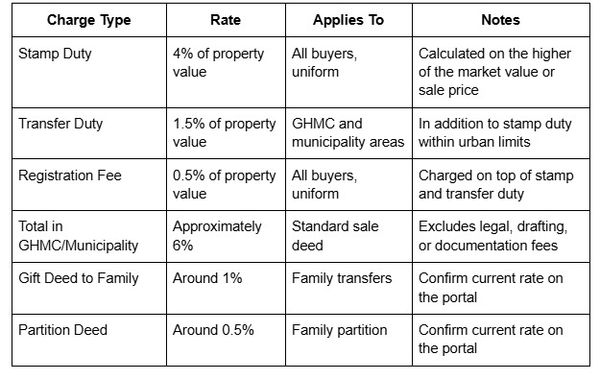
Charges are calculated on the market value or transaction value, whichever is higher. In GHMC and municipal areas, stamp duty, transfer duty, and registration fee combine into one composite figure: 5.5 percent stamp duty, 1.5 percent transfer duty and 0.5 percent registration fee on a sale deed, 7.5 percent in all.
On a flat worth 80 lakh rupees in a GHMC area, plan for close to 6 lakh rupees in total government charges before legal or documentation costs.
Other Services Available on the Portal
With a citizen account, you also get slot booking for the Sub-Registrar visit, certified copies of registered documents, and the Section 22A prohibited property check. Section 22A is the state's restricted list, covering government land, endowment and temple property, wakf land, and forest classification. Property on it cannot be legally registered.
The portal also handles firm registration, society registration, and marriage registration, plus Know Your SRO and Know Your Village for identifying the correct jurisdiction before you start.
IGRS Telangana vs Bhu Bharati: Which Portal to Use
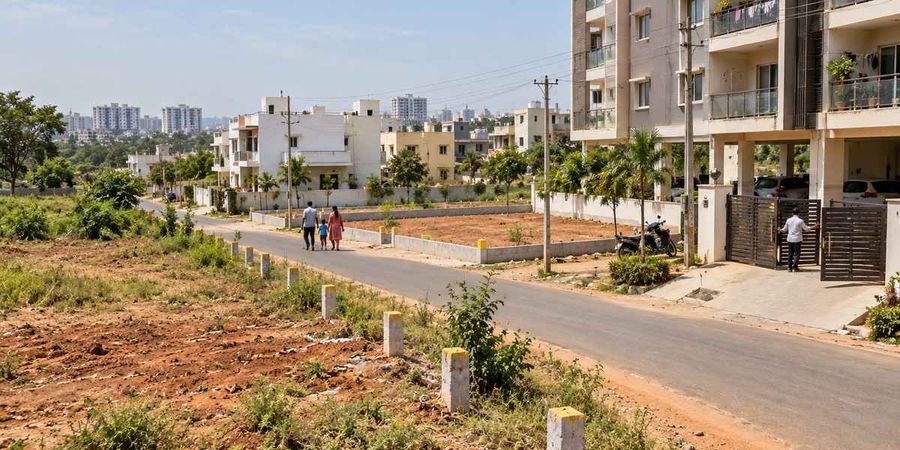
IGRS Telangana covers urban and non-agricultural transactions, meaning flats, plots, and commercial space. Agricultural land, Bhudhaar IDs, and rural Record of Rights entries moved to Bhu Bharati in 2025, which replaced Dharani under the Telangana Bhu Bharati (Record of Rights in Land) Act, 2025.
Converted land is where this gets expensive. If a plot started life as agricultural and was later converted under NALA, its transaction history is split across both systems. Pre-conversion transactions sit in the Bhu Bharati records; post-conversion ones sit in IGRS. Pulling only the IGRS EC on a converted plot in a growth corridor leaves the agricultural-era history invisible, including any mortgage from that period. Pull both and combine them manually.
The Telangana land buying guide sets out the two verification tracks in full, along with the state's unusually long list of non-transferable land categories.

Common Issues Buyers Face and How to Avoid Them
Checking outdated market values instead of the latest revision, particularly in IT corridor localities where rates have moved sharply
Mixing per square yard and per square metre rates during manual calculation
Assuming an EC search covers pre-1983 records, when it does not
Treating a Form 16 Nil EC as proof of clean title
Pulling only one portal's records on a converted plot
Declaring below the notified rate, which can trigger a Section 47-A reference and delay registration by months
Booking a slot before confirming whether the property falls under IGRS or Bhu Bharati
Checking the current market value on the portal before booking a slot or buying an e-stamp avoids most of these.
Reading Portal Records Against the Ground
A portal result is useful evidence. It is not a title certificate, and the distinction costs people money in Telangana specifically, because the state splits verification across two systems that do not talk to each other cleanly.
1acre maintains a Telangana guide set built around that split, covering the encumbrance certificate, the two verification tracks, and the restricted land categories that appear in ordinary revenue records but cannot be sold. Alongside those, the survey number map layer lets you locate a parcel boundary from the map when you have a location but not a number, which is often where a check starts.
The honest limits. The map layer draws on revenue records, so it maps agricultural and peri-urban land better than parcels deep inside municipal limits. And no map view substitutes for the EC, the Section 22A check or the Sub-Registrar's own records. Those remain the documents that decide a transaction.
Conclusion
IGRS Telangana does most of what a buyer needs before registration: the rate, the history, the slot, the payment. What it will not do is tell you when the record in front of you is incomplete.
Start at registration.telangana.gov.in rather than a lookalike domain. Check the market value before you negotiate, since duty follows the higher figure. Pull the EC yourself, read whether it is Form 15 or Form 16, and remember the digital record starts in 1983.
If the land was ever agricultural, pull the Bhu Bharati history too. Run the Section 22A check before any advance. And pull a fresh EC on the day you close, not the one the seller showed you last month.

-900x600.jpg)
-900x600.jpg)
-900x600.jpg)