
Jharnibandhan: Jharkhand Property Registration Online
Jharnibandhan handles pre-registration and stamp duty payment online, but it does not check whether the seller was legally entitled to sell the land.
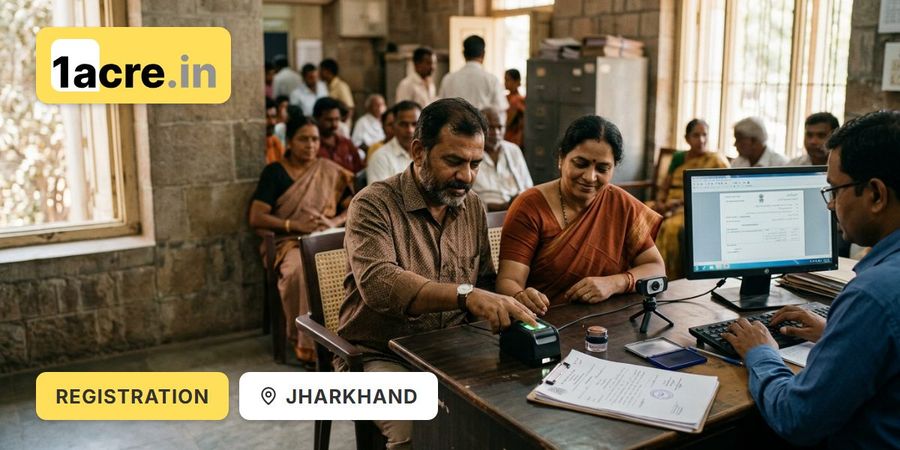
Jharnibandhan at jharnibandhan.gov.in is Jharkhand's official portal for registering property documents. Pre-registration, stamp duty calculation, payment and appointment booking all happen online. One visit to the Sub-Registrar office is still required for biometric verification.
- Run by the Department of Revenue, Registration and Land Reforms
- Most of the process, from pre-registration to payment, can be completed from home
- Current charges are 4 percent stamp duty and 3 percent registration fee
- Physical presence is required once, for biometric verification
- Two tenancy acts restrict tribal land transfers across most districts, and a transfer without DC permission is void
- Mutation after registration is a separate and equally important step
What Is Jharnibandhan and Why It Matters
Jharnibandhan is the Jharkhand government's digital platform for registering sale deeds, gift deeds, lease agreements and similar documents. It replaced a process that once meant repeated office visits and paper files.
In practice, a buyer can enter property and party details, calculate stamp duty and pay it from a phone or laptop, then visit the Sub-Registrar office once for identity verification and final signing.
The portal is maintained under the Department of Revenue, Registration and Land Reforms and works alongside JharBhoomi for land records and JharBhuLagan for land rent collection.
Worth being clear about what the portal does not do. It records the transaction. It does not verify that the land was legally transferable in the first place, and in Jharkhand that is the question that decides whether you end up owning anything. The Jharkhand title deed guide covers the chain of ownership checks that sit upstream of registration.
Documents You Need Before You Start
Valid ID proof of buyer, seller and witnesses, such as Aadhaar, PAN or voter ID
PAN card of buyer and seller
Draft of the sale deed or the specific deed type being registered
Property tax receipt or khata details
Encumbrance certificate, where applicable
Passport-size photographs of buyer, seller and two witnesses
Proof of payment or consideration, if applicable
The original Deputy Commissioner permission order, where the tenancy acts apply
Special Documents for Tribal Land Areas
Two statutes govern tribal land in Jharkhand and between them they cover most of the state.
The Chotanagpur Tenancy Act, 1908 applies across the Chotanagpur region, including Ranchi, Lohardaga, Gumla, Simdega, Khunti, East and West Singhbhum, Seraikela-Kharsawan, Bokaro, Ramgarh, Hazaribagh, Giridih, Koderma, Chatra, Latehar, Palamu and Garhwa.
The Santhal Pargana Tenancy Act, 1949 applies in the Santhal Pargana districts including Dumka, Deoghar and Godda.
Under both, any transfer of tribal raiyat land to a non-tribal without prior written permission from the Deputy Commissioner is void. Not voidable, void. Registering the deed does not cure it. Paying full stamp duty does not cure it. The transfer never legally happened, any construction sits on disputed land, and the DC can order eviction under Section 71A of the CNT Act.
The permission application is filed by the seller under Section 46, enclosing the Khatiyan, both parties' caste certificates, the buyer's residential proof and the proposed sale agreement. The DC refers it to the Circle Officer and Revenue Inspector for a mandatory field verification. Do not approach the Sub-Registrar until the original permission order is in hand.
One trap worth naming. Parcels in urban and peri-urban Jharkhand often carry Raiyati classification with ST ownership in the original Khatiyan, even where non-tribals have occupied them for years. Pull the Khatiyan yourself from jharbhoomi.jharkhand.gov.in and read the land nature and owner category fields rather than relying on the occupant's account. The CNT and SPT check guide sets out the full permission process.
Step-by-Step Process for Property Registration Jharnibandhan
Start at jharnibandhan.gov.in and select Pre-Registration from the online registration menu. From there the sequence runs:
Create an account using a valid mobile number and email ID, and set a password
Complete your profile with basic personal and contact information
Select the deed type, whether sale deed, gift deed or lease deed
Enter property details including location, survey number and area, along with buyer and seller information
Upload the required documents in the specified format
Calculate stamp duty using the portal's fee calculator by selecting district and deed type
Purchase the e-stamp through the linked payment system
Book an e-appointment for your visit to the Sub-Registrar office
Attend on the scheduled date with original documents for biometric verification and final registration
Most of this is online, but biometric verification is not, so the process is not paperless end to end.
Stamp Duty and Registration Charges in Jharkhand
Charges are calculated on the property's market value or the agreement value, whichever is higher. Stamp duty is 4 percent and the registration fee 3 percent. Jharkhand applies the same rate to men and women; the Re 1 registration scheme for women, announced in 2017, no longer applies.
Stamp duty is the tax on the instrument itself. The registration fee is what you pay to have the transaction recorded. Both are due at registration.

On a property worth 50 lakh rupees, expect roughly 2 lakh in stamp duty and 1.5 lakh in registration fee, about 3.5 lakh in total before other charges. You can cross-check against the Jharkhand stamp duty calculator before paying.
The calculation rule catches people out. If the circle rate for your area values the plot above what you agreed, duty is charged on the circle rate. You cannot register below it, whatever you actually paid.
How to Pay Stamp Duty and Book Your Appointment Online
Log in to jharnibandhan.gov.in, select the fee calculation and payment option, then choose e-stamp online payment. Once the e-stamp is generated, move to appointment booking.
In the appointment section, enter your Application ID, presenter name, mobile number, email ID and preferred date, then submit to confirm the slot. Keep a copy of the confirmation, since you will need it alongside your original documents at the office.

Common Mistakes That Delay Registration
Declaring a value below the government guidance value, which triggers additional scrutiny
Survey numbers or boundaries that do not match land records
Missing or mismatched ID proof for witnesses
Skipping mutation after registration, which leaves land records outdated
Booking an appointment before all documents are uploaded and verified
Proceeding on tribal land without the DC permission order in hand
The last one is different in kind from the others. The first five cost you time. That one costs you the land.
What Happens After Registration
Registration records the transfer. It does not update the revenue record.
The next step is Dakhil Kharij, Jharkhand's mutation process, filed on jharbhoomi.jharkhand.gov.in. It updates Register-II so your name replaces the seller's. Standard processing runs 15 to 30 days depending on Circle Office workload and whether objections are raised.
Until mutation is complete, the revenue record still carries the seller's name. Banks lend against that record rather than the deed, so a home loan will stall. A future buyer checking the record will find the wrong name, and resale stalls with it.
Jharkhand has been upgrading Jharbhoomi so mutations flow automatically from the registration system through NGDRS. Until that is fully live, apply separately after registration rather than assuming it is handled. Verify status at both the portal and the local Circle Office, because the two can lag each other. The Jharkhand mutation guide covers the application in detail.
Checking Land Status Before You Register
Jharnibandhan will register whatever you bring it, provided the stamp duty is paid and the documents are in order. Whether the seller was entitled to sell is a separate question, and the portal does not ask it.
1acre maintains a Jharkhand guide set built around those pre-registration checks: the tenancy act verification, the title deed chain, mutation and the current stamp duty position. Reading the Khatiyan alongside the deed chain is what surfaces a void transfer before your money moves rather than after.
The honest limit is that nothing substitutes for the DC's written permission order where CNT or SPT applies. No platform and no volume of documentation makes a void transfer valid. Where the tenancy acts are in play, the permission order is the only thing that counts, and it comes from the Deputy Commissioner's office alone.
Conclusion
Jharnibandhan has made the mechanical side of registration in Jharkhand straightforward. The forms, the fee calculation and the appointment all happen online, and the only unavoidable visit is the biometric step.
The work that actually protects you sits before the portal. Pull the Khatiyan and read the land nature and owner category. Confirm whether CNT or SPT applies to your district. If it does, confirm the seller holds the original DC permission order before any money changes hands. Check your circle rate so the duty holds no surprises. Then register, and apply for Dakhil Kharij once the deed is recorded.
-900x600.jpg)


-900x600.jpg)
-900x600.jpg)