
Dakhil Kharij: Meaning, Status Check and Mutation Process
A registered deed transfers title, but it does not update the revenue record, so Dakhil Kharij makes your ownership visible to banks and courts.
- Registration transfers title. Mutation updates the record that banks and courts actually read
- Several states impose a statutory filing deadline; Bihar's is 90 days from acquiring the interest
- The process applies after sale, inheritance, gift, will, partition, or court order
- Status labels each mean something specific for what you do next
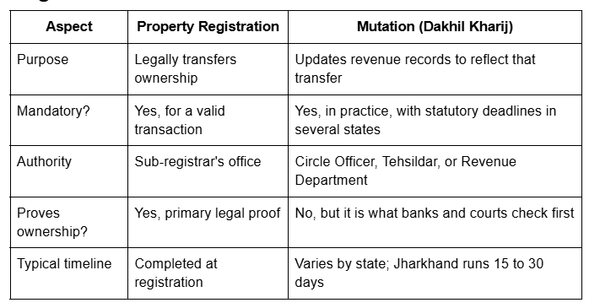
- A comparison table below sets out how the two processes differ
- Some states are moving to automatic mutation, removing the separate application
What Is Dakhil Kharij?
Dakhil Kharij is the recording of an ownership change in official land revenue records. The term comes from Urdu. "Dakhil" means entered and "Kharij" means removed, which describes the mechanism precisely: the old name comes out of the register, the new name goes in.
The term is used across Bihar, Jharkhand, Uttar Pradesh, Odisha, Chhattisgarh, Tripura, and Jammu and Kashmir, among others. Elsewhere, it appears as mutation, Namantaran, Intiqal, or Dasakhata. The concept is the same everywhere; only the register and the governing statute change.
Which register gets updated varies by state. In Bihar and Jharkhand, it is Register-II, the Jamabandi Panji. In Odisha, it is the Patta, via the Dasakhata entry. In Chhattisgarh, it is the B-1 Khatauni. Knowing your state's register name makes it far easier to check whether the job was actually done.
Dakhil Kharij vs Property Registration: What's the Difference?
Registration at the Sub-Registrar's office legally transfers ownership through the sale deed. Mutation is the separate administrative step where the Revenue Department updates its own working records to match.
Courts have been clear that mutation does not, by itself, create title. In Sawarni v. Inder Kaur, the Supreme Court held that a mutation entry neither creates nor extinguishes ownership; it simply enables the recorded person to pay land revenue.
That ruling is often misread as meaning mutation is optional. It is not, and the practical reality cuts the other way. Banks lend against the revenue record rather than the deed. Courts open the Jamabandi first. Tax notices, utility bills, and acquisition notices all follow the name in the register. You can hold a perfectly valid registered deed and still be invisible to every institution that matters.
The deed records that you paid. Mutation records that the government recognises you as the owner. States treat those as two separate facts.
When Do You Need to Apply for Dakhil Kharij?
After purchasing property through a registered sale deed
After inheriting land, with legal heir documentation
After receiving property through a registered gift deed or will
After a partition among co-owners
After an ownership change directed by a court order
Watch the clock on the first of these. Under Section 3 of the Bihar Land Mutation Act, 2011, the petition is due within 90 days of acquiring the interest, so for a purchase treat the registration date as day one. Other states set their own windows. Missing the deadline does not extinguish your right, but in Bihar a late petition has to be filed with a delay condonation application giving the reasons.
The Mutation Process Step by Step
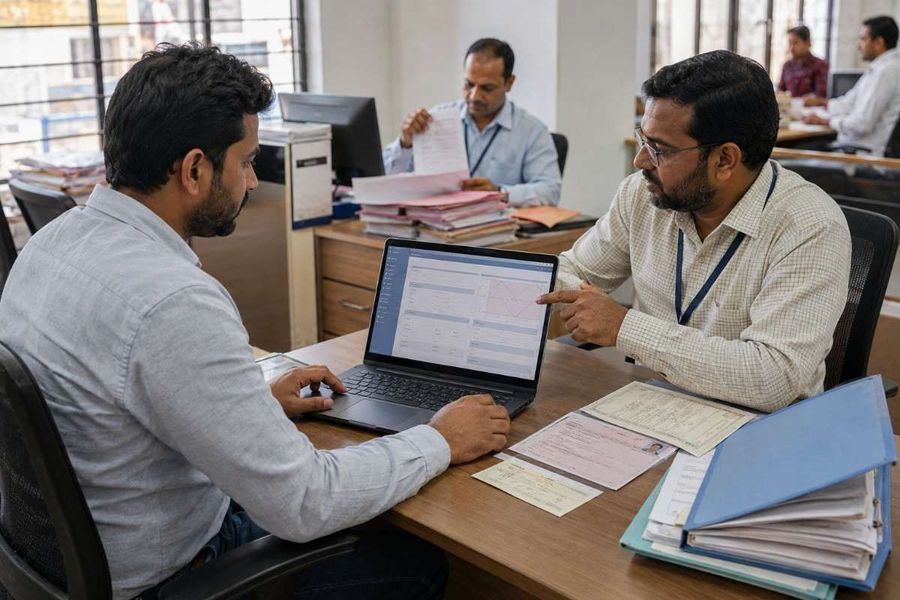
The structure holds across states, though the portal, the officer, and the register differ. The Bihar Dakhil Kharij guide and the Jharkhand guide cover two of the more common variants in detail.
Documents Required for Mutation
Registered sale deed or transfer document
Death certificate and legal heir certificate, for inheritance cases
Registered gift deed or will copy, where applicable
Applicant's identity proof, usually Aadhaar
Khata and Khesra or plot details
Latest land tax or Jamabandi receipt
Applying for Mutation Online
Open your state's official land records portal
Register or log in, then select the Mutation or Dakhil Kharij application option
Choose district, block or circle, and village
Enter land identification details such as Khata and Khesra number
Upload supporting documents
Submit and save the application number generated
The Circle Officer or Tehsildar then verifies the documents and, in most states, issues a public notice inviting objections before passing an order. In Bihar, the Circle Officer issues hearing notices as part of that sequence.
Several states now route registration data automatically from the National Generic Document Registration System to the Circle Officer's login, and Jharkhand has been upgrading its portal so mutations flow through without a separate application. Until such a system is fully live in your state, apply independently after registration rather than assuming it is handled.
How to Check Dakhil Kharij Status Online
Go to your state's land records or Bhumi portal
Select Check Mutation Status or Dakhil Kharij Status
Search by application or case number, registered deed number, or Khesra number
Enter the captcha and submit
Read the current status along with any remarks from the revenue office
Pending: still under review. Notice Issued: The objection window is running. This is routine and usually not a problem, though you may need to respond. Approved: the order has passed, and records are updated. Rejected: declined, generally for missing or mismatched documents.
Approval on the portal is not the end of the check. Portal status and Circle Office records can lag each other, so for anything consequential, confirm at the local office as well. Then pull the updated register entry and read it. Your name should appear exactly as on the deed, with the objections column blank and a current date. State-specific status quirks are covered in the Odisha, Chhattisgarh, and Tripura guides.
Registration vs Mutation at a Glance
What Happens If Your Mutation Application Faces an Objection or Rejection?
Most states run a public notice period during which other claimants can object. If nothing valid is raised, the application proceeds to order.
Rejections usually trace to incomplete documents, a mismatch in property details, or an unresolved dispute. If yours is rejected, read the remarks on the status page carefully, gather the corrected documents, and either reapply or file an appeal with the designated appellate authority within the applicable window. In Bihar, that authority is the Deputy Collector, Land Reforms. Track the appeal the same way as the original.
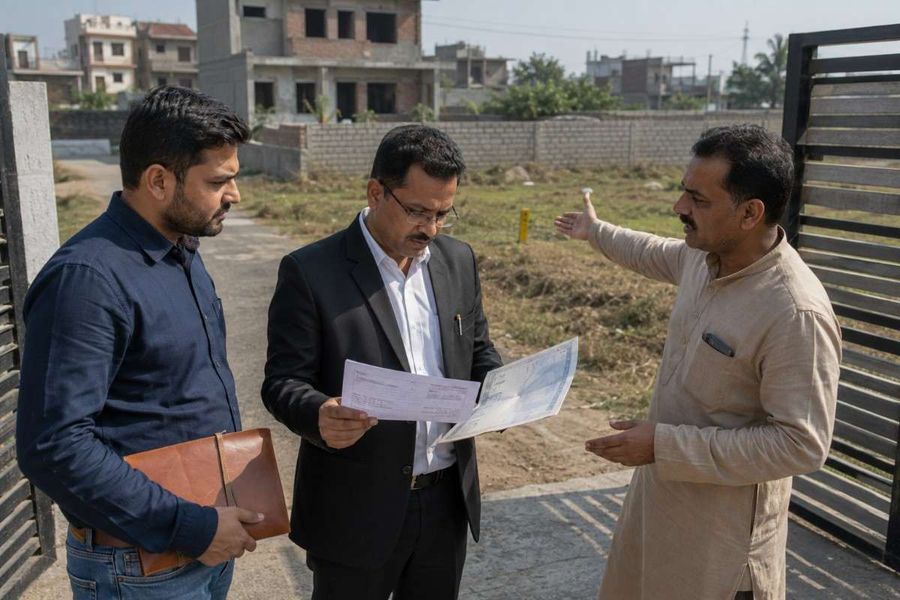
Most guidance on Dakhil Kharij treats it as something you do after purchase. The more valuable use is before.
The most common problem in Indian land transactions is not that the buyer forgets to mutate. It is that the seller never did. Their name sits on a deed but not in the register, which means the person selling you the land is someone the government has not formally recognised as owning it. A seller who says mutation is "in process" or "will be done after you register" is describing a gap you would be buying into.
1acre.in maintains state-level mutation guides covering the specific register, portal and statutory deadline for each state, which is what you need to run that check properly. The verification itself is unavoidably state-specific, and the platform's Preliminary Verification Process applies to listings rather than to third-party transactions.
For any purchase, the mutation status on the official state portal and at the Circle Office remains the record that counts.
Dakhil Kharij looks like paperwork that can wait. It cannot. Until it is complete, the land revenue record carries someone else's name, and that record is what a lender checks, what a court opens, and what the next buyer will look at when you eventually sell.
Confirm whether mutation is pending on anything you have bought, inherited, or been gifted. Check your state's filing deadline before assuming you have time. Keep the deed, ID proof, and plot details ready before applying.
Track the application until it shows approved, then verify the updated register entry rather than trusting the status page alone. And if an objection notice arrives, respond promptly rather than waiting for it to lapse.
-900x600.jpg)


-900x600.jpg)
-900x600.jpg)