
Bank Loan for Agricultural Land: Eligibility and Documents
Discover eligibility, required documents, and interest rates for bank loans on agricultural land, plus government schemes that cut costs.

- A bank loan for agricultural land funds purchase, development, or cultivation through regulated institutional credit, not informal moneylenders.
- Farmers, tenant farmers, sharecroppers, SHG members, and women applicants all have a defined path to qualify, even without prior land ownership.
- Most banks fund 70 to 85 percent of the land's valuation, at rates generally between 7 and 12 percent a year.
- What the bank checks before sanctioning anything is the land record, the sale deed, the revenue entry, and the survey report.
- Under the Modified Interest Subvention Scheme, a farmer who repays a short-term crop loan on time can bring the effective rate down to 4 percent, but it does not cover a land purchase loan.
- Checking a plot's records on a platform like 1acre.in before you sign a sale agreement helps you catch record mismatches early, but the bank still runs its own title and legal verification.
What a Bank Loan for Agricultural Land Is
This is secured credit for buying, developing, or cultivating farmland, offered under India's priority sector lending framework by public sector banks, private lenders, NBFCs, and regional rural banks.
One distinction buyers get wrong often enough to be worth stating plainly: A land purchase loan is a term loan, taken once, secured against the property being bought or land already owned, while a Kisan Credit Card is revolving working capital for seasonal crop expenses. Both sit under agricultural credit, which is why people conflate them, but no bank will sanction a land purchase against a KCC limit.
These loans cover new farmland purchase, developing fallow land, moving into horticulture or dairying, and funding irrigation or soil improvement on land already owned.
What the Bank Actually Verifies
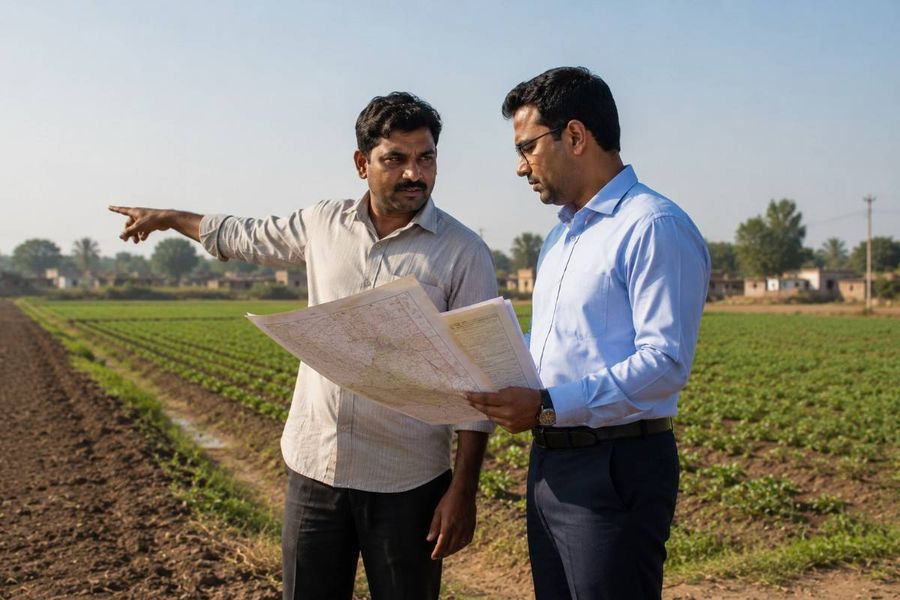
Before sanctioning anything, a lender checks the borrower's eligibility using farm records, bank statements, or ITRs, verifies the seller holds clear title using the sale deed, Record of Rights (RoR), mutation records, and other revenue records, and looks for encumbrances that could block a fresh mortgage.
It confirms the survey number and boundary match what's on paper, gets an approved valuer to price the land, and checks that it is still classified as agricultural, since reclassified land needs a different loan product.
Who Can Apply
Eligibility follows RBI priority sector guidelines fairly closely. Most banks want applicants between 18 and 65 at loan maturity, with active farmers as the default category, though a credible farm business plan can work for some lenders too.
Marginal farmers with up to a hectare are eligible and often get priority, as do small farmers with one to two hectares.
Tenant farmers, sharecroppers, and landless labourers can come in through self-help groups or joint liability groups, where collective liability stands in for individual collateral, and women applicants qualify on equal terms, with several public sector banks prioritising distress applicants and widows.
You don't need to already own land to apply. A registered sale agreement for the land you're planning to buy is usually enough to get the bank moving, as long as the seller's title is clean.
Documents You Will Need
The list shifts a little by lender, but most banks ask for the same core set: Aadhaar, PAN, or Voter ID for identity; a utility bill or passport for address; the sale deed, revenue record, and survey report for land verification; the registered sale agreement for ownership; and bank statements or ITRs for repayment capacity.
For loans above three lakh rupees, banks also want a valuer's report and a legal clearance certificate. Revenue records go by different names across states, but every bank requires the latest Record of Rights (RoR) or equivalent state land ownership record, along with updated mutation entries where applicable.
How the Application Process Works
Start by comparing rates across a few nearby lenders. Gather paperwork ahead of the bank visit, submit the application, often online, and the lender will verify documents, inspect the land, and order a valuation, with larger loans also going through a legal title search. Approval brings a sanction letter, and funds release once the mortgage is created.
With clean paperwork, most public sector banks get through this in three to six weeks. Missing or unclear land records are the biggest reason applications stall.
Common Pitfalls and Red Flags
A mismatched survey number, where plot boundaries don't match revenue records, is one of the most common holdups.
Land reclassified as non-agricultural rules out a standard loan entirely. An undisclosed encumbrance tends to surface during the legal search and can stall things for weeks, an unregistered sale agreement is a dead end for most lenders, and gaps in the ownership history slow the clearance stage more than almost anything else.
Interest Rates, Loan Amount, and Repayment
Most banks fund 70 to 85 percent of market valuation, shaped further by repayment capacity. Rates run 7 to 12 percent a year depending on lender and loan size.
Tenure can stretch to 15 years, though 7 to 10 is more typical, and many lenders align repayment with harvest cycles instead of a fixed monthly instalment.
Prepayment charges are minimal on floating-rate loans, and processing fees are usually waived below three lakh rupees.
Government Schemes That Cut Your Cost
The Kisan Credit Card gives revolving credit at subsidised rates and can double as working capital during land acquisition.
The Modified Interest Subvention Scheme covers short-term crop loans taken through a Kisan Credit Card, not land purchase loans. Eligible loans carry a concessional 7 percent, with a further 3 percent prompt repayment incentive bringing that down to 4 percent. The limit has been three lakh rupees, and Budget 2025-26 announced an increase to five lakh rupees, so confirm the current limit with your bank.
The Rashtriya Krishi Vikas Yojana channels state funding into land development, and the Pradhan Mantri Fasal Bima Yojana ties crop insurance to loans, protecting repayment if a crop fails. India's ground-level credit target for agriculture for FY 2025 to 2026 stood at 32.5 lakh crore rupees, a sign that institutional lending here keeps expanding.
Is the Process Reliable
The risk in an agricultural land loan rarely comes from the bank's side, since underwriting follows a fairly standardised process. It sits upstream, in whatever land records the borrower brings. A sale deed can look complete and still hide an unregistered prior transfer or an encumbrance that only shows up once the bank runs its legal search. Checking documents against the state revenue portal before applying saves real time.
How 1acre.in Supports Land Buyers
Getting a bank loan against agricultural land comes down almost entirely to the quality of the land record, and most buyers have no easy way to check that before they're deep into approval.
1acre.in cross-checks listed parcels against survey numbers and revenue records before they go live, so a buyer starts the loan process with a plot that has already cleared a first layer of scrutiny.
Its guides on Record of Rights (RoR), sale deeds, mutation records, survey maps, encumbrance certificates, and state land records portals cover the same documents banks typically verify during legal due diligence, helping buyers prepare before submitting a loan application.
Pre-Purchase Checklist
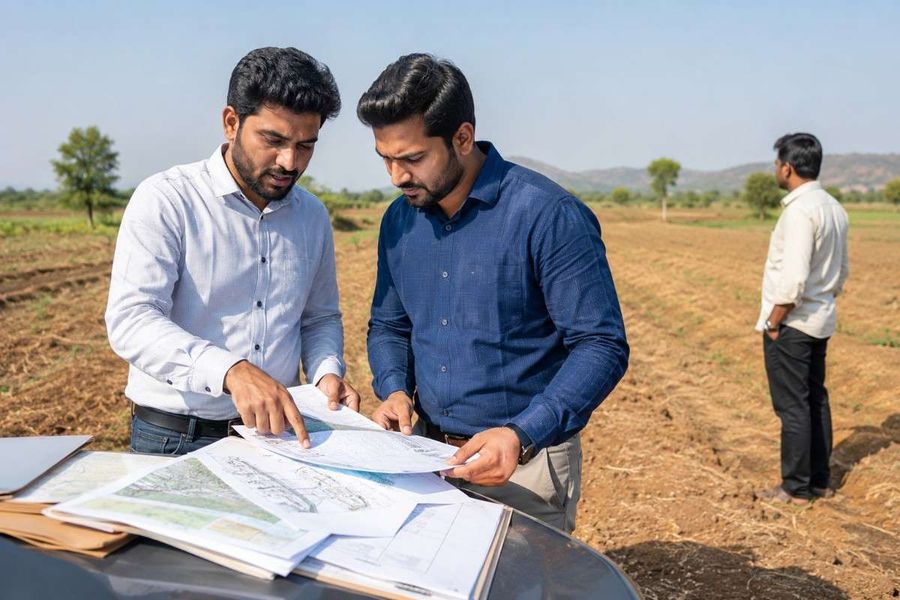
Confirm the land is still classified as agricultural in current revenue records. Check that the survey number and boundaries match the sale deed and the ground reality.
Look for existing encumbrances, liens, or pending litigation. Get the sale agreement registered with the Sub-Registrar before it goes to the bank.
Pull together six to twelve months of bank statements or farm income records ahead of time. Check which loan product the bank is offering; interest subvention covers short-term crop loans, not land purchase loans.
Conclusion
A bank loan for agricultural land is accessible, and government schemes can cut the cost of the crop credit that follows. What determines how fast it moves is the state of the land's paperwork before the application goes in. Sorting out title, survey numbers, and encumbrance status early is usually the difference between a three-week approval and a three-month one.
-900x600.jpg)
-900x600.jpg)
-900x600.jpg)
-900x600.jpg)
-900x600.jpg)
-900x600.jpg)