
Joint Development Agreement: Landowner and Builder Shares
Understand how joint development agreements work in India, typical share ratios, tax implications, and how to vet builders safely.
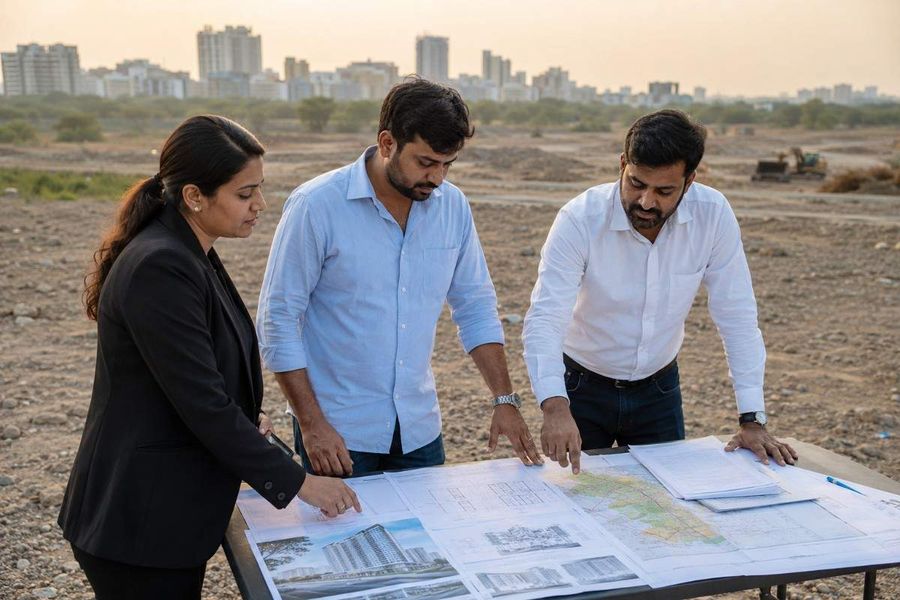
- A joint development agreement lets a landowner put in land and a builder handle construction, so both sides share the outcome instead of one paying the other upfront.
- There are three ways to structure shares, area, revenue, or profit, each with a different risk profile.
- Landowners usually walk away with 25 to 50 percent of the developed property, depending on location and leverage.
- Courts won't enforce a JDA unless it's registered under the Registration Act, 1908.
- Section 67(14) of the Income-tax Act, 2025 (Section 45(5A) of the 1961 Act) pushes capital gains tax out to the year the completion certificate is issued, not the year the agreement is signed.
- Checking a builder's RERA status and delivery record beforehand, easier through a platform like 1acre.in, heads off most disputes that show up later.
What a Joint Development Agreement Actually Is
Think of a JDA as a structured trade. The landowner hands over land, but not ownership, and the developer builds on their own dime, giving back a slice once the project's done, either physical units or a cut of sales revenue.
The landowner unlocks value from idle land without selling it off, the developer gets prime land without paying to buy it.
The landowner generally retains ownership until later conveyance documents are executed. A JDA primarily grants development rights rather than immediately transferring ownership. What moves is the right to develop and sell.
These agreements draw from four different laws at once, the Indian Contract Act of 1872, the Transfer of Property Act of 1882, the Registration Act of 1908, and RERA. Registration with the Sub-Registrar isn't optional: under Section 17(1A) of the Registration Act, an unregistered agreement cannot be relied on for part-performance protection under Section 53A of the Transfer of Property Act, and Section 49 limits its use as evidence.

What the Agreement Covers
Area sharing shows up most often in residential projects. The total built area, carpet, built-up, or super built-up, whichever gets defined upfront, is divided in an agreed ratio, so a 40:60 split on a 100-flat project leaves the landowner with 40 units to keep.
Owners who'd rather hold or rent than cash out tend to prefer this, since it shields them somewhat from a shaky market. Revenue sharing works differently. The developer sells everything and hands the landowner a cut of gross sales, which shows up more in hot urban markets where an owner trusts the builder's ability to sell and wants cash rather than keys.
The catch is precision, gross sales, net sales, or actual collections has to be spelled out clearly, because loose drafting here is where most fights start. Profit sharing barely gets used anymore.
It splits what's left after construction, approvals, marketing, and financing costs come out, and while it aligns incentives nicely in theory, a developer who inflates costs quietly shrinks the landowner's cut too, so this only really holds up with real audit rights baked in.
How the JDA Process Works
It starts with negotiation, both sides working out which model fits and what ratio makes sense. A lawyer then drafts the agreement, covering the sharing clause, timelines, and a registered GPA limited to what the project requires, before registration with the Sub-Registrar.
Only after that does the developer apply for approvals, register with RERA, and break ground, with units or revenue handed over once the project reaches completion. A mid-sized residential project usually takes three to five years for this whole cycle, longer for bigger ones.

Regulatory Red Flags
Skip registration, and the agreement is worth nothing in court, so any JDA transferring development rights needs to go through the Registration Act before construction begins.
Vague sharing clauses cause the most trouble, a bare percentage without specific units, floors, or a defined revenue base leaves too much open to interpretation.
A GPA drafted too loosely can hand the developer more authority than the project calls for, and that's hard to claw back.
Skip the penalty clauses, and delays go unremedied; skip the reversion clause and a default means litigation instead of an automatic handback of rights.
Area Sharing vs Revenue Sharing
Area sharing hands the landowner physical units and shields them from market swings, suiting anyone planning to hold or rent.
Revenue sharing trades that certainty for cash, riding on how well the developer sells, and works best for owners who want liquidity and trust the builder's track record.
Tax Implications
Individual and HUF landowners under a registered JDA get to push capital gains tax out to the year the completion certificate lands, under Section 67(14) (earlier 45(5A)), instead of paying up the year the agreement gets signed, fixing an old headache where owners owed tax before receiving a single unit. The Income-tax Act, 2025 replaced the 1961 Act from 1 April 2026; for transactions completed before then, the old section numbers apply.
Cash paid on top of the property share draws TDS at 10 percent under Section 393(1) (Table Sl. No. 3(ii)) of the Income-tax Act, 2025 (Section 194-IC of the 1961 Act), and units the builder keeps count as stock-in-trade, taxed as business income when sold. GST applies on units sold before the completion certificate; sell after, and it's an immovable property sale, GST-exempt.
The structure holds up fine on paper, and plenty of projects run through it without a hitch. Where things go wrong is almost always the builder, not the model. A developer running out of money can leave a project half-finished for years, and the landowner stuck with few options.
Checking RERA registration, delivery record, and financial health before signing catches most of what could go wrong. To help shortlist developers, 1acre.in provides a JD Matchmaking track that connects landowners directly with developers from its network.
How 1acre.in Supports Landowners Considering a JDA
Finding the right developer is the most critical step in a JDA. 1acre.in provides a dedicated Joint Development Matchmaking track specifically for landowners. Instead of searching blindly, owners of prime land with a clear title can receive up to three project proposals from reputed developers in 1acre’s network, usually within 2–3 weeks of the land being qualified.
Additionally, 1acre’s Premium geospatial tools allow owners to view HMDA masterplans, ring road overlays, and survey number maps. This data provides the transparency needed to value land accurately and choose between area or revenue sharing with confidence. For owners of prime parcels, 1acre also offers an Off-Market track that takes the land to developers directly, without a public listing.
Before Signing a JDA
Check the developer's RERA registration, financial standing, and past delivery record. Make sure the sharing ratio names exact units or a clearly defined revenue base, not just a bare percentage.
Confirm the GPA is scoped tightly, push for a real penalty clause on missed milestones, and build in a reversion clause that hands rights back automatically if the builder defaults.
Bring in both a property lawyer and a tax advisor before signing, since capital gains, GST, and TDS all shape what actually lands in your pocket.
Conclusion
A joint development agreement can unlock real value from land without forcing a sale. How well it works comes down almost entirely to the builder's track record and how carefully the agreement is drafted. Registration, a precise sharing clause, and a reversion clause that actually functions are what protect a landowner once construction starts.
-900x600.jpg)
-900x600.jpg)
-900x600.jpg)
-900x600.jpg)
-900x600.jpg)
-900x600.jpg)