
Can NRIs Buy Land in India? What's Allowed and What's Not
Understand NRI property buying rules in India, agricultural land restrictions, FEMA compliance, taxation, and the step-by-step legal purchase process.

- NRIs freely buy residential and commercial property. No cap, no RBI approval.
- Agricultural land, farmhouses, and plantation property are off-limits under FEMA, barring narrow exceptions, chiefly inheritance.
- Repatriation of sale proceeds depends on FEMA rules, the source of funds, tax compliance, and RBI regulations.
- Long-term gains on property over 24 months are taxed at 12.5% without indexation, and the grandfathering relief excludes NRIs.
- Absentee ownership brings real risk and needs active due diligence, not paperwork after the fact.
Who Actually Counts as an NRI
Two categories matter here. Under FEMA, 1999, an NRI is an Indian citizen residing outside India. Overseas Citizens of India (OCIs) generally enjoy similar property purchase rights for residential and commercial properties.
If you have an Indian passport abroad, you are an NRI. Foreign passport, Indian roots, most likely an OCI. For buying property, both are generally treated alike under FEMA.
What NRIs Can Actually Buy
Residential and commercial property is fair game. No RBI approval, no cap. Apartments, villas, houses, offices, and retail all qualify.
What is not on the table is agricultural land, farmhouses, or plantation property. The ban applies nationally, whatever your income or residence, and covers every route: sale deed, agreement to sell, or otherwise.
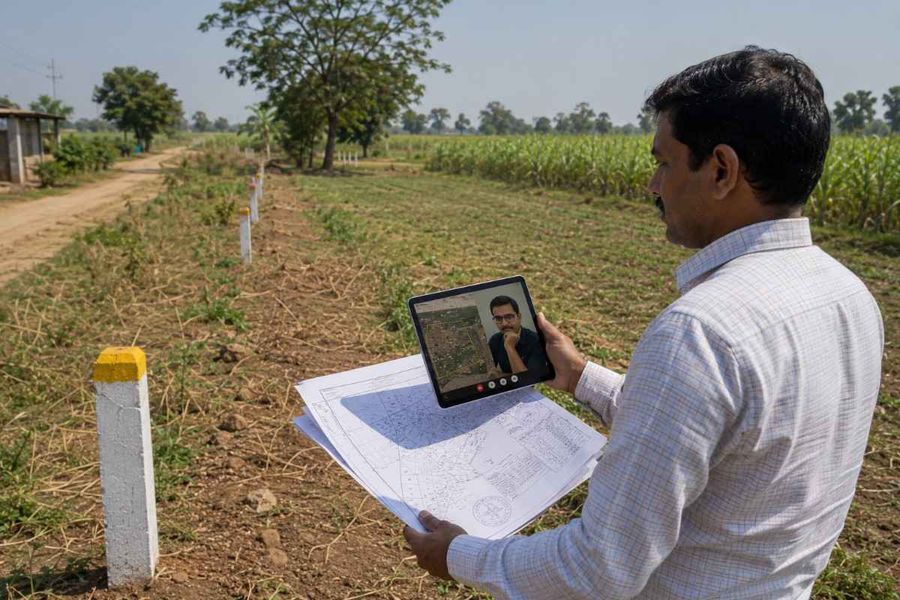
The Agricultural Land Ban: Why It Exists
The restriction runs through FEMA's capital-account framework, now the Foreign Exchange Management (Non-debt Instruments) Rules, 2019, and the RBI Master Direction, not a single section. Farmland ties into food security, and offshore capital risks distorting prices and displacing those who work the land.
RBI approval exists but is rarely granted, reserved for genuine agricultural or public-interest cases. It is not a realistic investment route.
Violating this is no minor slip. The transaction is voided, the Enforcement Directorate can step in, and penalties up to three times the value are possible.
The Narrow Exceptions
Inheritance is the most common path. An NRI can inherit agricultural land from a resident Indian, or from a person living abroad who acquired it lawfully under the foreign exchange rules in force at the time. RBI approval is not needed to inherit. Once inherited, it can be sold, but only to a resident Indian. The capital gains position on that sale is a separate calculation worth doing early.
Gift: not an exception. FEMA lets an NRI receive gifted property only if it is not agricultural land, a farmhouse or plantation property, so even a resident relative cannot gift you farmland.
Prior ownership: If you owned agricultural land as a resident before becoming an NRI, you can keep it. The restriction bites only on acquisitions after your status changed.
In both cases, repatriating proceeds is not automatic. It is subject to RBI guidance and tax compliance.
Step-by-Step: Buying Property as an NRI
The sequence, with the compliance point that governs each step.
Confirm eligibility. Verify NRI/OCI status and that the property is residential or commercial, not agricultural or plantation-related.
Choose the property. Shortlist RERA-registered projects and verify all statutory approvals with the relevant authority.
Due diligence. Run a 30-year title search and pull the EC to rule out disputes, mortgages, and restricted land or legally non-transferable land.
Open an NRI account. Set up NRE, NRO, or FCNR; all payments route through it.
Execute a PoA if needed. Get it attested at the embassy or apostilled in a Hague country and stamp it in India before use.
Sign the agreement on stamp paper with a payment schedule, and register within four months.
Transfer funds from NRE/NRO/FCNR and keep the FIRC.
Pay stamp duty at state rates, confirmed locally first.
Register the sale deed with the competent registration authority, in person or via the PoA holder. This is your proof of ownership.
Post-purchase, file tax on rental income; keep records for seven years.
Every purchase flows through an NRE, NRO, or FCNR account. Cash is barred under FEMA and tax law.
From an NRO account, up to USD 1 million per year can be sent abroad, subject to tax compliance. For residential property bought with foreign funds, full repatriation covers two properties; beyond that, funds stay within the USD 1 million.
A flat bought with foreign funds via your NRE account is fully repatriable later. Bought with NRO funds, money earned in India, repatriation is capped and needs RBI documentation.
Documents You'll Need
Identity: passport with OCI card, PAN, and proof of overseas residence.
Property: title deed with 30-year history, encumbrance certificate, regulatory approvals (where applicable), and the approved plan and occupancy certificate for completed builds.
Transaction: NRE/NRO/FCNR statements, the Foreign Inward Remittance Certificate, an attested Power of Attorney if absent, and Forms 15CA/15CB where annual remittances abroad cross ₹5 lakh.
Tax Obligations
TDS depends on who's selling: a resident seller means a small deduction on higher-value deals, but an NRI seller triggers TDS no matter the property's worth. Profits from property held over two years count as long-term capital gains, and NRIs no longer get the older indexation benefit that reduces taxable profit.
Rental income earned in India is taxable here too, though a standard deduction applies. If your home country has a tax treaty with India, you can usually claim credit for tax already paid in India against your bill there.
How 1acre.in Helps
The hardest part of buying from abroad is the distance between what a listing claims and what the land is. 1acre.in lists verified survey numbers with maps and master plan overlays, helping you verify land classification, zoning, survey details, and location before committing funds, and check its boundary before you fly in or wire an advance.
The scope is narrow and matters more for a remote buyer. A map overlay shows classification and location. It gives no FEMA or tax advice, cannot read a title or catch a forged deed, and does not replace a qualified property lawyer and tax advisor familiar with NRI transactions.

Conclusion
Buying property as an NRI is straightforward on paper but unforgiving in practice. Residential and commercial purchases move freely, agricultural land rarely does, and the gap between the two catches people who skip verification because they're buying from a distance. Confirm classification before you commit, route every payment through an NRE, NRO, or FCNR account, and bring in a qualified property lawyer and tax advisor familiar with NRI transactions, because no listing or map can substitute for the title and tax work.
-900x600.jpg)
-900x600.jpg)
-900x600.jpg)
-900x600.jpg)
-900x600.jpg)
-900x600.jpg)