Waqf land in India: What buyers must check before purchase
A waqf is a permanent dedication of property for religious or charitable use under Islamic law, and the Waqf Act, 1995 treats any sale of it as void. Waqf land in India cannot be sold through a private deal, yet plots with a waqf history still change hands through registered deeds. When that happens, buyers usually find out only after a State Waqf Board notice arrives, and the deed gives them little protection. The Waqf (Amendment) Act, 2025 has also changed how these properties are registered and claimed, and parts of it are on hold before the Supreme Court. This guide explains what counts as waqf land, what the law allows and how to check records in Telangana and Andhra Pradesh. It also covers how disputes are decided and the warning signs to look for before you pay an advance.

- A sale of waqf property is void under Section 51(1A) of the Waqf Act, even with a registered deed.
- Leases of waqf property are valid only with the State Waqf Board's prior sanction.
- The Supreme Court stayed parts of the Waqf (Amendment) Act, 2025 on 15 September 2025.
- Waqf disputes go to the Waqf Tribunal, with an appeal to the High Court.
- In Telangana and Andhra Pradesh, waqf land can appear on the Section 22A prohibited property list.
What counts as waqf land in India
Waqf land is property that a Muslim has dedicated permanently to a purpose Islamic law recognises as religious, pious or charitable. Once dedicated, it belongs to that purpose for good, and the original owner and their heirs lose the right to sell it. Mosques, dargahs (shrines built over a saint's grave), graveyards and madrasas fall in this category, along with the farmland, shops or buildings whose income funds them.
Who manages waqf board land
State Waqf Boards supervise these properties under the Waqf Act, 1995. Day-to-day affairs are run by a mutawalli, the caretaker or manager named for each waqf. Neither of them owns the land. Waqf board land is therefore not government land, and it isn't the Board's own asset to sell. The Board's job is to protect the endowment, keep records and act against anyone who occupies or transfers it unlawfully. Each Board keeps a register of auqaf (the plural of waqf), and the lists of auqaf found in surveys are published in the State Gazette.
Recorded waqf status versus land near a waqf
A plot next to a mosque or graveyard is not waqf just because of where it sits. What matters is whether the land itself, or the larger survey number it was split from, is recorded as waqf in the Board's register, the Gazette list or the revenue record. A survey number is the unique number given to a piece of land in revenue records. Even so, a religious structure on or beside a parcel is a good reason to check the records closely, because older waqf boundaries were often recorded loosely.
Can you buy waqf land? The core rule
No. You cannot buy waqf land in India through a private sale, and a registered sale deed does not change that. The law allows only 2 narrow kinds of dealing, and neither gives an individual buyer ownership.
Sale, gift and mortgage are void
Section 51(1A) of the Waqf Act says any sale, gift, exchange, mortgage or transfer of waqf property is void ab initio. That means the law treats it as if it never happened. This rule came in with the 2013 amendment. Before that, a sale needed the Board's prior sanction, and some older transfers were made that way. For a buyer, the waqf property buying rules come down to one point. The deed may be registered and the mutation (the update of the owner's name in revenue records) may be done, but if the land is waqf, the transfer has no legal effect and the Board can still claim it.
Leases and public acquisition
Leasing is treated differently. A lease of waqf property is valid only with the Board's prior sanction. Mosques, dargahs, khanqahs (Sufi lodges), graveyards and imambaras (halls used for Shia religious gatherings) cannot be leased at all. The Act also allows waqf land to be acquired for a public purpose under land acquisition law, in consultation with the Board and with compensation at market value. That is an acquisition by the State, not a private purchase, so it offers no route for an individual buyer.

What the 2025 amendment changed for buyers
The Waqf (Amendment) Act, 2025 came into force on 8 April 2025. It tightened record-keeping and curbed some claims, but it did not make waqf land saleable. On 15 September 2025, the Supreme Court declined to stay the whole Act and paused only selected provisions until the challenge is decided. Check the latest order before relying on any single rule.
Registration on the UMEED portal
UMEED (Unified Waqf Management, Empowerment, Efficiency and Development) is the central portal where every existing waqf had to upload its details. It went live on 6 June 2025, and the 6-month window closed on 6 December 2025. The Supreme Court refused to extend the deadline, noting that the Waqf Tribunal can allow more time in genuine cases. The older WAMSI (Waqf Assets Management System of India) database was shut down in May 2025. For a buyer, this means waqf board land records are being rebuilt and may be incomplete or still changing. A parcel missing from the portal is not proof that it is free of a waqf claim.
Waqf by user, government land and limitation
Waqf by user meant land treated as waqf because it had long been used for religious or charitable purposes, even without a deed. The 2025 Act removes this route for the future. Existing waqf by user properties registered before the Act came into force are kept, unless they are disputed or identified as government land. Long-used land without papers can therefore still be contested.
The Court also stayed the provision letting a government officer decide whether a waqf claim covers government land. While such an inquiry and any Tribunal decision are pending, no third-party rights can be created in that property. Separately, the Limitation Act, 1963, which sets time limits for filing suits, now applies to waqf claims. Earlier, Section 107 of the Waqf Act kept waqf suits for possession outside those limits.
How to check waqf land records in Telangana
Telangana has a large number of recorded waqf properties, so buyers in Hyderabad and the surrounding districts are better off treating this check as routine. For the wider purchase process, see the guide on how to buy land in Telangana.
Revenue records on Bhu Bharathi
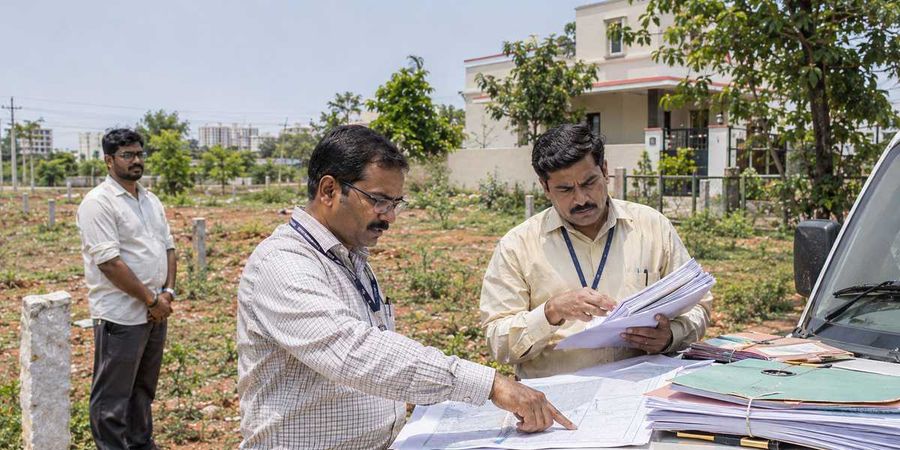
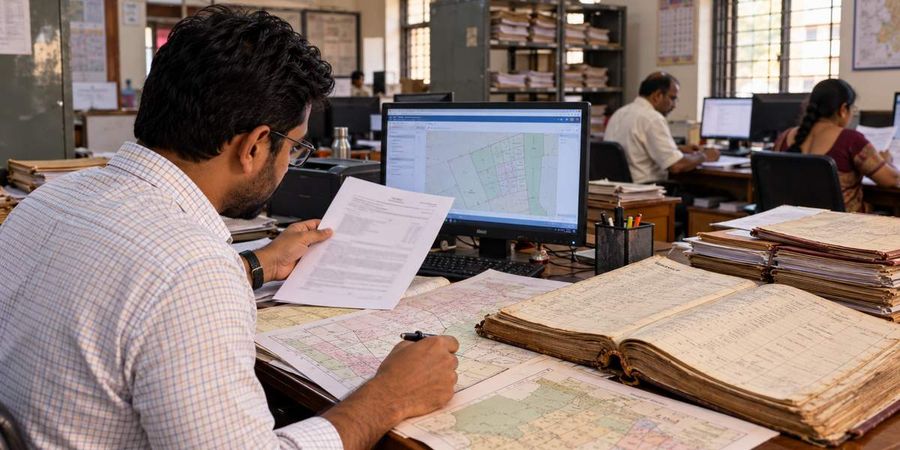
Bhu Bharathi replaced Dharani as Telangana's land records portal in 2025. Start with the Bhu Bharathi land records guide to pull the land details for the survey number. Then read the pahani and ROR-1B records in Telangana. The pahani is the village record of ownership and cultivation, and ROR-1B is the record of rights register. Look for any remark that mentions waqf, dargah, masjid or inam (land granted by a former ruler, often to a religious institution). Also review the mutation history on Bhu Bharathi to see how the land reached the current seller.
Prohibited property list and EC in Telangana
Section 22A of the Registration Act, as amended for the state, lets the government bar registration of certain lands, including waqf and endowment properties. Run a prohibited land (22A) check in Telangana before any advance changes hands. Next, get an encumbrance certificate in Telangana. An encumbrance certificate (EC) lists registered transactions on a property over a chosen period, so it can reveal an old sale by a mutawalli. Finally, write to the Telangana State Waqf Board for a reply on the survey number.
How to check waqf land records in Andhra Pradesh
Andhra Pradesh follows a similar sequence, using its own portals and the Andhra Pradesh State Waqf Board. Use the same survey number throughout, written exactly as it appears in the seller's documents, so every record you pull refers to the same parcel. The guide on how to buy land in Andhra Pradesh covers the rest of the purchase process.
Adangal and 1B on Meebhoomi
Meebhoomi is the state's online land records portal. The Meebhoomi portal guide explains how to search by survey number or account number. Pull the pahani and ROR-1B records in Andhra Pradesh, known locally as the adangal and 1B. The adangal shows the land's classification and cultivation details, and the 1B shows the recorded owner. Check both for any waqf, dargah or inam entry, and compare the extent with what the seller claims.
22A list and EC in Andhra Pradesh
Andhra Pradesh also keeps a Section 22A prohibited property list, which covers waqf and endowment lands among other categories. The Meebhoomi 22A prohibited list check shows how to search it by district and survey number. After that, get an encumbrance certificate in Andhra Pradesh covering at least 30 years. If any entry looks unclear, ask the Andhra Pradesh State Waqf Board for a written reply on the survey number and its parent survey number.
How a waqf land dispute plays out
A waqf land dispute is decided by a specialised tribunal, not an ordinary civil court. The buyer is often the party with the most to lose, because the money has already been paid.
Who decides a waqf land dispute
Each state has a Waqf Tribunal under Section 83 of the Waqf Act, and Section 85 bars civil courts from hearing matters the Tribunal is meant to decide. In Rajasthan Wakf Board v. Subhan Ali, the Supreme Court held that whether a property is waqf, and disputes over sales made in breach of Section 51, belong to the Tribunal. The old Act allowed the High Court only to revise Tribunal orders. The 2025 amendment adds a direct appeal to the High Court.
What the buyer risks
Under Section 52, the Board can ask the District Collector to recover possession of waqf property transferred in breach of the Act. In practice, a good-faith buyer can end up defending the land while holding a deed the law treats as void. The Munambam case in Kerala shows how long this can take. Residents bought plots decades ago from a college that had received the land as a gift. The Kerala State Waqf Board registered the land as waqf in 2019, and the earlier sales were questioned. The dispute has since gone before the Waqf Tribunal and the Kerala High Court.

Pre-purchase checks: a quick reference table
Check waqf status from 3 directions before you pay: revenue records, Board records and court records. Each one can show what the others miss.
Waqf land verification at a glance
Pre-purchase checks: a quick reference table
What to check
Where to check
What to look out for
Land status and remarks
Prohibited list
Waqf listing
Pending cases
Title chain
Ground reality
Bhu Bharathi (Telangana), Meebhoomi (Andhra Pradesh) and the village revenue record
The state's Section 22A list
State Waqf Board register, Gazette list of auqaf, UMEED portal data
Waqf Tribunal and High Court case status
Sale deeds and EC for at least 30 years
Site visit and talks with neighbours
A waqf, dargah, masjid or inam remark
Survey number appears on the list
Survey number or its parent survey number appears
Any case on the parcel, or a Board notice
Origin from a dargah, mosque or endowment, or a sale by a mutawalli
Graveyard, dargah wall or religious structure on or beside the parcel
Ask the Board for a written reply on the survey number rather than relying on a verbal assurance, and keep it with your papers.
What to look out for before you sign
If any of these appears, pause the deal and get a lawyer's opinion. Treat each one as a reason to dig further, not as proof of a problem.
The seller cannot show how the land passed to them from the original owner.
The price is well below nearby rates for the same type of land.
A mutawalli or "caretaker" is selling, or the papers mention a dargah, mosque or endowment.
The parcel is carved out of a larger survey number that has a waqf entry.
The seller resists a Board check or pushes for a quick advance.
Next steps before you pay an advance
Pull the revenue record and the 22A list, and note any waqf or prohibited remark.
Get the State Waqf Board's written reply on the survey number and its parent survey number.
Search Waqf Tribunal and High Court cases for the parcel and the seller.
Trace the title for at least 30 years and visit the site.
Have a property lawyer review everything before money changes hands.
Disclaimer
Browse land for sale on 1acre.in and run these checks on every plot you shortlist.