
Gift deed vs will vs settlement deed: Which is right for family land transfer?
Parents passing land to their children usually pick from 3 documents. The gift deed vs will vs settlement deed choice decides when ownership moves, how much control you keep and what you pay. A gift deed or settlement deed transfers the land while you are alive. A will transfers it only after death. A wrong choice can leave parents without a home, or heirs in court for years. In this blog, we will explain how each document works, how they compare, what they cost in Telangana and Andhra Pradesh, and the risks to check before you sign.
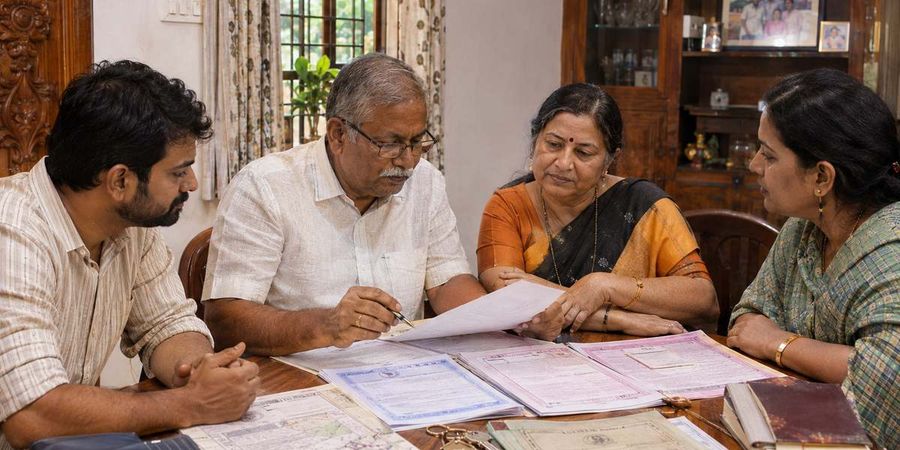
- A gift deed and a settlement deed transfer ownership now, while a will does so only after death.
- Gift and settlement deeds of land must be registered and cannot be cancelled by the giver alone.
- A will can be changed at any time and needs no stamp duty or registration.
- Gift deeds to family members attract 2% stamp duty in both Telangana and Andhra Pradesh.
- A transfer to a child can be cancelled if the child fails to maintain a senior citizen parent.
The short answer: which document fits which goal
Choose a gift deed or settlement deed to hand over land now, and a will to hand it over after your death. For anyone planning to transfer property within the family, the real choice is about timing, control and cost.
Which one should you choose?
You want your child to own the land now, with no conditions: a gift deed.
You want to transfer now but keep the right to live there or receive income: a settlement deed.
You want full control until death and no stamp duty: a will.
You have several children and want to avoid disputes: a will, or separate settlement deeds with clear terms for each.
How each document works
Gift deed
A gift deed is a voluntary transfer of land without payment, made while the owner is alive. Under Section 123 of the Transfer of Property Act, 1882, a gift of land must be signed by the donor, attested by 2 witnesses and registered. The receiver must accept it during the donor's lifetime. Once accepted, the donor cannot revoke it alone. Reversal is possible only on limited grounds, such as a condition agreed in the deed.
Settlement deed
A settlement deed is a lifetime transfer, usually within the family, that comes with conditions or arrangements. A parent might settle land on a child while keeping the right to live there or collect the income. The Supreme Court treats a settlement as an immediate transfer of ownership, even when the giver keeps such rights. Like a gift deed, it must be registered.
Will
A will sets out who gets your property after you die. Under Section 63 of the Indian Succession Act, 1925, you sign it and at least 2 witnesses attest it. Registration is optional under Section 18 of the Registration Act, 1908, and no stamp duty applies. You can revoke or change a will at any time during your life.
Settlement deed vs gift deed: what actually differs
Both transfer ownership at once and need registration. In N.P. Saseendran v. N.P. Ponnamma, the Supreme Court said the key difference is that a settlement can involve consideration, meaning something given or promised in return. A gift is purely gratuitous. A settlement may carry duties, such as the receiver's obligation to maintain the giver.
The Court also held that keeping a life interest, such as the right to live there, does not turn the deed into a will. This matters for parents who want to transfer title but keep the roof over their heads.

Gift deed vs will: timing and control
The gift deed vs will decision comes down to when you are ready to give up control.
With a gift deed, the receiver becomes the owner at once and can sell or mortgage the land.
With a will, you keep control until death, but the will can be challenged later and must be proved by an attesting witness.
For will vs gift deed property planning, order matters. Land you have already gifted is no longer yours, so a later will cannot pass it on. Gifting your only home to one child can also leave you dependent on that child.
Gift deed vs settlement deed vs will at a glance
Gift deed vs settlement deed vs will at a glance
Feature
Gift deed
Settlement deed
Will
Takes effect
Registration for land
Stamp duty
Can you revoke it?
Conditions
Your control in life
Suits
During your lifetime
Mandatory
State rate, lower for family
No, unless the deed allows
Possible, if accepted
Ends once accepted
Clean, unconditional handover
During your lifetime
Mandatory
State rate, lower for family
No, unless the deed allows
Usually central to it
Ends, apart from retained rights
Handover with terms or a life interest
After your death
Optional
None
Yes, at any time
Possible, within the law
Full
Keeping control until death
Cost and tax
Stamp duty is the main cost of a lifetime transfer, and it is charged on the land's market value.
Stamp duty in Telangana and Andhra Pradesh
Cost and tax
State
Gift deed to family
Gift deed to others
Telangana
Andhra Pradesh
2% stamp duty, registration fee Rs 2,000 to Rs 25,000
2% stamp duty, 0.5% registration fee
5% stamp duty
5% stamp duty, 1% registration fee
State
Gift deed to family
Gift deed to others
Telangana
Andhra Pradesh
2% stamp duty, registration fee Rs 2,000 to Rs 25,000
2% stamp duty, 0.5% registration fee
5% stamp duty
5% stamp duty, 1% registration fee
Source: Registration and Stamps Departments of Telangana and Andhra Pradesh, last checked March 2026. Confirm settlement deed rates with the Sub-Registrar before you draft. In Telangana, start with the market value on Bhu Bharathi. In Andhra Pradesh, check the Meebhoomi market value. The Andhra Pradesh stamp duty calculator then estimates the cost.
Income tax on family land transfers
Land gifted by a specified relative, such as a parent, spouse or sibling, is not taxed in the receiver's hands. Inheritance is not taxed on receipt either. The receiver takes over the giver's original cost and holding period for any later sale. A gift of land from a non-relative is taxable if its stamp duty value exceeds Rs 50,000. Under the Income-tax Act, 2025, this rule sits in Section 92(2)(m), which replaced Section 56(2)(x).
Risks to check before you choose
Most family disputes come from missing clauses, not missing documents.
Senior citizens and maintenance
Section 23 of the Maintenance and Welfare of Parents and Senior Citizens Act, 2007 lets a tribunal void a transfer if the receiver fails to maintain the giver. In Urmila Dixit v. Sunil Sharan Dixit (January 2025), the Supreme Court restored the cancellation of a gift to a son. Courts still differ on whether the condition must be written into the deed, so state it expressly.
Joint family and ancestral land
A coparcener (a member with a birthright in Hindu joint family property) generally cannot gift an undivided share without the other coparceners' consent. That share can, however, be left by will. A partition first, or written consent from the co-owners, avoids a later challenge.
Muslim law and formalities
Under Muslim personal law, a will can generally cover only one-third of the estate unless the heirs consent, and gift rules differ. An unregistered gift or settlement of land has no legal effect, and a will with weak execution invites challenge.
Next steps once you decide
Confirm the land is entirely yours, and whether it is ancestral or jointly held.
Add an express maintenance and life-interest clause if parents are transferring.
For agricultural land in Telangana, book a registration slot on Bhu Bharathi.
In Telangana, apply for mutation on Bhu Bharathi. Then get a new pattadar passbook in Telangana.
In Andhra Pradesh, apply for mutation on Meebhoomi. Then get a new pattadar passbook in Andhra Pradesh.

How 1acre helps
On 1acre.in, land record guides and stamp duty tools for Indian landowners sit in one place. The state-wise land guides explain mutation, pattadar passbooks, EC and market value on each state portal. The stamp duty calculators estimate the cost of a gift or sale deed from the market value and the state's current rates. Step-by-step Bhu Bharathi and Meebhoomi guides help you update land records after a family transfer. A property lawyer still needs to draft and review the deed itself.
Disclaimer
The information provided in this article is for general informational and educational purposes only. It does not constitute investment advice, legal advice, or a recommendation to buy, sell, or hold any property or financial instrument. Property prices, stamp duty rates, registration charges, government portal procedures, and land laws vary by state and are subject to change without notice. Readers are advised to verify all information independently with the relevant state government authorities, RERA portal, or a qualified legal professional before making any property-related decisions. 1acre.in makes no warranty, express or implied, regarding the completeness, accuracy, or timeliness of the information presented. Past trends or appreciation data mentioned in this article do not guarantee future returns.