
IAF Air Funnel Zones - Patna


Iaf Air Funnel Zones Patna Preview
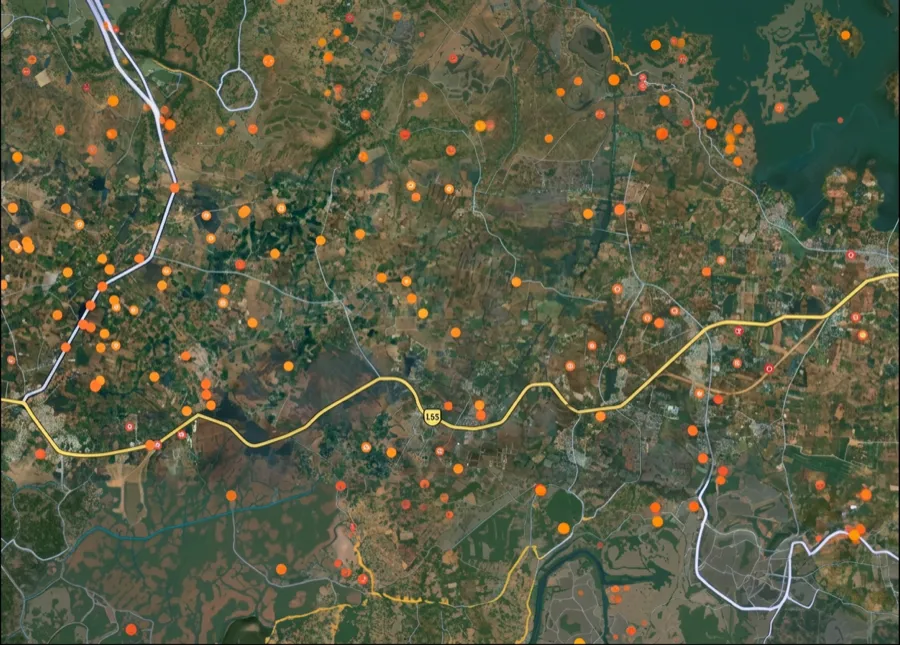
Try the IAF Air Funnel Zones - Patna on the map
एक बार साइन इन करें और पूरे दिन लेयर एक्सप्लोर करें।
- No card details needed
- Find nearby verified lands for sale
Overview
The Bihta Air Force Station land height restriction picture is unusual among Indian airbases because it is actively changing right now, not settled. This 900-acre Indian Air Force installation sits in Bihta, roughly 40 kilometres southwest of Patna, and dates back to World War II, when the British Army used it to assemble and test-fly Waco Hadrian combat gliders.
In August 2024, the Cabinet Committee on Economic Affairs approved a New Civil Enclave at Bihta at an estimated cost of Rs. 1,413 crore, designed to relieve congestion at Patna's existing Jay Prakash Narayan International Airport. Prime Minister Narendra Modi laid the foundation stone in May 2025, and terminal construction began that June, targeting completion by April 2027. It covers why this project's scale means the restricted zone here is still forming, the historic military footprint underneath it, and the road corridors already pricing in an airport that isn't finished yet.
Bihta Air Force Station Land: Regulatory Red Flags You Cannot Ignore
The first and most important red flag is that Bihta's restricted zone is a moving target, not a fixed line on a map. The approved New Integrated Terminal Building spans 66,000 square metres, designed to handle 3,000 peak-hour passengers and an initial annual capacity of 50 lakh, expandable to a further 50 lakh, with an ultimate planned capacity of one crore passengers per year. A project of this scale, going from a modest 2016-era proposal for an 85-acre civil enclave to a Rs. 1,413 crore international-capable terminal, does not simply slot into the base's existing footprint.
It requires infrastructure upgrades, including an advanced Category-II Instrument Landing System and an apron built for ten aircraft parking stands, changes that typically demand a larger, more formally defined funnel zone than the airbase needed when it operated purely as a military facility.
The second red flag is that two separate restricted-zone histories are layered on top of each other here. The military side of Bihta has operated continuously since the Indian Air Force's No. 6 Care and Maintenance Unit was raised at the airfield in 1964, giving it decades of established security-driven restriction.
The civil side is brand new, only formally approved in 2024 and still under construction as of this writing. A buyer checking only the older military zone risks missing the civil aviation height restrictions now forming around the new terminal and its instrument landing system, and a buyer checking only civil aviation guidance risks missing the underlying military security zone that predates it by sixty years.
The table below sets out the project's core confirmed parameters as approved.
Parameter
Confirmed Detail
Existing base area
Approximately 900 acres
Approved project cost
Rs. 1,413 crore
Terminal building size
66,000 sq m
Initial annual capacity
50 lakh (5 million) passengers
Ultimate planned capacity
1 crore (10 million) passengers per year
Construction timeline
Started June 2025, targeted completion April 2027
Key new infrastructure
Category-II Instrument Landing System, apron for 10 aircraft
Parameter
Confirmed Detail
Existing base area
Approximately 900 acres
Approved project cost
Rs. 1,413 crore
Terminal building size
66,000 sq m
Initial annual capacity
50 lakh (5 million) passengers
Ultimate planned capacity
1 crore (10 million) passengers per year
Construction timeline
Started June 2025, targeted completion April 2027
Key new infrastructure
Category-II Instrument Landing System, apron for 10 aircraft
The third red flag is what this project is designed to replace. Jay Prakash Narayan International Airport, Patna's existing airport, currently operates near capacity at roughly 3 million passengers annually and faces constraints from limited surrounding land. Bihta is being built specifically because that existing airport cannot expand further where it sits.
A civil enclave designed to eventually handle ten times Patna's current airport traffic is not a minor addition to a quiet military airfield; it is a full-scale replacement airport in the making, and its final approach and departure funnel will almost certainly need to accommodate larger aircraft than the base has historically handled.
Areas and Micro-Markets Affected by the Bihta Expansion
Land value pressure around Bihta is building well ahead of the airport's actual completion, concentrated along two connectivity corridors and the expanding municipal areas immediately to Bihta's east toward Patna.
Corridor / Locality
Position Relative to the Project
Growth Driver
Known Risk
Bihta core (airbase and civil enclave)
Direct project site
Civil enclave construction, Category-II ILS installation
Final restricted zone boundary is not yet fixed while construction and runway work proceed
Danapur-Bihta Elevated Road corridor
25 km NHAI project connecting Bihta toward Patna
Land acquisition substantially complete, construction targeting September 2026 completion
Land is already priced as if the road exists, ahead of actual completion
Khagaul-Shivala-Bihta road
Older connectivity route, being widened to four lanes
Direct road link between the civil enclave and Patna city
Widening timeline and scope have evolved since the original 2016 proposal
Danapur, Khagaul, Phulwari Sharif
Expanded municipal limits as of June 2025
Nine villages pulled into Danapur alone, area now 23.14 sq km
Formal civic jurisdiction is new; verify current zoning against the pre-expansion baseline
Corridor / Locality
Position Relative to the Project
Growth Driver
Known Risk
Bihta core (airbase and civil enclave)
Direct project site
Civil enclave construction, Category-II ILS installation
Final restricted zone boundary is not yet fixed while construction and runway work proceed
Danapur-Bihta Elevated Road corridor
25 km NHAI project connecting Bihta toward Patna
Land acquisition substantially complete, construction targeting September 2026 completion
Land is already priced as if the road exists, ahead of actual completion
Khagaul-Shivala-Bihta road
Older connectivity route, being widened to four lanes
Direct road link between the civil enclave and Patna city
Widening timeline and scope have evolved since the original 2016 proposal
Danapur, Khagaul, Phulwari Sharif
Expanded municipal limits as of June 2025
Nine villages pulled into Danapur alone, area now 23.14 sq km
Formal civic jurisdiction is new; verify current zoning against the pre-expansion baseline
The Danapur-Bihta Elevated Road corridor is the most important stretch to evaluate carefully right now. Land acquisition for this 25 kilometre NHAI project was substantially complete by late 2024, and construction was actively underway through 2025 with a September 2026 completion target.
According to 1acre's own tracking of the broader Patna region, land along this alignment is already being priced as though the road were finished, well before that target date arrives. That same speculative pricing pattern is worth expecting near Bihta's airport project itself: land values here are very likely running ahead of the airport's actual construction progress and, more specifically, ahead of the point at which the final restricted zone boundary becomes officially fixed.
The June 2025 municipal expansion pulling nine villages into Danapur, alongside similar growth in Khagaul and Phulwari Sharif, signals that Bihar's state government is actively preparing the surrounding area for formal urban development, not just reacting to speculative demand. That expanded municipal jurisdiction should reduce some of the uncontrolled peripheral development risk that typically surrounds a fast-growing project like this, but it does not resolve the core funnel zone question. A buyer in this corridor needs both a current zoning check against the newly expanded municipal boundaries and a separate check against whatever restricted zone the new civil enclave ultimately establishes once its terminal and landing system are operational.
क्या यह लेयर सहायक थी?
Anything wrong, outdated, or missing we want to hear it.
ज़मीन मालिकों और एजेंटों के लिए
Bihar में अपनी ज़मीन बेचना चाहते हैं?
मैं Bihar में अपनी ज़मीन बेचना चाहता हूँ
10:32
कृपया अपनी ज़मीन का स्थान साझा करें - हम इसे 1acre मैप पर सूचीबद्ध करेंगे, मुफ़्त.
10:32

ज़मीन खरीदारों के लिए
Bihar में सभी सत्यापित ज़मीन और प्लॉट ब्राउज़ करें
प्रत्येक लिस्टिंग हमारी प्रारंभिक सत्यापन प्रक्रिया से गुज़रती है।
Bihar में और लेयर्स
सभी 15 लेयर्स देखें
Darbhanga Air Funnel Zones
View IAF Air Funnel Zones - Darbhanga on a live map - check height clearance restrictions on any plot for free on 1acre....
पटना मास्टर प्लान
पटना मास्टर प्लान को लाइव मैप ओवरले के तौर पर देखें – 1acre.in पर किसी भी प्लॉट का लैंड यूज़ ज़ोन मुफ्त में चेक करें. पट...

# Amas Darbhanga Expressway Darbhanga Land: Zone Check and Buyer Guide for Package 4
Package 4 runs 42.21 km from Balbhadarpur to Bela Nawada on NH-119D. Gazette status and the Darbhanga land checks that m...
Bihar में और लेयर्स
Darbhanga Air Funnel Zones
View IAF Air Funnel Zones - Darbhanga on a live map - check height clearance restrictions on any plot for free on 1acre....
पटना मास्टर प्लान
पटना मास्टर प्लान को लाइव मैप ओवरले के तौर पर देखें – 1acre.in पर किसी भी प्लॉट का लैंड यूज़ ज़ोन मुफ्त में चेक करें. पट...
# Amas Darbhanga Expressway Darbhanga Land: Zone Check and Buyer Guide for Package 4
Package 4 runs 42.21 km from Balbhadarpur to Bela Nawada on NH-119D. Gazette status and the Darbhanga land checks that m...