
Bengaluru Air Funnel Zones: Building Height Restrictions
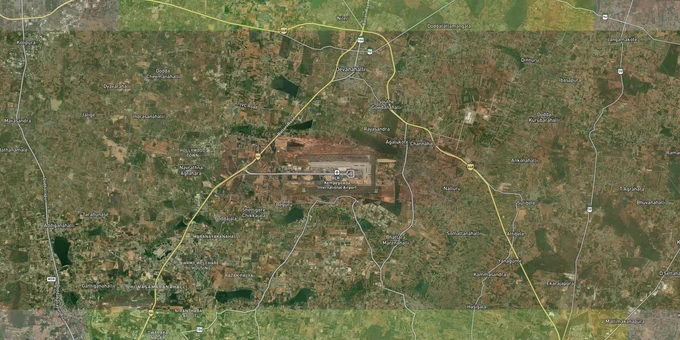

Bengaluru Air Funnel Zones Preview
Try the Bengaluru Air Funnel Zones on the map
Sign in once and explore the layer for a full day.
- No card details needed
- Find nearby verified lands for sale
Overview
Bengaluru's airport height restriction zones are not zoning notations on a BDA or BIAAPA map. They are federal airspace rules enforced under Aircraft Act 1934, with real demolition orders behind them. AAI's Colour Coded Zoning Map (CCZM) for Bengaluru covers four aerodromes: Kempegowda International Airport (KIAL) at Devanahalli, HAL Airport in Koramangala, Jakkur Government Flying Training School (GFTS), and Yelahanka Defence Aerodrome. Any construction within 20 km of each aerodrome's Aerodrome Reference Point (ARP) requires a height NOC from AAI via NOCAS.
Wrong AMSL Figures Have Already Cost Bengaluru Buyers Crores
The most dangerous mistake in Bengaluru's airport zone is not building too tall. It is submitting a wrong site elevation Above Mean Sea Level (AMSL) to get permission to build tall.
In the Raheja Vivarea case, the builder submitted an AMSL of 870 metres for a Koramangala site. Karnataka State Remote Sensing Application Centre (KSRSAC), ordered by the Karnataka High Court, measured the actual elevation at 892.41 metres AMSL. The difference of just 22 metres cost seven floors: in October 2021 the court ordered Chalet Hotels to demolish all construction above 932 metres AMSL, wiping out floors 11 to 17 across completed blocks. The 162 buyers who had invested approximately Rs 135 crore had no recourse. HAL's NOC, which had named the builder's own AMSL figure as the basis for clearance, was rendered void the moment an independent survey disproved it.
Obstacle Limitation Surfaces Around Bengaluru Airports
The table below shows the three Obstacle Limitation Surfaces that govern height around every Bengaluru aerodrome.
Surface
Distance from ARP
Max Permitted Height
NOC Required?
Inner Horizontal Surface
Up to 5 km radius
45 m AGL
Yes, from AAI/HAL/GFTS
Outer Conical Surface
5 km to 20 km radius
1 m height per 20 m distance from 5 km edge; max 150 m (defence)
Yes
Approach/Funnel Surface
Aligned with runway ends
2% gradient rule: 20 m at 1,000 m from runway edge
Yes; aeronautical study not permitted here
Outer Transitional Surface
20 km to 56 km
Structures above 150 m require NOC
Yes if above 150 m
Surface
Distance from ARP
Max Permitted Height
NOC Required?
Inner Horizontal Surface
Up to 5 km radius
45 m AGL
Yes, from AAI/HAL/GFTS
Outer Conical Surface
5 km to 20 km radius
1 m height per 20 m distance from 5 km edge; max 150 m (defence)
Yes
Approach/Funnel Surface
Aligned with runway ends
2% gradient rule: 20 m at 1,000 m from runway edge
Yes; aeronautical study not permitted here
Outer Transitional Surface
20 km to 56 km
Structures above 150 m require NOC
Yes if above 150 m
Before signing any sale agreement for a plot or apartment in Bengaluru's airport corridors, demand the NOCAS-issued NOC, not just the builder's elevation certificate. The AAI's own NOC letter states plainly that it does not authenticate the site coordinates and AMSL figures provided by the applicant; if those figures are later proved wrong, the NOC is cancelled and the structure faces demolition at the owner's cost.
Devanahalli, Yelahanka and Jakkur: Where the Zone Changes Every Street
Not all of North Bengaluru's hottest corridors sit inside the same restriction surface, and that distinction drives real differences in what you can build and at what price.
Devanahalli, the closest locality to KIAL's runway, is largely within the Outer Conical Surface. Plot rates in 2026 range between Rs 6,000 and Rs 10,000 per sq ft, driven by airport expansion, Special Investment Region status, and STRR connectivity. Heights here are manageable for low-rise and villa developments, but any multi-storey project needs BIAAPA approval plus an AAI NOC. The Yelahanka belt sits roughly 16 km from KIAL but within 5 km of Yelahanka Defence Aerodrome, which imposes its own NOC radius of 9.26 km (5 nautical miles). Buildings in Yelahanka that appear to be outside KIAL's Inner Horizontal Surface can still fall inside Yelahanka aerodrome's Inner Horizontal Surface.
Corridor
Distance from KIAL
Primary Governing Aerodrome
Zone Type
Typical Max Floor Count
Devanahalli
7 km
KIAL (BIAL)
Outer Conical Surface
4–6 floors (site-specific)
Yelahanka
16 km
Yelahanka Defence Aerodrome + KIAL
Inner Horizontal / Conical
Max 14 floors within 5 km of Yelahanka ARP
Jakkur
18 km
GFTS Jakkur + KIAL
Multiple overlapping surfaces
Requires multiple NOCs
Hebbal
22 km
KIAL (outer)
Outer Transitional
Less restricted; verify HAL radius
Corridor
Distance from KIAL
Primary Governing Aerodrome
Zone Type
Typical Max Floor Count
Devanahalli
7 km
KIAL (BIAL)
Outer Conical Surface
4–6 floors (site-specific)
Yelahanka
16 km
Yelahanka Defence Aerodrome + KIAL
Inner Horizontal / Conical
Max 14 floors within 5 km of Yelahanka ARP
Jakkur
18 km
GFTS Jakkur + KIAL
Multiple overlapping surfaces
Requires multiple NOCs
Hebbal
22 km
KIAL (outer)
Outer Transitional
Less restricted; verify HAL radius
The corridor most consistently misread is Yelahanka-Jakkur. Buyers and developers focus on KIAL's distance and miss that structures in this belt may need separate NOCs from GFTS Jakkur and Yelahanka Defence Aerodrome in addition to AAI. Each aerodrome has a different ARP elevation and a different NOC-issuing authority. Bundling them into a single NOCAS application without checking each surface is the most common approval error in this belt.
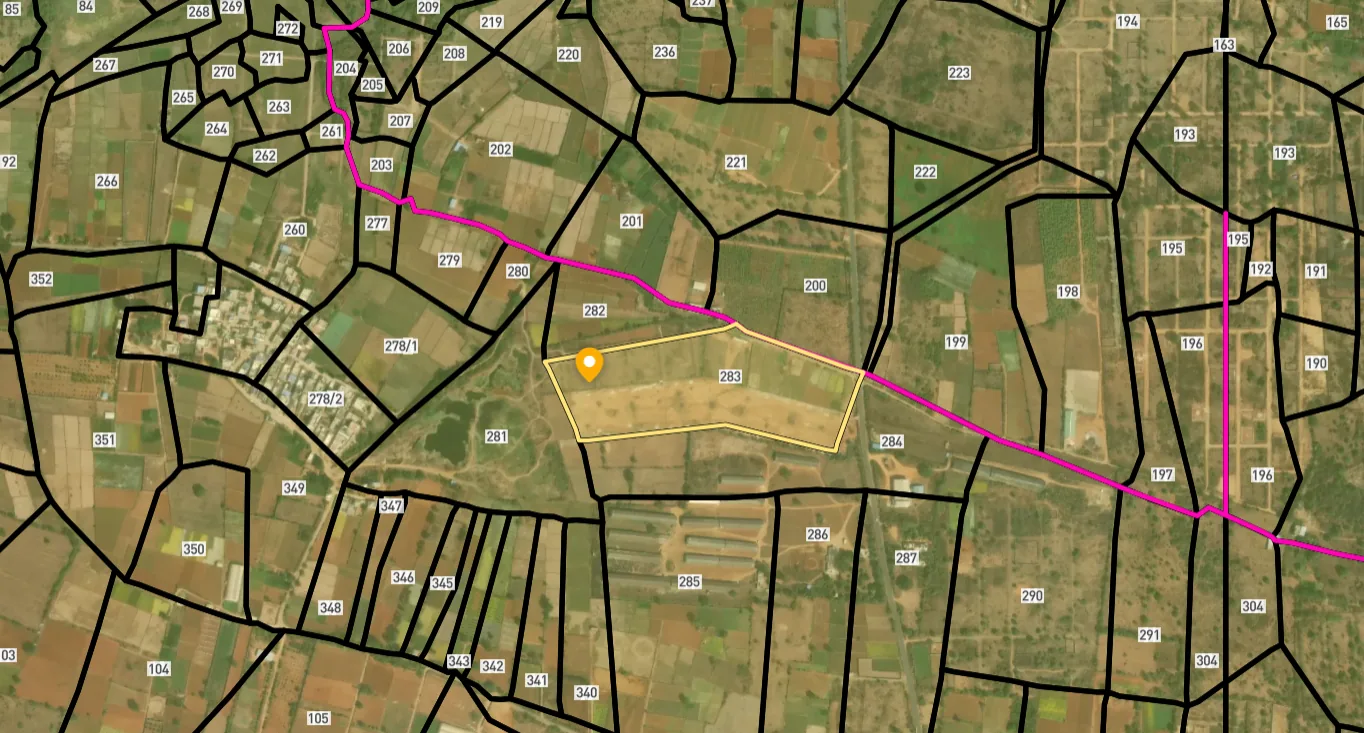
Access Survey NumbersAccess Karnataka
Survey Numbers
Boundaries and numbers come from published state cadastral records. See all map layers.
Looking to sell your land in Karnataka?

Browse all verified lands & plots in Karnataka
More Layers in Karnataka
See all 25 layers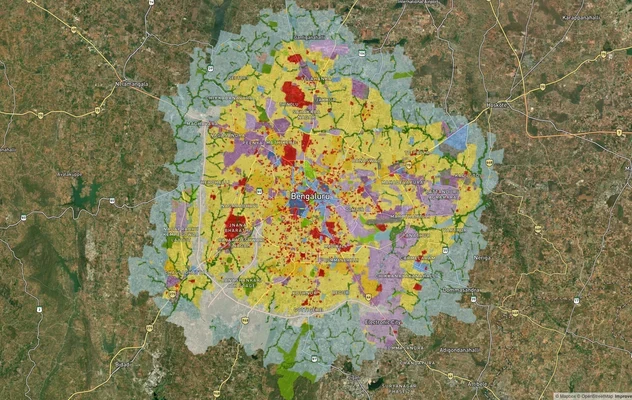
Bengaluru BDA Masterplan 2015
View Bengaluru Masterplan as a live map overlay – check any plot's land use zone for free on 1acre.in. Bengaluru BDA mas...
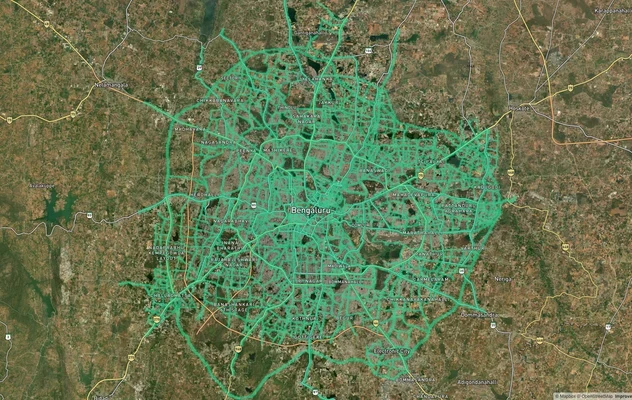
Bengaluru BDA Masterplan Roads: RMP 2015 Road Zones
View Bengaluru Masterplan - Roads alignment as a live map overlay – check road corridor and land impact free on 1acre.in...
Bengaluru STRR (Satellite Town Ring Road): Route Map and Land Impact
View STRR alignment as a live map overlay – check road corridor and land impact free on 1acre.in. Bengaluru STRR land bu...
More Layers in Karnataka
Bengaluru BDA Masterplan 2015
View Bengaluru Masterplan as a live map overlay – check any plot's land use zone for free on 1acre.in. Bengaluru BDA mas...
Bengaluru BDA Masterplan Roads: RMP 2015 Road Zones
View Bengaluru Masterplan - Roads alignment as a live map overlay – check road corridor and land impact free on 1acre.in...
Bengaluru STRR (Satellite Town Ring Road): Route Map and Land Impact
View STRR alignment as a live map overlay – check road corridor and land impact free on 1acre.in. Bengaluru STRR land bu...
Frequently Asked Questions
Within 5 km of any aerodrome's ARP, construction is capped at 45 m AGL. In the funnel zone, height equals 2% of distance from the runway edge. All zones fall under Aircraft Act 1934 and require a height NOC. Note: NOCs for KIAL and Jakkur GFTS are obtained via AAI’s NOCAS portal. NOCs for HAL Airport and Yelahanka Defence Aerodrome must be obtained directly from the respective defence authority — not via NOCAS.
Yes. Any construction within 20 km of KIAL's ARP requires a height NOC from AAI. Bengaluru's CCZM makes this mandatory regardless of floor count or structure type under GSR 751(E) 2015.
There is no single universal AMSL limit near HAL airport — your Permissible Top Elevation (PTE) is calculated as HAL’s surface height limit for your specific grid cell minus your site’s verified AMSL elevation. The 932 m AMSL figure in the Raheja Vivarea case arose because HAL’s runway is at 875 m AMSL and the Inner Horizontal Surface adds 45 m, yielding 920 m + margins for that grid — but your site’s PTE will differ based on exact coordinates and ground elevation. Always use NOCAS to obtain the PTE for your specific plot before any building plan submission.
Check your plot’s air funnel zone instantly on the 1acre Air Funnel Zones layer — it overlays AAI CCZM boundaries directly against survey numbers. Check 1acre Premium. For the official Permissible Top Elevation (PTE) in metres AMSL for your exact grid cell, download the CCZM from nocas2.aai.aero and use the NOCAS pre-check tool with your plot’s WGS84 coordinates. The PTE is the maximum height your structure can reach above mean sea level — subtract your site’s verified ground elevation to get your actual permitted building height.
Not within 5 km of any aerodrome's ARP. That zone caps height at 45 m AGL, roughly 14 floors. Beyond 5 km, permitted height increases by 1 m per 20 m distance under the conical surface rules, subject to site AMSL.
Demolition, at the developer's cost. Karnataka High Court ordered Chalet Hotels to remove seven floors from the Raheja Vivarea complex in Koramangala in 2021. Buyers in violation-risk buildings can be barred from occupancy and face OC denial.
Yes for both. Devanahalli falls under KIAL’s NOC zone — apply via AAI NOCAS. Yelahanka may require separate NOCs from: (1) AAI via NOCAS for KIAL and/or GFTS Jakkur surfaces, and (2) Yelahanka Defence Aerodrome authority directly — this component cannot be obtained via NOCAS. Each aerodrome has a different ARP elevation and NOC-issuing authority.
Register at nocas2.aai.aero, submit plot WGS84 coordinates and a certified AMSL elevation certificate (the AMSL certificate must be from a government-authorised agency or a surveyor certified by a government department — CPWD, State PWD, Survey of India, or AAI-empanelled surveyor — a privately-certified elevation carries the risk of the NOC being voided if the figure is later disputed), upload structural drawings showing height AMSL, and pay the fee. AAI processes applications within three weeks; the NOC is valid for eight years.
Source
Official Airports Authority of India (AAI) / Directorate General of Civil Aviation (DGCA) documents
Official Website
nocas2.aai.aero
Coordinate Reference System
EPSG:4326 (WGS 84)
Geometry Type
Polygon / MultiPolygon
Data Format
Vector (GeoJSON) + Raster Tiles
Last Verified
April 2026
Status
Active
Was this layer helpful?
Anything wrong, outdated, or missing we want to hear it.