
Hyderabad-Chennai Bullet Train High Speed Rail Project
Overview
The Hyderabad-Chennai Bullet Train land records question starts with a fact worth being direct about, since it changes how a buyer should read almost everything else written about this project: the corridor has not yet begun land acquisition, and its final alignment is still waiting on approval from a second state government it has to pass through before construction can even be scheduled. Announced as one of seven new high-speed rail corridors in the Union Budget 2026-27, the route runs somewhere between 744 and 778 kilometres depending on which official document you check, connecting Hyderabad through Vijayawada and Amaravati to Chennai, with around 18 stations planned along the way and a design speed of 320 to 350 kilometres per hour. That range in the stated length is itself a small but telling sign of a project still being finalised on paper, since a fully sanctioned corridor generally settles on one official figure rather than several slightly different ones appearing across different government releases. This is a genuinely different stage of development from India's only currently under-construction bullet train line, the Mumbai-Ahmedabad corridor, and treating the two projects as equally advanced is probably the single biggest mistake a buyer near this route could make. One has finished acquiring its land and is well past halfway through physical construction. The other is still negotiating which exact villages its tracks will run through. Land at the Hyderabad end of this corridor is checked through Bhu Bharati, Telangana's land records portal, which itself replaced an older, deeply troubled system only last year, adding a second layer of change a buyer needs to understand alongside the rail project itself. This guide walks through both: what Bhu Bharati now actually shows, and just how early-stage this particular high-speed line genuinely is.
Regulatory Red Flags Around the Hyderabad-Chennai Corridor
Start with the project's own maturity, because it directly affects how much weight you should give any claim about a confirmed station location or a guaranteed alignment near your plot. South Central Railway submitted a revised final alignment report to the Tamil Nadu government only in November 2025, and officials at the time indicated the Detailed Project Report would be finalised within roughly a month once that state's clearance came through. As of the most recent reporting available, the corridor's status still read as "DPR under preparation" or simply "announced, awaiting approval," a stage that sits well before Cabinet sanction, before any formal land acquisition notice, and well before actual construction of any kind. Industry estimates place the realistic construction window at ten to fifteen years from approval, with physical groundwork potentially beginning only sometime after 2026 or 2027, assuming the remaining approvals move smoothly. Anyone telling you that a specific plot sits inside a confirmed station catchment area on this corridor is making a claim well ahead of what the project itself has actually settled, since even the underlying route still needed sign-off from a second state government as recently as late 2025, and an alignment can still shift meaningfully between a preliminary report and a finalised DPR.
Land verification on the Telangana side of this corridor runs through a genuinely new system, and understanding it matters for any Hyderabad-area purchase right now, not just for land specifically near this one rail project. In April 2025, the state government replaced its long-running Dharani portal with a new system called Bhu Bharati, operating under the Telangana Bhu Bharati Record of Rights in Land Act, 2025, following years of complaints from farmers and landowners about records being locked with no clear or affordable way to fix an error. Bhu Bharati assigns every parcel a Bhudhaar number, a GPS-mapped unique identity tied to the land itself rather than just a written description of it, and it separates two documents that used to get conflated under the old system: the Pahani, which tracks crop and cultivation history, and the ROR 1B, the actual record of ownership rights that a buyer needs to confirm before any sale goes ahead. Mutations, the process of formally updating a record after a sale or inheritance, now route through the local Tahsildar rather than the District Collector, which has cut typical processing time from what used to run several months down to somewhere around two to four weeks in most cases.
Two specific details from this transition deserve particularly close attention from any buyer, because both can silently derail a purchase that looks perfectly fine on the surface. First, any parcel flagged under Section 22A carries what banks formally classify as a non-marketable title. A property carrying this flag cannot be used to secure a home loan, and the Sub-Registrar will refuse to register a sale on it outright, even in cases where the underlying flag turns out to reflect nothing more than an old data-entry error rather than any genuine legal dispute over the land. Second, and arguably more urgent given how recently it happened, the Bhu Bharati Act gave every landowner exactly one year from the law's commencement to file a formal correction to their Record of Rights, and that window closed on 13 April 2026. Under the Act's finality clause, any entry that was not formally challenged within that one-year period is now treated as settled and final. That means an old Dharani-era mistake, the kind that used to be fixable through a fairly simple correction application, may now require a landowner to go through a full revenue-authority process or even a civil court case rather than a quick portal-based fix. Because Bhu Bharati's rollout has also been phased mandal by mandal through 2026 rather than switched on everywhere at once, a buyer should specifically confirm that the village in question has actually transitioned onto the new system before treating any record, whether it looks old or new, as fully authoritative.
Regulatory Red Flags Around the Hyderabad-Chennai Corridor
Land Record Term
What It Proves
Where to Check
Blocks Registration or Loans Without It?
ROR 1B
Current ownership rights for a specific parcel
Bhu Bharati
Yes
Pahani
Crop and cultivation history
Bhu Bharati
Not directly, but confirms possession consistency
Bhudhaar number
GPS-linked unique identity for the parcel
Bhu Bharati
Increasingly required for registration
Section 22A prohibited status
Confirms whether a title is treated as non-marketable
Bhu Bharati
Yes, blocks both loans and registration
Final rail alignment / DPR status
Confirms whether a plot sits inside any formally approved corridor
NHSRCL / South Central Railway
No formal acquisition process exists yet for this corridor
Land Record Term
What It Proves
Where to Check
Blocks Registration or Loans Without It?
ROR 1B
Current ownership rights for a specific parcel
Bhu Bharati
Yes
Pahani
Crop and cultivation history
Bhu Bharati
Not directly, but confirms possession consistency
Bhudhaar number
GPS-linked unique identity for the parcel
Bhu Bharati
Increasingly required for registration
Section 22A prohibited status
Confirms whether a title is treated as non-marketable
Bhu Bharati
Yes, blocks both loans and registration
Final rail alignment / DPR status
Confirms whether a plot sits inside any formally approved corridor
NHSRCL / South Central Railway
No formal acquisition process exists yet for this corridor
Given that this rail project has no land acquisition process running yet, the far more urgent check for anyone buying near Hyderabad right now is Telangana's own land record transition, not the bullet train's alignment. Confirm the ROR 1B, check specifically for any Section 22A flag on the parcel, and verify the village's actual migration status onto Bhu Bharati before assuming that an old Dharani printout, however official it once looked, still tells the full and current story.
Growth Corridors Along the Hyderabad-Chennai Route
This corridor's real significance right now lies less in any single station's land value today and more in its role within a much larger, longer-term vision for South India's rail network as a whole. Once built, the route is designed to cut a roughly 12-hour conventional rail journey between Hyderabad and Chennai down to somewhere between two hours twenty minutes and two hours fifty-five minutes, passing through Vijayawada and Amaravati along the way and including an 11.6-kilometre tunnel section within Tamil Nadu near the southern end. The Hyderabad terminus itself is being planned as a dedicated High-Speed Rail Hub near Shamshabad, integrated directly with Rajiv Gandhi International Airport rather than sitting as a standalone station somewhere else in the city. That hub is positioned to serve not only this Chennai-bound corridor but also the separately planned Hyderabad-Bengaluru and Mumbai-Hyderabad high-speed lines, all converging on the same physical location. This shared-hub design is exactly why industry commentary has increasingly started framing the Hyderabad-Chennai and Hyderabad-Bengaluru corridors together as a "Golden Triangle" concept, one meant to eventually link Telangana, Andhra Pradesh, Karnataka, and Tamil Nadu into a single connected high-speed network rather than as two entirely unrelated engineering projects that happen to share a city.
For a buyer today, though, the practical reality is that none of this changes what is actually buildable or valuable near Hyderabad right now. The Mumbai-Ahmedabad line offers a useful point of comparison here, precisely because it shows what real progress on a corridor like this eventually looks like: that project has completed its land acquisition entirely and crossed more than half of its total physical construction, which is exactly why land value near its stations has already started to reflect genuine, measurable progress rather than pure speculation. Hyderabad-Chennai sits many years behind that same milestone, still working its way through an inter-state alignment approval process that a comparable Gujarat-Maharashtra corridor finished long ago. A construction horizon stretching ten to fifteen years, starting from a DPR that has not even been finalised yet, means any land near the proposed Shamshabad hub or along the Vijayawada-Amaravati stretch should be evaluated on its own existing merits today, things like airport proximity, established local growth patterns, and current infrastructure already in place, rather than on an assumption that bullet train connectivity here is some kind of near-term certainty worth paying a premium for today.
Growth Corridors Along the Hyderabad-Chennai Route
Location
Growth Driver
Known Consideration
Shamshabad (proposed HSR hub)
Planned junction for three separate high-speed corridors plus the international airport
No land acquisition has begun; final alignment awaited state approval as of late 2025
Vijayawada-Amaravati stretch
Proposed intermediate section of the corridor
Still within the DPR stage, years from any formal notification
Hyderabad city (Telangana land records generally)
Bhu Bharati transition affecting every property, not just this corridor
Confirm the specific village's migration status and any Section 22A flag
Chennai end (Tamil Nadu tunnel section)
11.6 km tunnel planned within the state
Alignment approval from Tamil Nadu remains a precondition for the whole project
Location
Growth Driver
Known Consideration
Shamshabad (proposed HSR hub)
Planned junction for three separate high-speed corridors plus the international airport
No land acquisition has begun; final alignment awaited state approval as of late 2025
Vijayawada-Amaravati stretch
Proposed intermediate section of the corridor
Still within the DPR stage, years from any formal notification
Hyderabad city (Telangana land records generally)
Bhu Bharati transition affecting every property, not just this corridor
Confirm the specific village's migration status and any Section 22A flag
Chennai end (Tamil Nadu tunnel section)
11.6 km tunnel planned within the state
Alignment approval from Tamil Nadu remains a precondition for the whole project
The honest read on this corridor is that it represents a genuine long-term vision with real institutional momentum behind it, given how many detailed project reports the National High Speed Rail Corporation Limited has already prepared across all seven newly announced lines in a fairly short span of time. But genuine momentum at the planning stage is simply not the same thing as construction progress on the ground, and this particular route remains meaningfully further from land acquisition than India's only currently operating bullet train project, let alone from opening day. Land near Hyderabad's Shamshabad hub genuinely deserves attention today, but for its existing, airport-driven growth happening right now, not for a rail connection that realistically sits a decade or more away from carrying its first passenger.
क्या यह लेयर सहायक थी?
Anything wrong, outdated, or missing we want to hear it.
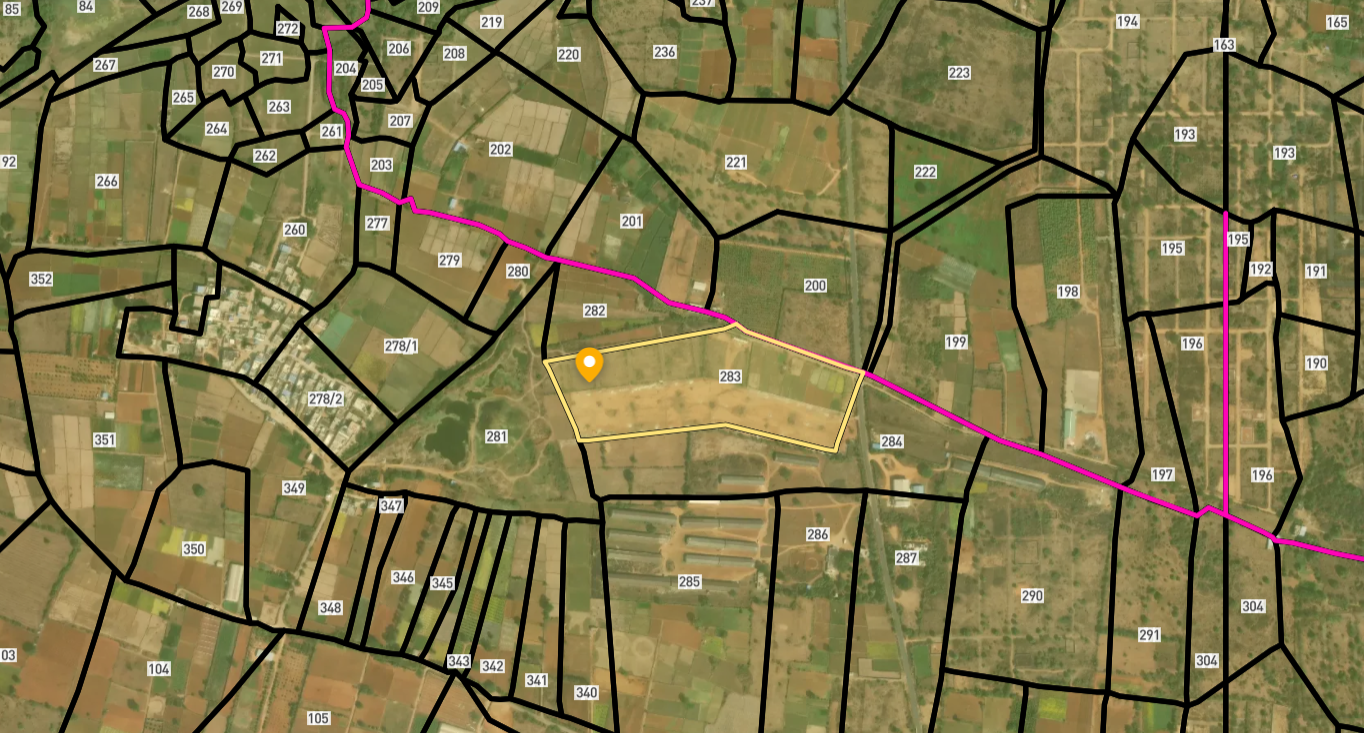
सर्वे नंबर देखेंTelangana
के सर्वे नंबर देखें
सीमाएँ और नंबर राज्य के प्रकाशित भू-अभिलेखों से लिए गए हैं। सभी मैप लेयर्स देखें।
Telangana में अपनी ज़मीन बेचना चाहते हैं?

Telangana में सभी सत्यापित ज़मीन और प्लॉट ब्राउज़ करें
Telangana में और लेयर्स
सभी 26 लेयर्स देखें
वारंगल मास्टरप्लान: WUDA ज़ोन चेक और लैंड यूज़ गाइड
वारंगल मास्टरप्लान को लाइव मैप ओवरले के रूप में देखें – 1acre.in पर किसी भी प्लॉट का लैंड यूज़ ज़ोन मुफ्त में चेक करें। ...
हैदराबाद HMDA मास्टरप्लान: ज़ोन चेक और लैंड यूज़ गाइड
हैदराबाद मास्टरप्लान को लाइव मैप ओवरले के रूप में देखें – 1acre.in पर किसी भी प्लॉट का लैंड यूज़ ज़ोन मुफ़्त में चेक करे...
हैदराबाद रीजनल रिंग रोड (RRR): रूट मैप और ज़मीन पर असर
RRR अलाइनमेंट को लाइव मैप ओवरले के रूप में देखें – 1acre.in पर ज़मीन अधिग्रहण का जोखिम और प्लॉट की नज़दीकी मुफ़्त में चे...
Telangana में और लेयर्स
वारंगल मास्टरप्लान: WUDA ज़ोन चेक और लैंड यूज़ गाइड
वारंगल मास्टरप्लान को लाइव मैप ओवरले के रूप में देखें – 1acre.in पर किसी भी प्लॉट का लैंड यूज़ ज़ोन मुफ्त में चेक करें। ...
हैदराबाद HMDA मास्टरप्लान: ज़ोन चेक और लैंड यूज़ गाइड
हैदराबाद मास्टरप्लान को लाइव मैप ओवरले के रूप में देखें – 1acre.in पर किसी भी प्लॉट का लैंड यूज़ ज़ोन मुफ़्त में चेक करे...
हैदराबाद रीजनल रिंग रोड (RRR): रूट मैप और ज़मीन पर असर
RRR अलाइनमेंट को लाइव मैप ओवरले के रूप में देखें – 1acre.in पर ज़मीन अधिग्रहण का जोखिम और प्लॉट की नज़दीकी मुफ़्त में चे...